Electric Field, Potential Energy, & Voltage Slide 2 / 66 Work - - PDF document

electric field
SMART_READER_LITE
LIVE PREVIEW

Electric Field, Potential Energy, & Voltage Slide 2 / 66 Work - - PDF document

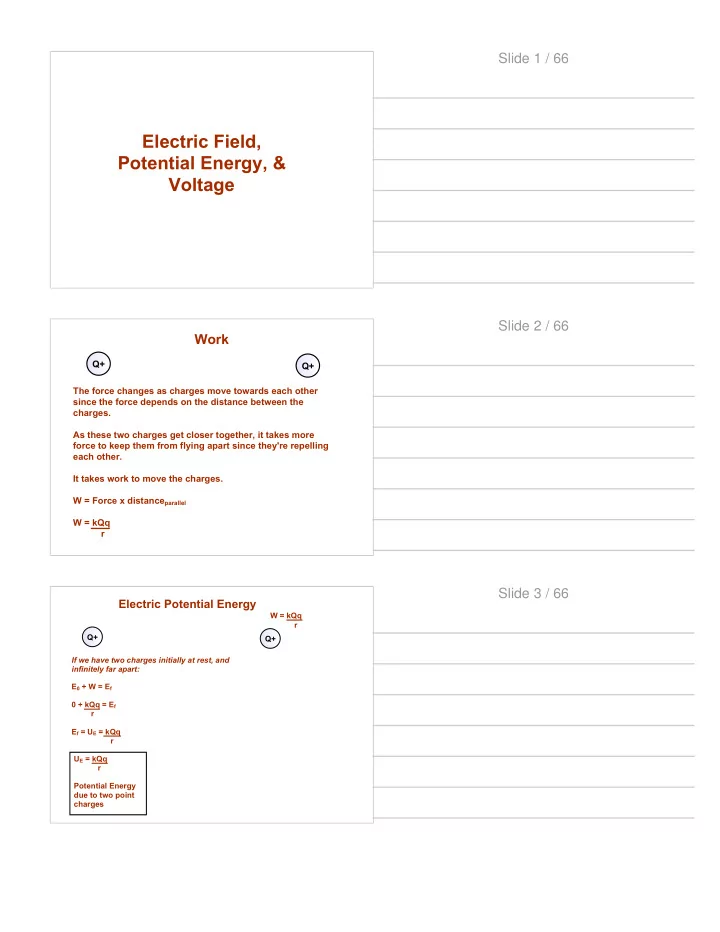
Slide 1 / 66 Electric Field, Potential Energy, & Voltage Slide 2 / 66 Work Q+ Q+ The force changes as charges move towards each other since the force depends on the distance between the charges. As these two charges get closer


slide-1
SLIDE 1

Electric Field, Potential Energy, & Voltage

Slide 1 / 66 Work

Q+ Q+ The force changes as charges move towards each other since the force depends on the distance between the charges. As these two charges get closer together, it takes more force to keep them from flying apart since they're repelling each other. It takes work to move the charges. W = Force x distanceparallel W = kQq r

Slide 2 / 66

Electric Potential Energy

If we have two charges initially at rest, and infinitely far apart: E0 + W = Ef 0 + kQq = Ef r Ef = UE = kQq r W = kQq r UE = kQq r Potential Energy due to two point charges Q+ Q+

Slide 3 / 66

slide-2
SLIDE 2

Electric Potential Energy

UE = kQq r This is the equation for the potential energy due to two point charges being near each other. Energy is NOT a vector, it is a scalar. There is no direction, but the sign matters. If you have two positive charges or two negative charges, there will be a positive potential energy. This means it is taking energy to keep them from flying apart. If you have a positive charge and a negative charge near each other, you will have a negative potential energy. This means that it takes energy to keep them from getting closer together.

Slide 4 / 66

1 2 3 4 5 6 7 8 9 10

  • 1
  • 2
  • 3
  • 4
  • 5
  • 6
  • 7
  • 8
  • 9
  • 10

+Q2 +Q1

A positive charge Q1 = 5 mC is located at x1 = -8 m and a charge Q2 = 2.5 mC is located at x2 = 3 m. Compute the potential energy of the two charges.

UE = kQq = (9x10⁹ Nm2/C2)(5x10-3 C)(2.5x10⁻³ C) r 11m UE = 10227 J

X(m)

Slide 5 / 66 Energy of Multiple Charges

Utotal = U1 + U2 + U3 + ... To get the total energy for multiple charges, you must first find the energy due to each pair of charges. Then, you can add these energies together. Since energy is a scalar, there is no direction involved.

Slide 6 / 66

slide-3
SLIDE 3

Electric Potential or Voltage

We know that: Just as we can break electrical force into two parts: F = qE and E = kQ, r2 we could separate potential energy into two parts: UE = qV and V = kQ r where V is called the voltage.

Slide 7 / 66 Electric Potential or Voltage

Voltage is also called electric potential (NOT to be confused with electric potential energy). Voltage is measured in Volts (V) where one V = J C Voltage is NOT a vector, so multiple voltages can be added directly (sign is important!).

Slide 8 / 66 Uniform Electric Field

The field cancels

  • utside the plates and

adds together between the plates for a strong electric field. Uniform means that the strength of the field is the same everywhere (between the plates).

e- p+ e- p+ e- p+ e- p+ e- p+ e- p+ e- p+

Slide 9 / 66

slide-4
SLIDE 4

Uniform Electric Field

Point charges have a non-uniform field strength since the field weakens with distance. Only some equations we have learned apply to uniform electric fields.

+

e- p+ e- p+ e- p+ e- p+ e- p+ e- p+ e- p+

Slide 10 / 66

F = kQq r2 F = qE E = kQ r2 UE = kQq r UE = qV V = kQ r Use ONLY with point charges. Equations with the "k" are point charges ONLY. Use in ANY situation. For point charges AND uniform electric fields

Slide 11 / 66 Electric Field & Voltage

Hill

The slope of the plane determines the acceleration and the net force

  • n the object.

Slope = 0 Fnet = 0 no acceleration!

FN mg FN mg a

Slide 12 / 66

slide-5
SLIDE 5

Electric Field & Voltage

E0 + W = Ef where W = 0 mgΔh = ½mvf

2

If vf

2 = v0 2 + 2aΔx and v0 = 0 then vf 2 = 2aΔx

mgΔh = ½m(2aΔx) mgΔh = maΔx gΔh = aΔx gΔh Δx a =

If we look at the energy of the block on the inclined plane...

Slide 13 / 66 Electric Field & Voltage

A similar relationship exists with uniform electric fields and voltage. With the inclined plane, a difference in height was responsible for

  • acceleration. Here, a difference in electric potential (voltage) is

responsible for the electric field.

e- p+ e- p+ e- p+ e- p+ e- p+ e- p+ e- p+

Vf Vo

Slide 14 / 66 Electric Field & Voltage

e- p+ e- p+ e- p+ e- p+ e- p+ e- p+ e- p+

Vf Vo The change in voltage is defined as the work done per unit charge against the electric field. Therefore energy is being put into the system when a positive charge moves in the opposite direction of the electric field (or when a negative charge moves in the same direction of the electric field).

p+

Slide 15 / 66

slide-6
SLIDE 6

Electric Field & Voltage

E0 + W = Ef where W = 0 qV0 = qVf + ½mvf

2

qV0 - qVf = ½mvf

2

  • qΔV = ½mvf

2 where ΔV = Vf - V0

If vf

2 = v0 2 + 2aΔx and v0 = 0 then vf 2 = 2aΔx

  • qΔV = ½m(2aΔx)
  • qΔV = maΔx

If F = ma, and F = qE, then we can substitute ma = qE

  • qΔV = qEΔx
  • ΔV = EΔx

E = -ΔV = -ΔV Δx d To see the exact relationship, look at the energy of the system.

Slide 16 / 66 Electric Field & Voltage

The equation only applies to uniform electric fields. ΔV ΔV Δx d E = _ = _ 1 N C V m =

and a V J C

= 1 N C = (J/C) m

and a J N m

= 1 N C (N m/C) m = It follows that the electric field can also be shown in terms of volts per meter (V/m) in addition to Newtons per Coulomb (N/C). This can be shown: 1 N C = 1 N C The units are equivalent.

Slide 17 / 66 Electric Field & Voltage

A more intuitive way to understand the negative sign in the relationship is to consider that just like a mass falls down, from higher gravitational potential energy to lower, a positive charge "falls down" from higher electric potential (V) to lower. Since the electric field points in the direction of the force on a hypothetical positive test charge, it must also point from higher to lower potential. The negative sign just means that objects feel a force from locations with greater potential energy to locations with lower potential energy. This applies to all forms of potential energy. ΔV Δx E = _

Slide 18 / 66
slide-7
SLIDE 7

1 In order for a charged

  • bject to experience an

electrostatic force, there must be a:

A a large electric potential B a small electric potential

C the same electric potential everywhere D a difference in electric potential

Slide 19 / 66

2 How strong (in V/m) is the electric field between two metal plates 25 cm apart if the potential difference between them is 100 V?

A

400 V/m

B

600 V/m

C

800 V/m

D

1000 V/m

E

1200 V/m

Slide 20 / 66

3 An electric field of 3500 N/C is desired between two plates which are 4.0 mm apart; what voltage should be applied?

A

10 V

B

12 V

C

14 V

D

16 V

E

18 V

Slide 21 / 66

slide-8
SLIDE 8

Combining Two Ideas...

E = - ΔV d ΔV = -Ed UE = q ΔV UE = -qEd

Slide 22 / 66

4 How much work (in Joules)is done by a uniform 300 N/C electric field on a charge of 6.1 mC in accelerating it through a distance of 20 cm?

A

4.23 x 10⁻² J

B

3.66 x 10⁻² J

C

3.81 x 10⁻² J

D

3.12 x 10⁻² J

E

4.93 x 10⁻² J

Slide 23 / 66

F = kQq r2 F = qE E = kQ r2 UE = kQq r UE = qV V = kQ r Use ONLY with point charges. Equations with the "k" are point charges ONLY. Use in ANY situation. For point charges AND uniform electric fields E = - ΔV d UE = -qEd ONLY for uniform electric fields

Slide 24 / 66

slide-9
SLIDE 9

Topographic Maps

Each line represents the same height value. The area between lines represents the change between lines. A big space between lines, there is a slow change in height. Little space between lines means there is a very quick change in height.

Where in this picture is the steepest incline?

Slide 25 / 66 Equipotential Lines

230 V 300 V 0 V 50 V 300 V 300 V 230 V 50 V 0 V 0 V 50 V 230 V

These "topography" lines are called "equipotential lines" when we use them to represent the electric potential. The closer the lines, the faster the change in voltage.... the bigger the change in voltage, the larger the electric field.

Slide 26 / 66 Equipotential Lines

  • 1. The direction of the

electric field and force are always perpendicular to the lines.

  • 2. The electric field lines

are farther apart when the equipotentials are farther apart.

  • 3. The electric field goes

from high to low potential (just like a positive charge).

+

Slide 27 / 66

slide-10
SLIDE 10

5 At point A in the diagram, what is the direction of the electric field?

A

Up

B

Down

C

Left

D

Right

+300 V

  • 300 V

0 V

  • 150 V

+150 V A B C D E

Slide 28 / 66

6 How much work is done to a +10μC charge that moves from point C to B?

A

1 x 10 J

B

1.3 x 10 J

C

2 x10 J

D

3.5 x 10 J

E

1.5 x 10 J

+300 V

  • 300 V

0 V

  • 150 V

+150 V A B C D E

Slide 29 / 66 Parallel Plate Capacitors

The simplest version of a capacitor is the parallel plate capacitor which consists of two metal plates that are parallel to one another and located a distance apart.

Slide 30 / 66

slide-11
SLIDE 11

When a battery is connected to the plates, charge moves between

  • them. Every

electron that moves to the negative plate leaves a positive nucleus behind. The plates have equal magnitudes of charges, but one is positive, the other negative.

e- p+

Parallel Plate Capacitors

V

Slide 31 / 66

Only unpaired protons and electrons are represented here. Most of the atoms are neutral since they have equal numbers of protons and electrons.

Parallel Plate Capacitors

V

e- p+ e- p+ e- p+ e- p+ e- p+ e- p+ e- p+

Slide 32 / 66

e- p+ e- p+ e- p+ e- p+ e- p+ e- p+ e- p+

Drawing the Electric Field from the positive to negative charges reveals that the Electric Field is uniform everywhere in a capacitor's gap. Also, there is no field outside the gap.

Parallel Plate Capacitors

V

Slide 33 / 66

slide-12
SLIDE 12

Capacitors

ANY capacitor can store a certain amount

  • f charge for a given
  • voltage. That is called

its capacitance, C.

e- p+ e- p+ e- p+ e- p+ e- p+ e- p+ e- p+

C = Q V This is just a DEFINITION and is true of all capacitors, not just parallel plate capacitors. V

Slide 34 / 66 Units of Capacitance

e- p+ e- p+ e- p+ e- p+ e- p+ e- p+ e- p+

C = Q V The unit of capacitance is the farad (F). A farad is a Coulomb per Volt. A farad is huge; so capacitance is given as picofarad (1pf = 10-12 F), nanofarad (1nf = 10-9 F), microfarad (1µf = 10-6 F), millifarads (1mf = 10-3 F) V

Slide 35 / 66

7 What is the capacitance of a fully charged parallel plate capacitor that has a charge of 25 µC and a difference in potential of 50 V?

A

5 x 10⁻⁷ F

B

2 x 10⁻⁷ F

C

4 x 10⁻⁷ F

D

8 x10⁻⁷ F

E

1 x 10⁻⁷ F

Slide 36 / 66

slide-13
SLIDE 13

8 A fully charged 50µF parallel place capacitor has a potential of 100V across it's plates. How much charge is stored in the capacitor?

A

6 x 10⁻³ F

B

4 x 10⁻³ F

C

5 x 10⁻³ F

D

9 x 10⁻³ F

E

10 x 10-3 F

Slide 37 / 66

The Area of the capacitor is just the surface area of ONE PLATE, and is represented by the letter A. The distance between the plates is represented by the letter d. A d

Parallel Plate Capacitors Slide 38 / 66

For PARALLEL PLATE CAPACITORS, the capacity to store charge increases with the area of the plates and decreases as the plates get farther apart. C # A C # 1/d

e- p+ e- p+ e- p+ e- p+ e- p+ e- p+ e- p+

Parallel Plate Capacitors

V

Slide 39 / 66

slide-14
SLIDE 14

e- p+ e- p+ e- p+ e- p+ e- p+ e- p+ e- p+

The constant of proportionality is called the Permitivity of Free Space and has the symbol #

  • .

#

  • = 8.85 x 10⁻¹² C2/N-m2

Parallel Plate Capacitors

V

Slide 40 / 66

So for PARALLEL PLATE CAPACITORS:

e- p+ e- p+ e- p+ e- p+ e- p+ e- p+ e- p+

Parallel Plate Capacitors

C = #

  • A

d The larger the Area, A, the higher the capacitance. The closer together the plates get, the higher the capacitance. V

Slide 41 / 66

Imagine you have a fully charged capacitor. If you disconnect the battery and change either the area or distance between the plates, what do you know about the charge

  • n the capacitor?

The charge remains the same.

e- p+ e- p+ e- p+ e- p+ e- p+ e- p+ e- p+

Parallel Plate Capacitors

V

Slide 42 / 66

slide-15
SLIDE 15

Imagine you have a fully charged capacitor. If you keep the battery connected and change either the area or distance between the plates, what do you know about the voltage across the plates? The voltage remains the same.

e- p+ e- p+ e- p+ e- p+ e- p+ e- p+ e- p+

Parallel Plate Capacitors

V

Slide 43 / 66

9 A parallel plate capacitor has a capacitance C0. If the area on the plates is doubled and the distance between the plates drops by one half, what will be the new capacitance? A C0/4 B C0/2 C C0 D 2C0 E 4C0

Slide 44 / 66

10 A parallel-plate capacitor is charged by connection to a battery and remains connected. What will happen to the charge on the capacitor and the voltage across it if the area of the plates increases and the distance between them decreases? A Both increase B Both decrease C Both remain the same D The voltage remains the same and charge increases E The voltage remains the same and the charge decreases

Slide 45 / 66

slide-16
SLIDE 16

11 A parallel-plate capacitor is charged by connection to a battery and the battery is disconnected. What will happen to the charge on the capacitor and the voltage across it if the area of the plates decreases and the distance between them increases? A Both increase B Both decrease C Both remain the same D The charge remains the same and voltage increases E The charge remains the same and the voltage decreases

Slide 46 / 66

After being charged the plates have equal and

  • pposite voltage, V.

There is a uniform electric field, E, between the plates. We learned earlier that with a UNIFORM E-FIELD that #V = -Ed; this is true in the case of the parallel plate capacitor.

e- p+ e- p+ e- p+ e- p+ e- p+ e- p+ e- p+

E-field and Voltage in P.P. Capacitors

+V/2

  • V/2

V

Slide 47 / 66

The Electric Field is constant everywhere in the gap. The Voltage (also know as the Electric Potential) declines uniformly from +V to -V within the gap; it is zero at the location midway between the plates. It is always perpendicular to the E- Field.

e- p+ e- p+ e- p+ e- p+ e- p+ e- p+ e- p+

E-field and Voltage in PP Capacitors

+V/2

  • V/2
  • V/4

+V/4

Slide 48 / 66

slide-17
SLIDE 17

Energy Storage in Capacitors

The energy stored in ANY capacitor is given by formulas most easily derived from the parallel plate capacitor. Consider how much work it would take to move a single electron between two initially uncharged plates.

e- p+

Slide 49 / 66

That takes ZERO work since there is no difference in voltage. However, to move a second electron to the negative plate requires work to

  • vercome the

repulsion from the first one...and to

  • vercome the

attraction of the positive plate.

e- p+ p+

V

Energy Storage in Capacitors

e-

Slide 50 / 66

To move the last electron from the positive plate to the negative plate requires carrying it through a voltage difference of V. The work required to do that is q#V...

e- p+ e- p+ e- p+ e- p+ e- p+ e- p+ e- p+

V +V/2

  • V/2

Energy Storage in Capacitors

Here the charge of a electron is -e, and the difference in potential is -V (-V/2 - V/2)... the work = eV.

Slide 51 / 66

slide-18
SLIDE 18

If the work to move the first electron is zero. And the work to move the last electron is eV. The the AVERAGE work for ALL electrons is eV/2.

e- p+ e- p+ e- p+ e- p+ e- p+ e- p+ e- p+

V +V/2

  • V/2

Energy Storage in Capacitors Slide 52 / 66

Then, the work needed to move a total charge Q from

  • ne plate to the
  • ther is given by

W = QV/2 That energy is stored in the electric field within the capacitor.

e- p+ e- p+ e- p+ e- p+ e- p+ e- p+ e- p+

V +V/2

  • V/2

Energy Storage in Capacitors Slide 53 / 66

So the energy stored in a capacitor is given by: Where Q is the charge on one plate and V is the voltage difference between the plates.

e- p+ e- p+ e- p+ e- p+ e- p+ e- p+ e- p+

V +V/2

  • V/2

Energy Storage in Capacitors

UC = QV

2

Slide 54 / 66

slide-19
SLIDE 19

Energy Storage in Capacitors

UC = QV

2

UC = Q2

2C UC = 1/2 CV2

Using our equation for capacitance (C=Q/V) and our equation for electric potential energy in a capacitor, we can derive three different results.

solve for V solve for Q substitute substitute

Slide 55 / 66

12 How much energy is stored in a fully charged parallel plate capacitor that is storing 15 nC with 3 V across its plates?

A

1.3 x 10⁻⁸ J

B

1.9 x 10⁻⁸ J

C

2.3 x 10⁻⁸ J

D

2.7 x 10⁻⁸ J

E

3.0 x 10⁻⁸ J

Slide 56 / 66

13 How much energy is stored in a fully charged 3 mF parallel plate capacitor with 2 V across its plates?

A

6 x 10⁻³ J

B

3 x 10⁻³ J

C

5 x 10⁻³ J

D

8 x 10⁻³ J

E

12 x 10-3 J

Slide 57 / 66

slide-20
SLIDE 20

14 How much energy is stored in a fully charged 16 mF parallel plate capacitor with 220 V across its plates?

A

234.6 J

B

294.9 J

C

372.8 J

D

387.2 J

E

408.4 J

Slide 58 / 66

15 A parallel plate capacitor is connected to a

  • battery. The capacitor becomes fully charged and

stays connected to the battery. What will happen to the energy held in a parallel plate capacitor if the area of the plates increases? A Remains the same B Increased C Decreased D Zero E More information is required

Slide 59 / 66

16 A parallel plate capacitor is connected to a battery. The capacitor becomes fully charged and is then disconnected from the battery. What will happen to the energy held in a parallel plate capacitor if the area of the plates increases? A Remains the same B Increased C Decreased D Zero E More information is required

Slide 60 / 66

slide-21
SLIDE 21

Capacitance can be increased by inserting a dielectric (an insulator) into the gap. Before the plates are charges the atoms are unpolarized, the electron is bound to the nucleus and not

  • riented in any

direction.

Dielectrics and Capacitors

+

  • +
  • +
  • +
  • +
  • +
  • +
  • +
  • +
  • +
  • +
  • +
  • +
  • +
  • +
  • Slide 61 / 66

When the plates charge, the atoms are polarized and line up to reduce the external E-field. This reduces the electric field, which lowers the voltage for a given charge (since V = Ed). Since C = Q/V, this increases the capacitance.

e- p+ e- p+ e- p+ e- p+ e- p+ e- p+ e- p+

V +V/2

  • V/2

Dielectrics and Capacitors

+

  • +
  • +
  • +
  • +
  • +
  • +
  • +
  • +
  • +
  • +
  • +
  • Slide 62 / 66

Every material has a dielectric constant, # (kappa), which is given in a table. For a vacuum, = 1; air is about 1. If a dielectric is present, then:

e- p+ e- p+ e- p+ e- p+ e- p+ e- p+ e- p+

V +V/2

  • V/2

Dielectrics and Capacitors

+

  • +
  • +
  • +
  • +
  • +
  • +
  • +
  • +
  • +
  • +
  • +
  • C = ##
  • A

d The larger #, the larger C.

Slide 63 / 66

slide-22
SLIDE 22

Capacitor Problems

These two equations are true for all capacitors. UC = QV 2 C = Q V C = ##

  • A

d This equation is true for Parallel Plate Capacitors. Unless indicated otherwise, # = 1. Some combination of these can solve all problems related to the Voltage, Charge, Electric Field and Voltage of a Capacitor.

Slide 64 / 66

Since the battery is connected, V is constant...but Q will change. So we need an equation for energy which doesn't rely on Q since it may change. Combine and to get: Combine this with to get a relationship between energy and distance for constant voltage: UC = 1/2 V2 From this we see if we double the distance we halve the energy.

Capacitor Problems

A capacitor is fully charged by a battery. While the battery is connected the distance between the plates is doubled. By what factor is the energy stored in the capacitor changed? UC = QV

2

C = Q V C = ##

  • A

d C = Q V UC = QV 2 UC = 1/2 CV2 C = ##

  • A

d ##

  • A

d

Slide 65 / 66 Slide 66 / 66