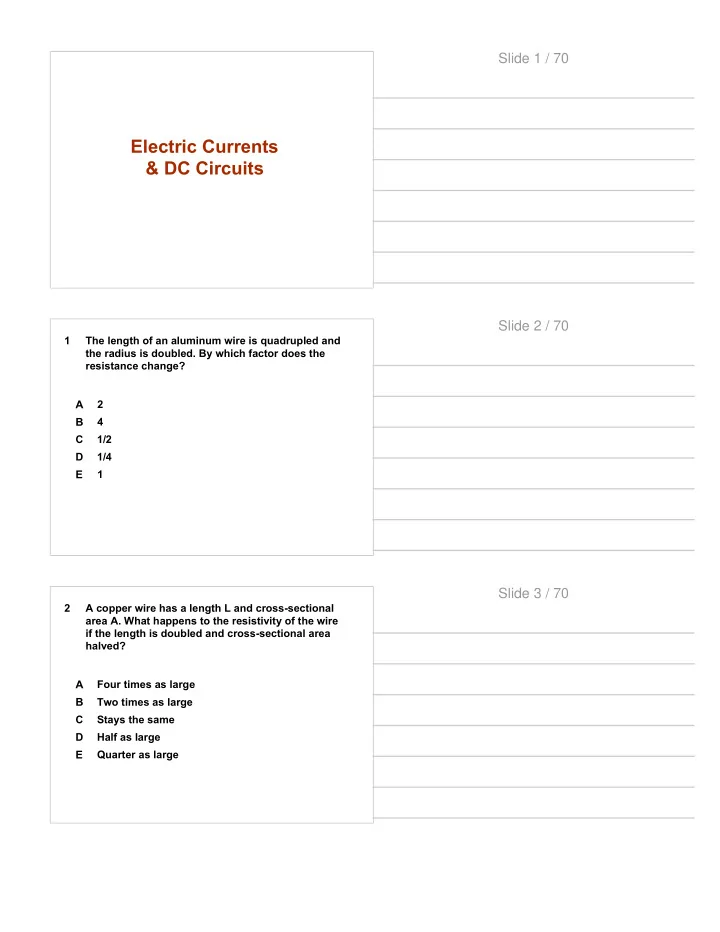
Electric Currents & DC Circuits Slide 2 / 70 1 The length of - - PDF document
Slide 1 / 70 Electric Currents & DC Circuits Slide 2 / 70 1 The length of an aluminum wire is quadrupled and the radius is doubled. By which factor does the resistance change? A 2 B 4 C 1/2 D 1/4 E 1 Slide 3 / 70 2 A copper
3 Which circuit has greater resistance between the terminals? A A B B C C D D E C and D
Slide 4 / 70
4 Which circuits have the same resistance between the terminals? A A and B B B and C C C and D D D and A E C and A
Slide 5 / 70
5 In the circuit shown above, what is the value of the net resistance? A 1 Ω B 2 Ω C 3 Ω D 4 Ω E 6 Ω
Slide 6 / 70
6 What is the current in 4 - Ω resistor? A 1A B 2A C 3A D 4A E 5A
Slide 7 / 70
7 What is the voltage between points L and M? A 2 V B 3 V C 4 V D 3 V E 5 V
Slide 8 / 70
8 A lamp L1, a voltmeter V, an ammeter A, and a battery with zero internal resistance are connected as shown above. Connecting another lamp L2 in series with the first lamp as shown by the dashed lines would A Increase the ammeter reading B Decrease the ammeter reading C Increase the voltmeter reading D Decrease the voltmeter reading E Produce no change in either meter reading
Slide 9 / 70
9 Into which circuit should the battery be connected to obtain the greatest steady power dissipation? A B C D E
Slide 10 / 70
10 Which circuit will retain stored energy if the battery is connected to it and then disconnected? A A B B C C D D E E
Slide 11 / 70
A A B B C C D D E E 11 The five resistors shown below have the lengths and cross sectional areas indicated and are made
- f material with the same resistivity. Which has
the smallest resistance?
Slide 12 / 70
12 Two capacitors are connected in parallel as shown
- above. A voltage V is applied to the pair. What is
the ratio of charge stored on C1 to the charge stored on C2, when C1 = 3C2? A 4/9 B 2/3 C 3/1 D 3/2 E 9/4
Slide 13 / 70
13 The circuit shown above left is made up of a variable resistor and a battery with negligible internal resistance. A graph of the power P dissipated in the resistor as a function of the current I supplied by the battery is given above
- right. What is the emf of the battery?
A 5 V B 8 V C 10 V D 20 V E 40 V
Slide 14 / 70
14 The total equivalent resistance of the circuit shown on the diagram is: A 3 Ω B 4 Ω C 5 Ω D 6 Ω E 9 Ω
Slide 15 / 70
15 A heating spiral of resistance R converts elec trical energy into thermal energy that is transferred to the liquid in which the spiral is
- immersed. If the voltage across the spiral is V, the
thermal energy trans ferred to the liquid in time t is: A Vrt B V2Rt C VR2t D VRt2 E V2t/R
Slide 16 / 70
16 In the circuit two identical resistors R are connected in series with 8-Ω resistor and 12-V
- battery. What is the value of R if the current in the
circuit I = 1 A? A 1 Ω B 2 Ω C 4 Ω D 12 Ω E 18 Ω
Slide 17 / 70
17 The equivalent capacitance for this network is: A 1 μF B 2 μF C 3 μF D 4 μF E 5 μF
Slide 18 / 70
18 The charge stored in the circuit is: A 6 μC B 12 μC C 48 μC D 24 μC E 36 μC
Slide 19 / 70
19 What is the emf of the battery? A 2 V B 4 V C 3.6 V D 12 V E 18 V
Slide 20 / 70
20 What is the potential difference across the terminals A and B of the battery? A 1.2 V B 2.4 V C 3.6 V D 12.2 V E 18.4 V
Slide 21 / 70
21 What power is dissipated by the 2-ohm internal resistance of the battery? A 0.06 W B 1.2 W C 3.2 W D 0.08 W E 4.8 W
Slide 22 / 70
22 In the diagrams, resistors R1 and R2 are shown in two different connections to the same source of emf ε that has no internal resistance. How does the power dissipated by the resistors in these two cases compare? A It is greater for the series connection. B It is greater for the parallel connection. C It is the same for both connections. D It is different for each connection, but
- ne must know the values of R1 and R2 to
know which is greater. E It is different for each connection, but one must know the value of ε to know which is greater.
Slide 23 / 70
23 The product 3 amperes x3 volts x 3 seconds is equal to A 27 C B 27 N C 27 J D 27 W E 27 N·A
Slide 24 / 70
24 The electrical resistance of the part of the circuit shown between point X and point Y is A 4/3 Ω B 2.5 Ω C 2.75 Ω D 4.5 Ω E 6/5 Ω
Slide 25 / 70
25 When there is a steady current in the circuit, the amount of charge passing a point per unit of time is: A the same everywhere in the circuit B greater at point X than at point Y C greater in the 2 Ω resistor than in the 5 Ω resistor D the same in the 2 Ω resistor and in the 5 Ω resistor E greater in the 3 Ω resistor than in the 5 Ω resistor
Slide 26 / 70
26 A certain coffeepot draws 2.0 A of current when it is operated on 110 V household lines. If electrical energy costs 10 cents per kilowatt-hour, how much does it cost to operate the coffeepot for 5 hours? A 2.4 cents B 4.8 cents C 8.0 cents D 9.6 cents E 11 cents
Slide 27 / 70
27 What is the net capacitance of the circuit? A 3C B 2C C 3/2 C D 2/3 C E C
Slide 28 / 70
28 What is the net charge stored in the circuit? A CV B 3CV/2 C 2CV/3 D CV/2 E CV/3
Slide 29 / 70
29 What is the potential difference between the points X and Y? A V B 1/3 V C 1/2 V D 2/3 V E 3/2 V
Slide 30 / 70
30 What is the net resistance of the circuit? A 30 Ω B 40 Ω C 50 Ω D 60Ω E 80 Ω
Slide 31 / 70
31 What is the current in the light bulb L1? A 1 A B 2 A C 3 A D 4 A E 5 A
Slide 32 / 70
32 Which light bulb or bulbs could burn out without causing others to go out? A Only L1 B Only L2 C Only L3 and L4 D Only L4 E Only L5
Slide 33 / 70
33 Four resistors and a capacitor are connected to an 18 V battery with negligible internal resistance, as shown on the diagram. Initially the capacitor is disconnected from the battery – switch is open A Calculate the net resistance of the circuit. B Calculate the current in the 2-Ω resistor. C Calculate the current in the 3-Ω resistor. D Calculate the charge on the capacitor. E Calculate the energy stored in the capacitor.
Slide 34 / 70
Free Response
Slide 35 / 70
- 1. A physics student has an assignment to make an electrical heating system
with the set of materials listed below:
- a. In a space above draw a diagram showing all the elements connected in one
electrical circuit that can provide the maximum rate of heat produced. Use two meters in your circuit, they will help to measure the heat rate. The battery has an emf of 12 V and an internal resistance of 0.5 Ω and each heating coil has a resistance of 17.3 Ω.
- b. When the switch is closed, what is the current running through the battery?
- c. What is the terminal voltage on the battery?
- d. What is the rate of energy delivered by the heating system?
- e. If the switch is closed for 5 min, what is the total energy dissipated in the
coils?
Slide 36 / 70
- 1. A physics student has an assignment to make an electrical heating system
with the set of materials listed below:
- a. In a space above draw a diagram showing all the elements connected in one
electrical circuit that can provide the maximum rate of heat produced. Use two meters in your circuit, they will help to measure the heat rate.
Slide 37 / 70
- 1. A physics student has an assignment to make an electrical heating system
with the set of materials listed below: The battery has an emf of 12 V and an internal resistance of 0.5 Ω and each heating coil has a resistance of 17.3 Ω. First find the equivalent resistance: 1/Rcoil = 1/17.3Ω + 1/17.3Ω Rcoil = 8.65Ω Req = R + r Req = 8.65Ω + 0.5Ω Req = 9.15Ω Then find the current: I = V/R I = 12V / 9.15 Ω = 1.3 A
- c. When the switch is closed, what is the current running through the battery?
Slide 38 / 70
- 1. A physics student has an assignment to make an electrical heating system
with the set of materials listed below: The battery has an emf of 12 V and an internal resistance of 0.5 Ω and each heating coil has a resistance of 17.3 Ω.
- c. What is the terminal voltage on the battery?
VT = E - Ir VT = 12V - (1.3A)(0.5Ω) VT = 11.35 V
Slide 39 / 70
- 1. A physics student has an assignment to make an electrical heating system
with the set of materials listed below:
- d. What is the rate of energy delivered by the heating system?
The battery has an emf of 12 V and an internal resistance of 0.5 Ω and each heating coil has a resistance of 17.3 Ω. P1 = V1
2/R1
P1 = (11.35 V)2/(8.65Ω) P1 = 14.9 W
Slide 40 / 70
- 1. A physics student has an assignment to make an electrical heating system
with the set of materials listed below:
- e. If the switch is closed for 5 min, what is the total energy
dissipated in the coils? The battery has an emf of 12 V and an internal resistance of 0.5 Ω and each heating coil has a resistance of 17.3 Ω. W = Pt W = (14.9 W)(300 s) W = 4470 J
Slide 41 / 70
- 2. An electric motor in a toy car can operate when connected to a 6 V
battery and has a current of 0.5 A. A physics student wants to run the toy car but unfortunately he could find a 12 V battery in the physics lab. The student also found a box with a set of five 6-Ω resistors.
- a. Use given materials design an electric circuit in which the electric motor
will operate properly.
- i. Draw the circuit including all devices.
- ii. Explain your reasoning in designing this particular circuit.
- b. Calculate the net resistance of the circuit.
- c. Calculate the power dissipated in the circuit.
Slide 42 / 70
- 2. An electric motor in a toy car can operate when connected to a 6 V
battery and has a current of 0.5 A. A physics student wants to run the toy car but unfortunately he could find a 12 V battery in the physics lab. The student also found a box with a set of five 6-Ω resistors.
- a. Use given materials design an electric circuit in which the electric motor
will operate properly.
- i. Draw the circuit including all devices.
- ii. Explain your reasoning in designing this particular circuit.
12V
motor
Rmotor = 6V/0.5A = 12 Ω Req = 12V/0.5A = 24 Ω 6Ω + 3Ω + 3Ω + 12 Ω = 24Ω
Slide 43 / 70
- 2. An electric motor in a toy car can operate when connected to a 6 V
battery and has a current of 0.5 A. A physics student wants to run the toy car but unfortunately he could find a 12 V battery in the physics lab. The student also found a box with a set of five 6-Ω resistors.
- b. Calculate the net resistance of the circuit.
Req = 6Ω + 3Ω + 3Ω + 12 Ω = 24Ω
Slide 44 / 70
- 2. An electric motor in a toy car can operate when connected to a 6 V
battery and has a current of 0.5 A. A physics student wants to run the toy car but unfortunately he could find a 12 V battery in the physics lab. The student also found a box with a set of five 6-Ω resistors.
- c. Calculate the power dissipated in the circuit.
P = I V = (0.5A)(12V) = 6 W P = (0.5A)(12V) = 6 W P = 6 W
Slide 45 / 70
- 3. Three light bulbs are connected in the circuit show on the diagram. Each light
bulb can develop a maximum power of 75 W when connected to a 120-V power
- supply. The circuit of three light bulbs is connected to a 120 V power supply.
- a. What is the resistance of the
circuit?
- b. What is the power dissipated
by the circuit?
- c. How would you compare this power to the power when all bulbs are
connected in parallel?
- d. What is the current in light bulb L1?
- e. What is the voltage across light bulb L1?
- f. What is the voltage across light bulb L2?
Slide 46 / 70
- 3. Three light bulbs are connected in the circuit show on the diagram. Each light
bulb can develop a maximum power of 75 W when connected to a 120-V power
- supply. The circuit of three light bulbs is connected to a 120 V power supply.
- a. What is the resistance of the
circuit? P = V2/R R = V2/P R = (120V)2/(75W) R = 192 Ω for each light bulb Req2&3 = 96Ω Rcircuit = 192Ω + 96Ω = 288Ω
Slide 47 / 70
- 3. Three light bulbs are connected in the circuit show on the diagram. Each light
bulb can develop a maximum power of 75 W when connected to a 120-V power
- supply. The circuit of three light bulbs is connected to a 120 V power supply.
- b. What is the power dissipated
by the circuit? P = V2/R P = (120V)2/288Ω P = 50W
Slide 48 / 70
- 3. Three light bulbs are connected in the circuit show on the diagram. Each light
bulb can develop a maximum power of 75 W when connected to a 120-V power
- supply. The circuit of three light bulbs is connected to a 120 V power supply.
- c. How would you compare this
power to the power when all bulbs are connected in parallel? This power is less. The power for bulbs connected in series is: P = 3(75W) P = 225 W
Slide 49 / 70
- 3. Three light bulbs are connected in the circuit show on the diagram. Each light
bulb can develop a maximum power of 75 W when connected to a 120-V power
- supply. The circuit of three light bulbs is connected to a 120 V power supply.
- d. What is the current in light bulb L1?
I1 = V1/R1 I1 = 120V/288Ω = 0.42A
Slide 50 / 70
- 3. Three light bulbs are connected in the circuit show on the diagram. Each light
bulb can develop a maximum power of 75 W when connected to a 120-V power
- supply. The circuit of three light bulbs is connected to a 120 V power supply.
- e. What is the voltage across
light bulb L1? V = IR V = (0.42A)(192Ω) V = 80V
Slide 51 / 70
- 3. Three light bulbs are connected in the circuit show on the diagram. Each light
bulb can develop a maximum power of 75 W when connected to a 120-V power
- supply. The circuit of three light bulbs is connected to a 120 V power supply.
- f. What is the voltage across
light bulb L2? V = IR V = (0.42A)(96Ω) V = 40V
Slide 52 / 70
- 4. Four resistors are connected in a circuit. The circuit is connected to a battery
with emf ε and negligible internal resistance. The current through 9.6 Ω resistor is 0.25 A.
- a. What is the net resistance of the circuit?
- b. What is the voltage drop across 6-Ω resistor?
- c. What is the current in 4-Ω resistor?
- d. What is the emf of the battery?
- e. What is the net power dissipation?
Slide 53 / 70
- 4. Four resistors are connected in a circuit. The circuit is connected to a battery
with emf ε and negligible internal resistance. The current through 9.6 Ω resistor is 0.25 A.
- a. What is the net resistance of the circuit?
Middle Section: 1/6Ω + 1/4Ω = 5/12Ω Req = 2.4Ω Whole circuit: Req = 9.6Ω + 2.4Ω + 12Ω Req = 24Ω
Slide 54 / 70
- 4. Four resistors are connected in a circuit. The circuit is connected to a battery
with emf ε and negligible internal resistance. The current through 9.6 Ω resistor is 0.25 A.
- b. What is the voltage drop across 6-Ω resistor?
V = IR V = (0.25A)(2.4Ω) = 0.6V (2.4Ω is the equivalent resistance of the middle section.)
Slide 55 / 70
- 4. Four resistors are connected in a circuit. The circuit is connected to a battery
with emf ε and negligible internal resistance. The current through 9.6 Ω resistor is 0.25 A.
- c. What is the current in 4-Ω resistor?
I = V/R I = (0.6V)/(4Ω) I = 0.15A
Slide 56 / 70
- 4. Four resistors are connected in a circuit. The circuit is connected to a battery
with emf ε and negligible internal resistance. The current through 9.6 Ω resistor is 0.25 A.
- d. What is the emf of the battery?
V = IR V = (0.25A)(24Ω) V = 6V
Slide 57 / 70
- 4. Four resistors are connected in a circuit. The circuit is connected to a battery
with emf ε and negligible internal resistance. The current through 9.6 Ω resistor is 0.25 A.
- e. What is the net power dissipation?
P = IV P = (0.25A)(6V) P = 1.5 W
Slide 58 / 70
- 5. Five resistors are connected to
a battery with an emf of 12 V and an internal resistance of 1 Ω.
- a. Calculate the external resistance
- f the circuit.
- b. Calculate the current in the battery.
- c. Calculate the terminal voltage of the battery.
- d. Calculate the power dissipation in the 3-Ω resistor.
- e. Calculate the power dissipation in the internal resistance.
Slide 59 / 70
- 5. Five resistors are connected to
a battery with an emf of 12 V and an internal resistance of 1 Ω.
- a. Calculate the external resistance
- f the circuit.
Top part: 2Ω + 4Ω = 6Ω Middle: 1/3Ω + 1/6Ω = 3/6Ω Req = 2Ω Whole circuit: Req = 4Ω + 2Ω + 2Ω = 8Ω
Slide 60 / 70
- 5. Five resistors are connected to
a battery with an emf of 12 V and an internal resistance of 1 Ω.
- b. Calculate the current in the battery.
I = V/R I = (12V)/(8Ω+1Ω) I = 1.3A
Slide 61 / 70
- 5. Five resistors are connected to
a battery with an emf of 12 V and an internal resistance of 1 Ω.
- c. Calculate the terminal voltage of the
battery. VT = E - Ir VT = 12V - (1.3A)(1Ω) VT = 11.7 V
Slide 62 / 70
- 5. Five resistors are connected to
a battery with an emf of 12 V and an internal resistance of 1 Ω.
- d. Calculate the power dissipation in
the 3-Ω resistor. Find the potential difference across the two side resistors: V2 = (1.3A)(2Ω) = 5.2V V4 = (1.3A)(4Ω) = 2.6V Find the potential difference across the 3Ω resistor: V3 = 11.7V - 5.2V - 2.6V = 3.9V Find the power dissipation in the 3Ω resistor: P = V2/R = (3.9V)2/(3Ω) = 5.1W
Slide 63 / 70
- 5. Five resistors are connected to
a battery with an emf of 12 V and an internal resistance of 1 Ω.
- e. Calculate the power dissipation in
the internal resistance. P = I2R P = (1.3A)2(1Ω) P = 1.7W
Slide 64 / 70
- 6. Four resistors and a capacitor are connected to an 18 V battery with negligible
internal resistance, as shown on the diagram. Initially the capacitor is disconnected from the battery - switch is open
- a. Calculate the net resistance of the circuit.
- b. Calculate the current in the 2-Ω resistor.
- c. Calculate the current in the 3-Ω resistor.
Switch is closed and the current reached constant value.
- d. Calculate the charge on the capacitor.
- e. Calculate the energy stored in the capacitor.
Slide 65 / 70
- 6. Four resistors and a capacitor are connected to an 18 V battery with negligible
internal resistance, as shown on the diagram. Initially the capacitor is disconnected from the battery - switch is open
- a. Calculate the net resistance of the circuit.
Calculate Req of the 9 and 3 Ω resistors: 9Ω + 3Ω = 12Ω Calculate Req of the previous branch and the 6Ω resistor: 1/12Ω + 1/6Ω = 3/12Ω Req = 4Ω Calculate the net resistance of the circuit: 4Ω + 2Ω = 6Ω
Slide 66 / 70
- 6. Four resistors and a capacitor are connected to an 18 V battery with negligible
internal resistance, as shown on the diagram. Initially the capacitor is disconnected from the battery - switch is open
- b. Calculate the current in the 2-Ω resistor.
Current in the 2Ω resistor is the same as the current in the battery. I = V/R I = (18V)/(6Ω) I = 3A
Slide 67 / 70
- 6. Four resistors and a capacitor are connected to an 18 V battery with negligible
internal resistance, as shown on the diagram. Initially the capacitor is disconnected from the battery - switch is open
- c. Calculate the current in the 3-Ω resistor.
Calculate the potential difference across the 2Ω resistor: V = (3A)(2Ω) = 6V Calculate the potential difference across the 9 & 3Ω resistors: 18V - 6V = 12V Calculate the current though the 9 & 3Ω resistors: I = V/R = (12V)/(12Ω) = 1A
Slide 68 / 70
- 6. Four resistors and a capacitor are connected to an 18 V battery with negligible
internal resistance, as shown on the diagram. Initially the capacitor is disconnected from the battery - switch is open Switch is closed and the current reached constant value.
- d. Calculate the charge on the capacitor.
Calculate the potential difference across the 9Ω resistor which is the same as the potential difference across the capacitor: V = IR = (1A)(9Ω) = 9V Find the charge on the capacitor: Q = CV = (2μF)(9V) = 18μC
Slide 69 / 70
- 6. Four resistors and a capacitor are connected to an 18 V battery with negligible
internal resistance, as shown on the diagram. Initially the capacitor is disconnected from the battery - switch is open Switch is closed and the current reached constant value.
- e. Calculate the energy stored in the capacitor.
Uc = ½CV2 Uc = ½(2μF)(9V)2 Uc = 81μJ