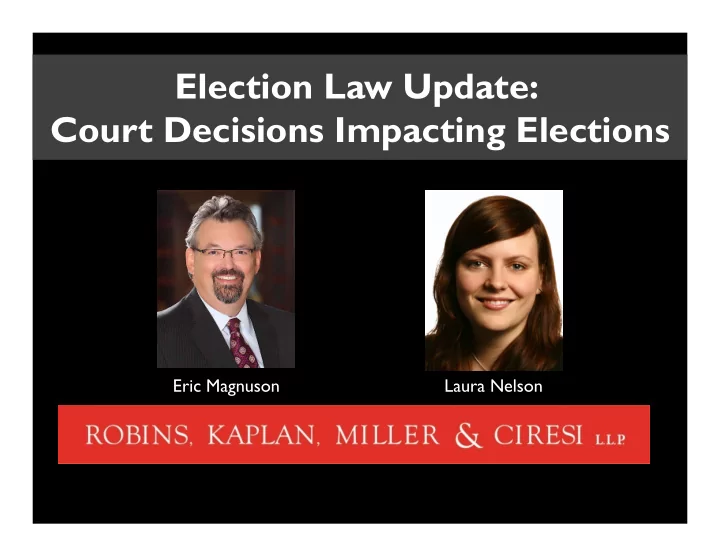
SLIDE 1 Election Law Update: Court Decisions Impacting Elections
Eric Magnuson Laura Nelson
SLIDE 2
Pre-Roberts’ Court...
SLIDE 3
Buckley v. Valeo (1976)
Upholds contribution limits on the basis of the government's "compelling interest" in preventing political corruption or its appearance.
SLIDE 4
First National Bank of Boston v. Bellotti (1978)
Corporations have a First Amendment right to make contributions to ballot initiative campaigns.
SLIDE 5
California Medical Association v. FEC (1981)
Upholds limits that prevented individuals and unincorporated associations from contributing more than $5,000 per calendar year to any multicandidate political committee.
SLIDE 6
FEC v. Massachusetts Citizens for Life (1986)
Ban on corporate spending in connection with federal elections, was unconstitutional as applied to certain independent expenditures made by nonprofit corporations.
SLIDE 7 Austin v. Michigan Chamber of Commerce (1990)
Upholds prohibition on corporations using treasury money to make independent expenditures to support or
- ppose candidates in elections.
SLIDE 8
Nixon v. Shrink Missouri Government PAC (2000)
Upholds state limits on campaign contributions to state offices.
SLIDE 9
FEC v. Colorado Republican Federal Campaign Committee (2001)
Upholds the constitutionality of coordinated expenditure limitations imposed on political parties.
SLIDE 10 Republican Party of Minnesota v. White, 536 U.S. 765 (2002)
Ban on candidates for judicial
- ffice announcing their views on
disputed legal issues and political views is unconstitutional.
SLIDE 11
FEC v. Beaumont (2003)
Upholds ban on corporate contributions to federal candidates is constitutional, even when applied to nonprofit advocacy corporations.
SLIDE 12
McConnell v. FEC (2003)
Upholds the constitutionality of the Bipartisan Campaign Reform Act of 2002.
SLIDE 13
Roberts’ Court
SLIDE 14
Randall v. Sorrell (2006)
Striking down Vermont’s contribution limits—noting that limits might be permissible if they were "closely drawn" to match a "sufficiently important interest."
SLIDE 15
FEC v. Wisconsin Right to Life (2007)
Issue ads may not be banned from the months preceding a primary or general election.
SLIDE 16
Davenport v. Washington Education Association (2007)
Upheld state requirement for public-sector unions to receive affirmative authorization from a non-member before spending that nonmember's agency fees for election-related purposes.
SLIDE 17
Davis v. FEC (2008)
Striking down the Millionaire Amendment, as no important governmental interest was advanced, because a reliance on personal expenditures reduces the likelihood of corruption.
SLIDE 18 Caperton v. A.T. Massey Coal Co.,
Due Process requires a judge to recuse himself when the judge has an economic interest in the
- utcome of the case, but also
when "extreme facts" create a "probability of bias."
SLIDE 19
Citizens United v. FEC (2010)
First Amendment prohibits the government from restricting political independent expenditures by corporations, associations, or labor unions.
SLIDE 20
Arizona Free Enterprise Club Freedom Club PAC v. Bennett (2011)
Striking down Arizona's matching funds scheme, which provides additional funds to a publicly funded candidate when expenditures by a privately financed candidate and independent groups exceed the funding initially allotted to the publicly financed candidate.
SLIDE 21
American Tradition Partnership v. Bullock (2012)
Reversing without argument a Montana Supreme Court ruling which upheld the state’s prohibition on corporate financing in elections despite the Citizens United decision.
SLIDE 22
McCutcheon v. FEC (2014)
Struck down the biennial aggregate limit on individual contributions to national party and federal candidate committees.
SLIDE 23
In the wake of the Roberts’ Court...
SLIDE 24 New York Progress & Prot. PAC v. Walsh, 2014 U.S. Dist LEXIS 57477 (S.D.N.Y.
“Indeed, today’s reality is that the voices of we the people are too often drowned out by the few who have great resources.. . . ‘But this Court is bound to apply this definition no matter how misguided . . . [the Court] may think it to be.’”
SLIDE 25
- Wis. Right to Life, Inc. v. Barland,
2014 U.S. App. LEXIS 9015 (7th Cir. May 14, 2014)
“Certain statutory provisions—the ban on corporate political spending and the cap on the amount a corporation may spend to raise money for an affiliated PAC—are obviously unconstitutional under Citizens United”
SLIDE 26 Seaton v. Wiener, 0:14-cv-01016- DWF-JSM (D. Minn. May 19, 2014)
“Although the undersigned may not agree with the Supreme Court’s recent line of cases on the subject of campaign finance, and their effect on the integrity
- f our public governmental institutions,
the Court acknowledges that it is nevertheless bound by the decisions of the Supreme Court.”
SLIDE 27
Questions?
SLIDE 28
FIN