Ele lectromagnetic ic mod odes in in arr arrays of of alu - - PowerPoint PPT Presentation

ele lectromagnetic ic mod odes in in arr arrays of of alu
SMART_READER_LITE
LIVE PREVIEW

Ele lectromagnetic ic mod odes in in arr arrays of of alu - - PowerPoint PPT Presentation

Ele lectromagnetic ic mod odes in in arr arrays of of alu alumin inum nan anoparticles V.S. Gerasimov 1,2 , A.E. Ershov 1,2 , R.G. Bikbaev 2,3 , S.P. Polyutov 2 , S.V. Karpov 2,3 1 Institute of Computational Modeling SB RAS, 660036,


slide-1
SLIDE 1

V.S. Gerasimov1,2, A.E. Ershov1,2, R.G. Bikbaev2,3, S.P. Polyutov2, S.V. Karpov2,3

Ele lectromagnetic ic mod

  • des in

in arr arrays of

  • f alu

alumin inum nan anoparticles

1 Institute of Computational Modeling SB RAS, 660036, Krasnoyarsk, Russia 2 Siberian Federal University, 660041, Krasnoyarsk, Russia 3 L.V. Kirensky Institute of Physics, Federal Research Center KSC SB RAS, 660036, Krasnoyarsk, Russia

Introduction Theory Results Conclusion

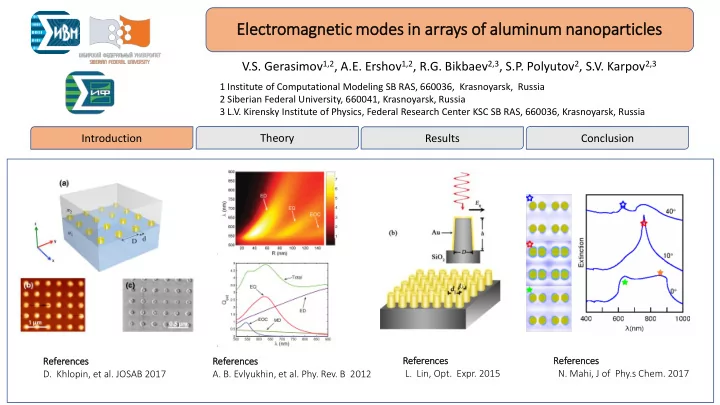
References

  • D. Khlopin, et al. JOSAB 2017

References

  • A. B. Evlyukhin, et al. Phy. Rev. B 2012

References

  • L. Lin, Opt. Expr. 2015

References

  • N. Mahi, J of Phy.s Chem. 2017
slide-2
SLIDE 2

Introduction Theory Results Conclusion

Main equations of generalized Mie theory

References

  • G. Mie, Beitrage zur Optik truber Medien, speziell kolloidaler

Met-allosungen, Annalen der Physik 330 (3) (1908) 377–445.

Main equations of generalized Mie theory V.S. Gerasimov, A.E. Ershov, R.G. Bikbaev, S.P. Polyutov, S.V. Karpov

Ele lectromagnetic ic mod

  • des in

in arr arrays of

  • f alu

alumin inum nan anoparticles

Sketch view of the square Al nanoparticles array.

slide-3
SLIDE 3

V.S. Gerasimov, A.E. Ershov, R.G. Bikbaev, S.P. Polyutov, S.V. Karpov

Ele lectromagnetic ic mod

  • des in

in arr arrays of

  • f alu

alumin inum nan anoparticles

Single Al nanoparticles Single Ag and Au nanoparticles

The first order spherical multipoles components of extinction efficiency for single Ag and Au spherical nanoparticles of different radii R and wavelengths of incident light.

Introduction Theory Results Conclusion

Extinction efficiency decomposed in a set of spherical multipoles for single aluminum nanospheres of different radii R and wavelengths of incident light.

slide-4
SLIDE 4

V.S. Gerasimov, A.E. Ershov, R.G. Bikbaev, S.P. Polyutov, S.V. Karpov

Ele lectromagnetic ic mod

  • des in

in arr arrays of

  • f alu

alumin inum nan anoparticles

Array of Al nanoparticles Single Al nanoparticle

Extinction efficiency decomposed in a set of spherical multipoles for square array consisting of Al NPs of different radii R and wavelengths of incidence light (a,b,c) are for the electrical field component while (d,e,f) are for magnetic field component. The array period is 290 nm. White dash lines represents the Rayleigh anomalies.

Introduction Theory Results Conclusion

Extinction spectra of the infinite (left) and 30x30 (right) arrays of Al NPs with h=290 nm for different values of R calculated by FDTD and generalized Mie theory, respectively. White dashed line represent the different orders of the Rayleigh anomalies and white dots line represent the position of corresponding mode resonance.

slide-5
SLIDE 5

Field distribution R = 110 nm Field distribution R = 60 nm V.S. Gerasimov, A.E. Ershov, R.G. Bikbaev, S.P. Polyutov, S.V. Karpov

Ele lectromagnetic ic mod

  • des in

in arr arrays of

  • f alu

alumin inum nan anoparticles

The configuration of electric (a,c) and magnetic (b,d) fields at 435 and 480 nm, respectively for R=60 nm and h=290 nm. The configuration of electric (a,d) and magnetic (b,c) fields at 439 and 463 nm, respectively for R=110 nm and h=290 nm.

Introduction Theory Results Conclusion

slide-6
SLIDE 6

Tailoring

Figures, text etc

Lattice Kerker effect

References Submitted to PRL

(a),(f) Reflectance spectra, and (b)-(e), (g)-(j) multipole (ED, MQ, MD, EQ) decomposition of extinction efficiency for arrays with fixed hx=240 nm and different hy (top), and with fixed hy = 280 nm and different hx(bottom). Al NPs with radius R=60 nm have been considered in all

  • cases. Notice a suppression of reflection which follows [0;1] RA. Multipole decomposition of

the extinction efficiency is calculated from the spatial electromagnetic field distribution as described in [A.B. Evlyukhin, et.al. Phys. Rev. B84,235429 (2011)]. (a) Reflectance for arrays with different geometrical parameters (R, hx, hy) as marked in the legend. Vertical dashed lines show respective spectral positions of [1;0] and [0;1] RAs for each array. (b) Electric field distribution in the ZY plane for (60, 240, 280) array at =417.6 nm (top, maximum reflectance) and = 420.5 nm (bottom, zero reflectance).

Introduction Theory Results Conclusion

V.S. Gerasimov, A.E. Ershov, R.G. Bikbaev, S.P. Polyutov, S.V. Karpov

Ele lectromagnetic ic mod

  • des in

in arr arrays of

  • f alu

alumin inum nan anoparticles

slide-7
SLIDE 7
  • 1. To conclude, the extinction spectra of the single aluminum nanoparticles and nanoparticle arrays vs the particle

radius have been investigated. It was shown that for single nanoparticles an increase of their radius leads to a sequential excitation and decay of electric and magnetic modes

  • 2. The spectral manifestations of hybrid modes are the formation of narrow lines in the extinction spectra and the

corresponding hybrid configurations of the electromagnetic field. The feature here is that the each mode of both electric and magnetic fields interact with the Rayleigh anomalies of different orders. As the result we observe the increased extinction efficiency in the vicinity of the Rayleigh anomalies. This effect can be used to control the spectral position of the extinction maximum.

  • 3. We have demonstrated the lattice Kerker effect in plasmonic arrays of Al nanoparticles, whereas for single lossy NPs it is in

principle impossible to achieve.

Introduction Theory Results Conclusion

V.S. Gerasimov, A.E. Ershov, R.G. Bikbaev, S.P. Polyutov, S.V. Karpov

Ele lectromagnetic ic mod

  • des in

in arr arrays of

  • f alu

alumin inum nan anoparticles