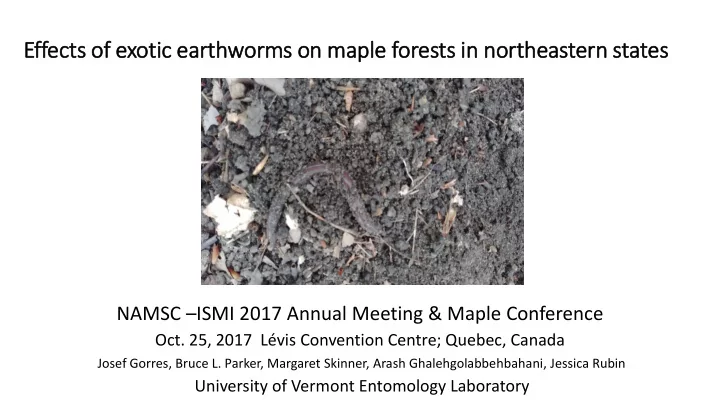
SLIDE 1 Effects of exotic earthworms on maple le forests in in northeastern states
NAMSC –ISMI 2017 Annual Meeting & Maple Conference
- Oct. 25, 2017 Lévis Convention Centre; Quebec, Canada
Josef Gorres, Bruce L. Parker, Margaret Skinner, Arash Ghalehgolabbehbahani, Jessica Rubin
University of Vermont Entomology Laboratory
SLIDE 2
Why is is it it im impo portant for su suga gar mak akers to kn know ab about ear earthworm pres presence in in map aple le forests?
No earthworms
Camels Hump, VT
Forest invaded by Amynthas agrestis
Shelburne, VT
Maple forest regeneration is threatened
SLIDE 3 Main Objectives:
- Which worms are present?
- What are their effects on maple
regeneration?
located?
SLIDE 4 Worm niches in forest floor:
Lumbricus terrestris (night crawlers) Eiseina fetida (red wriggler), Dendrobaena Octolasion, Aporrectodea
EPI-ENDOGEIC
- surface feeder
- mix top layers into middle
- travel & live between top & middle
- small size
- pigmented
Amynthas sp., Lumbricus rubellus
SLIDE 5
How worms affect forest floor soil structure:
SLIDE 6 Examples of soil structure disturbance from this summer’s sampling:
No damage, all ll organic horiz izons prese sent t IER IERAT cla class ss = = 1
Litter Organic duff Layer:
- Oi: leaves intact from previous fall)
- Oe: fermented fragmented leaves greater than
a year; fine roots present
- Oa: humic or decomposed organic matter
Mineral horizon:
- transition from O to upper mineral soil horizon
- less than 30% organic matter
SLIDE 7 Forest soil structure after worm invasion:
Maximum dam amage, no
left ft an and lots lots of
large ear arthworms, IE IERAT clas class = 5 Intact leaves from previous fall Oe and Oa layers missing. A soil horizon mineral soil and earthworm castings. Some roots remain but fine roots absent. Transition from mineral soil to parent material
SLIDE 8 Methodology:
- 5 cold hardiness zones
- 5 states
- 35 sites
- all maple sugaring forests
Zones States Sites Color 4a VT, NY 6 Green 4b VT 7 Blue 5a VT, NY, NH 9 Yellow 5b NH, MA, CT 6 Red 6a MA, CT 7 White
SLIDE 9 Sampling Techniques:
1 square meter:
- overstory: trees
- understory: herbaceous species
@5m:
- nonnative plants
- maple seedlings
- maple saplings
½ square meter:
- forest soil structure
- worms
SLIDE 10 For 3 years UVM Entomology Lab gathered data to answer:
- In which USDA plant cold hardiness zones are worms present?
- Which worm species occur most frequently?
- How is worm presence related to forest damage?
(using IERAT rating)
- Is there a correlation between:
forest damage level & plant diversity?
- Does forest damage level affect maple regeneration?
- How does forest damage level affect nonnative plant presence?
SLIDE 11
# Worms & plant cold hardiness zone correlation:
SLIDE 12
Worm families, genus, & species found:
Lumbricidae: Aporrectodea: (Aporrectodea rosea, A. turgida, A. tuberculata, A. caliginosa) Dendrobaena: (Dendrobaena octaedra) Octolasion: (Octolasion cyaneum) Lumbricus: (Lumbricus terrestris) night crawlers; (L. rubellus) red worms Megascolecidae: *Pheretimoids: (Amynthas agrestis, A. tokioensis, A. hilgendorfi)
SLIDE 13
Most concerning worms species found:
Amynthas (crazy snake worm) (A. agrestis, tokiensis, hilgendorfi*)
Known now as Metaphire hilgendorfi (Chang, 2016)
SLIDE 14
Most concerning Worms Species found:
Lumbric icus: : (Lumbricus terrestris*, L. rubellus, L. castaneaus, L. festivus)
*Commonly known as Night Crawlers: anecic, making burrows Notice the tunnels they make
SLIDE 15 # of worms present to forest damage level (according to IERT)
1 2 3 4 5 6 7
5 10 15 20 25 30 35
# of forest damage rating # of worms present
SLIDE 16
Patterns in 3 years of Data
SLIDE 17
How many forests did we see that are damaged?
SLIDE 18
Forest damage in relation to to plant diversity
SLIDE 19
Regeneration via maple seedlings across forest damage le levels
SLIDE 20
Effects of Amyn ynthas on map aple le regeneratio ion in in 2017 What is the impact on Maple regeneration via seedling counts?
SLIDE 21
Relationship of ‘invasive’ plants & forest damage
SLIDE 22
Correlation between forest damage & ‘invasive’ plant presence:
Observed in the field: higher forest damage ‘invasive’ plants presence more likely
Species observed:
Common buckthorn (Rhamnus cathartica) Garlic mustard (Alliaria petiolata) Japanese barberry (Berberis thunbergii) Japanese honeysuckle (Lonicera japonica) Multiflora rose (Rosa multiflora) Oriental bittersweet (Celastrus orbiculatus) Winged Burning Bush (Euonymus alatus)
SLIDE 23 Potential Vectors of these worms:
- Horticultural exchanges
- Mulch
- Plant exchange
- Soil fill
- Discarded fishing bait
Recent Case studies:
- UVM Master gardener called: commercial compost---Amynthas agrestis.
- Home gardener of 20 years: worms appear, odd texture, spreading to woods around house
SLIDE 24 In Summary:
Findings:
- Plant cold hardiness zone seems irrelevant; earthworms are present in all zones
- Worm species most present & damaging were: Amynthas spp. & Lumbricus spp.
- Forest damage directly relates to earthworm presence
- Forest damage level does not indicate plant diversity
- Severe forest damage low maple regeneration
- Forest damage does not always indicate ‘invasive’ plant presence
SLIDE 25 Recommendations if you do not yet have worms in your sugarbush:
Avoid vector introductions:
- Minimize horticultural material movement
- Inspect all nursery species root balls before planting
- Avoid exposure to aquatic areas where fishing bait may be discarded
Observe patterns in forests you tend:
- look for earthworm castings, diminished organic
layers & decrease in understory plants
Inform and stay informed:
- share this information with your community & the public
- stay tuned for further recommendations
SLIDE 26 Recommendations if if you do have worms in in your sugarbush:
Support forest health:
- Promote deep taproots tree species, especially in sandy or low organic matter
substrate, so they can hold trees in place as forest floor structure changes Stay tuned for updates:
- Furthur research is being conducted on natural pathogens to explore
biocontrols and Entomo-pathogenic fungi or other microorganisms
- Visit UVM Entomology lab for details
SLIDE 27
Resources
Worm Watch: a science-based education & national volunteer monitoring program used to identify ecological changes in the environment (field guides..) Great Lakes Worm Watch: valuable resource of research, worm identification, forest ecology, resources.. Vermont Invasives: includes information about identification, biology, management, distribution, and citations for earthworms and many other species UVM Entomology Lab: contact for UVM scientists working on this research
SLIDE 28 Peer reviewed scientific articles to read:
Bal, Tara L, Andrew J. Storer, Martin F. Jurgensen, “Evidence of damage from exotic invasive earthworm activity was highly correlated to sugar maple dieback in the Upper Great Lakes region.” Biological Invasions, 2017: p. 1-14. Chang, Chih-Han Bruce A. Snyder & Katalin Szlavecz. “Asian pheretimoid earthworms in North America north of Mexico: An illustrated key to the genera Amynthas, Metaphire, Pithemera, and Polypheretima (Clitellata: Megascolecidae)” Zootaxa 2016: p. 495-529. Gorres, Josef H. & Ryan D.S. Melnichuk. “Asian Invasive Earthworms of the Genus Amynthas Kinberg in Vermont.” Northeastern Naturalist 19:2, 2012: p 313-322. Hale, Cindy M, Lee E. Frelich, Peter B. Reich.“Changes in Hardwoodforest Understory Plant Communities in Response to European Earthworm Invasions.” Ecology Society of America 2006 Vol #87 Issue 7, 2006: p. 1637-1649. Resner, Kit, Kyungsoo Yoo, Stephen D. Sebestyen, Anthony Aufdenkampe, Cindy Hale, Amy Lyttle, Alex Blum. “Invasive Earthworms Deplete Key Soil Inorganic Nutrients (Ca, Mg, K, and P) in a Northern Hardwood Forest Kit.” Ecosystems Vol #18 Issue I, 2014: p. 89-102.
SLIDE 29
Acknowledgements
The scientists thank:
the North American Maple Syrup Council, Chittenden County Sugarmakers Assoc., and Univ. of Vermont College of Agriculture & Life Sciences for financial support to conduct this worm work. They also appreciate the technical support received from: Cheryl Frank Sullivan, Donald Tobi and Laura Sisco. Thanks also to: the sugarmakers who permitted us to sample their sugarbushes.
SLIDE 30
Questions, Comments…
SLIDE 31 Extra slides
These following slides cover more details:
- More details on IERAT Protocol
- Breakdown across damage levels: percentages of ‘invasive’ plant presence
- Correlation of forest damage level across plant cold hardiness zones
- 2016 data on correlation of Amynthus presence and maple seedling regeneration
- Effects of Lumbricus on maple regeneration via seedling #’s 2015 & 2017
- Anomaly year data on Lumbricus effects on maple regeneration via seedling #’s
- Relationship of maple regeneration via saplings across forest damage levels
- Correlation between plant diversity and forest damage level across cold hardiness zones
- Maple regeneration via maple seedlings broken down into state
SLIDE 32 Examples of soil structure disturbance from this summer’s sa sampli ling
- Damage of forest floor assessed with:
- the Invasive Earthworm Rapid Assessment Tool (IERAT).
- No damage, all organic horizons present IERAT class = 1
- Maximum damage, no organic horizon left and lots of large earthworms, IERAT class =5
Amynthas and L. terrestris (night crawlers)
1 2 3 4 5
SLIDE 33
Breakdown across damage levels: percentages of ‘invasive’ pla lant presence
SLIDE 34
2015-2017 patterns of forest damage across plant cold hardiness zones
SLIDE 35
2016: Rela lationship of Amynthas maple regeneration via ia seedlin ings
SLIDE 36
Effects of f Lu Lumbricus on maple seedling #’s in 2015 & 2017
SLIDE 37
Anomaly year data on Lumbricus effects on maple regeneration via seedling #’s
SLIDE 38
Forest damage and maple regeneration via saplings:
SLIDE 39 Rela lationship ip of
lant div iversit ity an and for
amage le level l ac accordin ing to
lant cold ld har ardiness s zon
SLIDE 40
Maple regeneration via ia maple seedlings across states