
SLIDE 1
Pathology and Immunology Office of Faculty Development
Effective Mentorship: Consultant, Counselor, Cheerleader
Carey-Ann Burnham
Professor of Pathology & Immunology Vice Chair for Faculty Mentoring & Advancement November 5, 2020
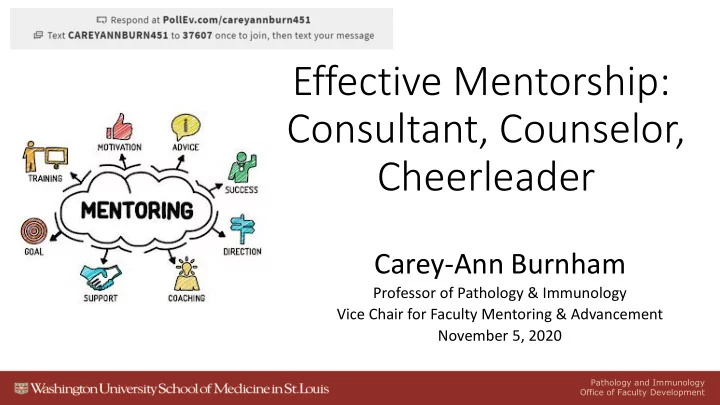
Effective Mentorship: Consultant, Counselor, Cheerleader Carey-Ann - - PowerPoint PPT Presentation
Effective Mentorship: Consultant, Counselor, Cheerleader Carey-Ann Burnham Professor of Pathology & Immunology Vice Chair for Faculty Mentoring & Advancement November 5, 2020 Pathology and Immunology Office of Faculty Development
Pathology and Immunology Office of Faculty Development
Professor of Pathology & Immunology Vice Chair for Faculty Mentoring & Advancement November 5, 2020
Zerzan et al. 2009. Academic Medicine. 84: 140-144.
Chopra et al. 2016. JAMA. 315: 1453-1454.
counsel that was less than helpful. How did that feel? What might have gone differently?
counsel that was especially helpful/ effective/useful. Why was it effective? How did it feel?
goals do you have for your mentees?
and bad) what practices do you try to incorporate as a mentor and advisor yourself?
said
constructive feedback
problems (rather than direct what to do)
an individual (resist urge to produce a clone)
area
Benefits for Mentee Benefits for Mentor Benefits for Institution Career progression Career satisfaction Personal development Professional productivity Personal enrichment and satisfaction Sense of giving back Develop larger circle of influence and legacy Faculty retention Faculty productivity
Sambunjak et al. 2006. JAMA. 296: 1103-1115.
Chopra et al. 2018. JAMA Internal Medicine. 187: 175-176.
meetings
scholarship, career milestones
communication
Chopra et al. 2018. JAMA Internal Medicine. 187: 175-176.
issue (rather than growth in multiple directions)
understand
traditional mentor
writer, specific technical problem
Chopra et al. 2018. JAMA Internal Medicine. 187: 175-176.
individual
committees
Chopra et al. 2018. JAMA Internal Medicine. 187: 175-176.
mentee, but needs to know influential individuals in the field
minority faculty; less likely to be sponsored
Chopra et al. 2018. JAMA Internal Medicine. 187: 175-176.
government, private sector, etc.
faculty at all states of development
Chopra et al. 2018. JAMA Internal Medicine. 187: 175-176.
Chopra et al. 2018. JAMA Internal Medicine. 187: 175-176.
Preparation Negotiation and building trust Enabling advancement/ the middle period Closure/ redefining the partnership
and beneficial relationship
take place more readily
goals for their partnership
check progress
homework
you would like the mentor to look out for
homework
you would like the mentor to look out for
Zerzan et al. 2009. Academic Medicine. 84: 140-144.
gel
honest discussion about what you want and need, and how you see the role
termination possibility so that mismatched mentoring partners are not trapped in a negative relationship
both mentor and mentee
questions, share concerns and disappointments
mentor, who can help the mentee think more strategically about her/his career
move apart
would like the partnership to move forward
areas does the mentee still need guidance?
from the mentor
effort they have put into helping their junior faculty succeed
Successful
Successful
Unsuccessful
expectations
http://phdcomics.com/comics.php?f=2004
Active Mentorship Malpractice
Passive Mentorship Malpractice
Chopra et al. 2016. JAMA. 315: 1453-1454.
Chopra et al. 2016. JAMA. 315: 1453-1454.
Underlying Pathology Diagnostic Signs and Symptoms Complicit Mentee Actions Potential Countermeasures Self-preserving behavior related to a string of failures Academic or intellectual insecurity, financial challenges, limited creativity, fear
Sacrifice first-author positions; name mentor as principal investigator on projects Quick and complete exit
Underlying Pathology Diagnostic Signs and Symptoms Complicit Mentee Actions Potential Countermeasures Self-serving philosophy with tendency to self- worship; promotes personal interests over mentees Assignment of tasks such as supervising staff, managing projects unrelated to mentee. Believes mentee should be privileged to work with them. Willing to accept nonacademic chores that support mentor rather than self. Trial of firm boundary setting and use of additional mentors to evaluate requests. If cannot resolve, may need to exit the relationship. Chopra et al. 2016. JAMA. 315: 1453-1454.
activities
them
Underlying Pathology Diagnostic Signs and Symptoms Complicit Mentee Actions Potential Countermeasures Anxious personality with powerful feelings of inadequacy, fears loss of mentee to others Specific instructions to not engage with other mentors or collaborators; constant supervision of mentee activities. Foster isolation by following mentor demands; misinterpret undivided attention Insist on a mentorship committee; confront mentor with concerns regarding a silo-ed approach Chopra et al. 2016. JAMA. 315: 1453-1454.
position
Underlying Pathology Diagnostic Signs and Symptoms Complicit Mentee Actions Potential Countermeasures Internal preoccupation coupled with limited bandwidth or interest to support mentee growth. Often busy with own tasks or projects; limited time to meet face-to-face; inadequate response to requests for help; delays in feedback. Allows the mentor to set timelines; facilitate behavior by silence or lack of insistence on clarity/detail. Set firm deadlines and be clear about what happens
Follow through with action and articulate frustration with mentor inability to prioritize. Chopra et al. 2016. JAMA. 315: 1453-1454.
work product (handcuff the timeline)
Underlying Pathology Diagnostic Signs and Symptoms Complicit Mentee Actions Potential Countermeasures Conflict-avoidant personality, needs to be liked by colleagues, values social order more than mentee growth. Avoids advocating for mentee resources such as staff, protected time; discourages mentee from similar debates. Fail to ask mentor to advocate for mentee. Develop a mentorship team so other mentors may engage in conflict on your behalf. Approach conflict/debate with focus
addressed. Chopra et al. 2016. JAMA. 315: 1453-1454.
Underlying Pathology Diagnostic Signs and Symptoms Complicit Mentee Actions Potential Countermeasures Academic success fueling personal ambitions, travel requirements, desire for fame/appreciation. Internationally renowned, highly sought-after for speaking engagements. Limited face-to-face time due to not being physically present. Accept lack of mentor availability; fail to connect with mentor via alternative methods of communication. Establish a regular cadence of
time well in advance for in-person meetings. Use alternative communication methods. Chopra et al. 2016. JAMA. 315: 1453-1454.
Best Practices Worst Practices
solutions
be initially obvious)
her/his situation
confidant)
happen)
goals and the organization’s goals
really important” has come up
(People vote with their time)
Best Practices Worst Practices
solutions
be initially obvious)
her/his situation
confidant)
happen)
goals and the organization’s goals
really important” has come up
(People vote with their time)
https://pathology.wustl.edu/office-of-faculty-development/career-development/for-mentees/
Committee Composition:
institution)
committee chair
https://pathology.wustl.edu/office-of-faculty-development/career-development/for-mentees/ https://pathology.wustl.edu/wp-content/uploads/2020/05/1-JFMP-Guidelines-2020.5.pdf
OFD
https://pathology.wustl.edu/office-of-faculty-development/career-development/for-mentees/ https://pathology.wustl.edu/wp-content/uploads/2020/05/1-JFMP-Guidelines-2020.5.pdf
Division Chief
the most satisfaction?
meeting (or from the past year if the first meeting) are you most proud of?
meeting?
this upcoming year?
inside and outside of Washington University
guidance?
specifically indicated on which you should focus?
committee members to sponsor or connect you?
https://pathology.wustl.edu/wp-content/uploads/2020/05/3-Discussion-guide-2020.5.8.pdf
medical school or hospital, service outside of the school, etc.)
advancement for the faculty member?
https://pathology.wustl.edu/wp-content/uploads/2020/05/4-Summary-Document_Chair-2020.5.pdf
https://pathology.wustl.edu/wp-content/uploads/2020/05/2-Agreement-Form-2020.5.pdf
area
than helpful. How did that feel? What might have gone differently?
especially helpful/effective/useful. Why was it effective? How did it feel?
and bad) what practices do you try to incorporate as a mentor and advisor yourself?
partnership will change over time
https://pathology.wustl.edu/office-of-faculty-development/