EE 109 Unit 15 Subroutines Program Counter and GPRs (especially - - PowerPoint PPT Presentation

ee 109 unit 15
SMART_READER_LITE
LIVE PREVIEW

EE 109 Unit 15 Subroutines Program Counter and GPRs (especially - - PowerPoint PPT Presentation

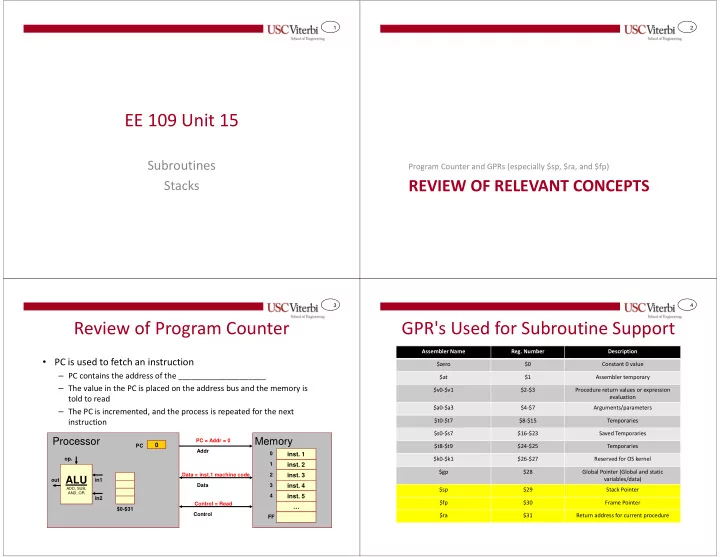
1 2 EE 109 Unit 15 Subroutines Program Counter and GPRs (especially $sp, $ra, and $fp) REVIEW OF RELEVANT CONCEPTS Stacks 3 4 Review of Program Counter GPR's Used for Subroutine Support Assembler Name Reg. Number Description PC is


slide-1
SLIDE 1

1

EE 109 Unit 15

Subroutines Stacks

2

REVIEW OF RELEVANT CONCEPTS

Program Counter and GPRs (especially $sp, $ra, and $fp)

3

Review of Program Counter

  • PC is used to fetch an instruction

– PC contains the address of the ____________________ – The value in the PC is placed on the address bus and the memory is told to read – The PC is incremented, and the process is repeated for the next instruction

Processor

Addr Data Control

Memory

  • inst. 2

1 2 3 4 FF

ALU

ADD, SUB, AND, OR

  • p.

in1 in2

  • ut

PC $0-$31

  • inst. 1
  • inst. 3
  • inst. 4
  • inst. 5

PC = Addr = 0 Data = inst.1 machine code Control = Read 4

GPR's Used for Subroutine Support

Assembler Name

  • Reg. Number

Description $zero $0 Constant 0 value $at $1 Assembler temporary $v0-$v1 $2-$3 Procedure return values or expression evaluation $a0-$a3 $4-$7 Arguments/parameters $t0-$t7 $8-$15 Temporaries $s0-$s7 $16-$23 Saved Temporaries $t8-$t9 $24-$25 Temporaries $k0-$k1 $26-$27 Reserved for OS kernel $gp $28 Global Pointer (Global and static variables/data) $sp $29 Stack Pointer $fp $30 Frame Pointer $ra $31 Return address for current procedure

slide-2
SLIDE 2

5

Subroutines (Functions)

  • Subroutines are portions of code that we can call

from anywhere in our code, execute that subroutine, and then ____________________________

void main() { ... x = 8; res = avg(x,4); ... } int avg(int a, int b){ return (a+b)/2; } C code: A subroutine to calculate the average

  • f 2 numbers

We call the subroutine to calculate the average and return to where we called it

6

Subroutines

  • Subroutines are similar to _____________

where we jump to a new location in the code

void main() { ... x = 8; res = avg(x,4); ... } int avg(int a, int b){ return (a+b)/2; } C code:

1

Call “avg” sub-routine will require us to branch to that code

7

Normal Branches vs. Subroutines

  • Difference between normal branches and

subroutines branches is that with subroutines we have to return to where we left off

  • We need to leave a ___________ to the return

location _____________ we jump to the subroutine…once in the function its _____________

void main() { ... x = 8; res = avg(x,4); ... } int avg(int a, int b){ return (a+b)/2; } C code:

1

Call “avg” sub-routine to calculate the average After subroutine completes, return to the statement in the main code where we left off

2

8

Implementing Subroutines

  • To implement subroutines in assembly we

need to be able to:

– ______________ to the subroutine code – _______________________ to when we finish the subroutine

... res = avg(x,4); ... int avg(int a, int b) { ... } C code: Assembly: .text ... jal AVG ... AVG: ... jr $ra

Call Definition

slide-3
SLIDE 3

9

Jumping to a Subroutine

  • JAL instruction (Jump And Link)

– Format: jal Address/Label – Similar to jump where we load an address into the PC [e.g. PC = addr]

  • Same limitations (26-bit address) as jump instruction
  • Addr is usually specified by a label
  • JALR instruction (Jump And Link Register)

– Format: jalr $rs – Jumps to address specified by $rs (so we can jump a full 32-bits)

  • In addition to jumping, JAL/JALR ______________

______________________________ to be used as a link to return to after the subroutine completes

10

Jumping to a Subroutine

Assembly: 0x400000 jal AVG 0x400004 add ... AVG: = 0x400810 add ... jr $ra

1

jal will cause the program to jump to the label AVG and store the return address in $ra/$31.

  • Use the JAL instruction to jump execution to

the subroutine and leave a link to the following instruction

0040 0000 PC before exec. of jal: 0000 0000 $ra before exec. of jal: PC after exec. of jal: $ra after exec. of jal:

11

0x400000 jal AVG 0x400004 add ... AVG: = 0x400810 add ... 0x4008ec jr $ra

Returning from a Subroutine

  • Use a JR with the $ra register to return to the

instruction after the JAL that called this subroutine

Go back to where we left

  • ff using the return

address stored by JAL

2 1

jal will cause the program to jump to the label AVG and store the return address in $ra/$31.

0040 08ec PC before exec. of jr: 0040 0004 $ra before exec. of jr: PC after exec. of jr:

12

Return Addresses

  • No single return address for a subroutine since AVG may be

called many times from many places in the code

  • JAL always stores the address of the instruction after it

(i.e. PC of ‘jal’ + 4)

Assembly: 0x400000 jal AVG 0x400004 add ... 0x400024 jal AVG 0x400028 sub ... 0x400810 AVG ... jr $ra 0x400004 is the return address for this JAL 0x400028 is the return address for this JAL

0040 0000 PC 0040 0024 PC

slide-4
SLIDE 4

13

Return Addresses

  • A further complication

is _______________ ________________

  • Example: Main routine

calls SUB1 which calls SUB2

  • Must store both return

addresses but _______ ___________________

Assembly: ... jal SUB1 0x40001A ... SUB1 jal SUB2 0x400208 jr $ra SUB2 ... jr $ra

1 2 3 4

14

Dealing with Return Addresses

  • Multiple return addresses

can be spilled to memory

– “Always” have enough memory

  • Note: Return addresses will

be accessed in _________ _______ as they are stored

– 0x400208 is the _________ RA to be stored but should be the _______ one used to return – A _________ is appropriate!

Assembly: ... jal SUB1 0x40001A ... SUB1 jal SUB2 0x400208 jr $ra SUB2 ... jr $ra

1 2 3 4

15

Stacks

  • Stack is a data structure where data is

accessed in reverse order as it is stored (a.k.a. LIFO = ________________)

  • Use a stack to store the return addresses

and other data

  • System stack defined as growing towards

_______________ addresses

– MARS starts stack at 0x7fffeffc – Normal MIPS starts stack at 0x80000000

  • Top of stack is accessed and maintained

using $sp=R[29] (stack pointer)

– $sp points at top _______________ location of the stack

0000 0000 0000 0000 0000 0000 0000 0000 7fffeffc $sp = 0040 0208 0000 0000

Stack Pointer Always points to top occupied element of the stack

0x7fffeffc is the base of the system stack for the MARS simulator 7fffeffc 7fffeff8 7fffeff4 7fffeff0 7fffefec 7fffefe8

Stack grows towards _______ addresses

16

Stacks

  • 2 Operations on stack

– _______: Put new data on top

  • f stack
  • Decrement $sp
  • Write value to where $sp points

– _______: Retrieves and “removes” data from top of stack

  • Read value from where $sp

points

  • Increment $sp to effectively

“delete” top value

Push will add a value to the top of the stack Pop will remove the top value from the stack Empty stack Push 0000 0000 7fffeffc $sp = 0000 0000 0000 0000 7fffeffc 7fffeff8 7fffeff4 $sp = 0000 0000 7fffeffc 7fffeff8 7fffeff4 Pop $sp = 7fffeffc 7fffeff8 7fffeff4 0000 0000

slide-5
SLIDE 5

17

Push Operation

  • Recall we assume $sp points

at top occupied location

  • Push: Put new data on top of

stack

– Decrement SP

  • ____________________
  • Always decrement by 4 since

addresses are always stored as words (32-bits)

– Write return address ($ra) to where SP points

  • _____________________

Push return address (e.g. 0x00400208)

Decrement SP by 4 (since pushing a word), then write value to where $sp is now pointing 7fffeffc $sp = 0000 0000 7fffeffc 7fffeff8 7fffeff4 $sp = 7fffeff8

18

Pop Operation

Pop return address

0000 0000 7fffeff8 $sp = 0040 0208 0000 0000 7fffeffc 7fffeff8 7fffeff4 7fffeffc

  • Pop: Retrieves and

"removes" data from top

  • f stack

– Read value from where SP points

  • ____________________

– Increment SP to effectively "deletes" top value

  • ___________________
  • Always increment by 4 when

popping addresses

Read value that SP points at then increment SP (this effectively deletes the value because the next push will overwrite it) Warning: Because the stack grows towards lower addresses, when you push something

  • n the stack you subtract 4 from the SP and

when you pop, you add 4 to the SP.

19

Subroutines and the Stack

  • When writing native assembly, programmer must add code to

manage return addresses and the stack

  • At the beginning of a routine (PREAMBLE)

– Push $ra (produced by 'jal') onto the stack addi _____________ sw _____________

  • Execute subroutine which can now freely call other routines
  • At the end of a routine (POSTAMBLE)

– Pop/restore $ra from the stack lw _____________ addi ______________ jr $ra

20

Subroutines and the Stack

... jal SUB1 0x40001A ... SUB1 addi $sp,$sp,-4 sw $ra,0($sp) jal SUB2 0x400208 lw $ra,0($sp) addi $sp,$sp,4 jr $ra SUB2 addi $sp,$sp,-4 sw $ra,0($sp) ... lw $ra,0($sp) addi $sp,$sp,4 jr $ra

$sp = 0000 0000 7fffeffc 7fffeff8 7fffeff4 $sp = 0000 0000 7fffeffc 7fffeff8 7fffeff4 $sp = 0000 0000 7fffeffc 7fffeff8 7fffeff4

1 1 2 3 2 3

$ra = $ra = $ra = 0000 0000 7fffeffc $sp = 0000 0000 0000 0000 7fffeffc 7fffeff8 7fffeff4 $ra =

slide-6
SLIDE 6

21

Optimizations for Subroutines

  • Definition:

– Leaf procedure: A procedure that ____________ _______________________________________

  • Optimization

– A leaf procedure need not save $ra onto the stack since it will not call another routine (and thus not

  • verwrite $ra)

22

Leaf Subroutine

... jal SUB1 0x40001A ... SUB1 addi $sp,$sp,-4 sw $ra,0($sp) jal SUB2 0x400208 lw $ra,0($sp) addi $sp,$sp,4 jr $ra // Leaf Procedure SUB2 ... jr $ra

0000 0000 7fffeff8 $sp = 0040 001a 0000 0000 7fffeffc 7fffeff8 7fffeff4 0000 0000 7fffeffc $sp = 0040 001a 0000 0000 7fffeffc 7fffeff8 7fffeff4

1 1 2 3 3

0040001a $ra = 0040001a $ra = 0000 0000 7fffeffc $sp = 0000 0000 0000 0000 7fffeffc 7fffeff8 7fffeff4 0040001a $ra = 0000 0000 7fffeff8 $sp = 0040 001a 0000 0000 7fffeffc 7fffeff8 7fffeff4

2

00400208 $ra =

23

Arguments and Return Values

  • Most subroutine calls pass

arguments/parameters to the routine and the routine produces return values

  • To implement this, there must be

locations agreed upon by caller and callee for where this information will be found

  • MIPS convention is to use certain

registers for this task

– ______________________ used to pass up to 4 arguments – _______________________ used to return up to a 64-bit value

void main() { int arg1, arg2; ans = avg(arg1, arg2); } int avg(int a, int b) { int temp=1; // local var’s return a+b >> temp; }

24

Arguments and Return Values

  • Up to 4 arguments can

be passed in $a0-$a3

– If more arguments, use the stack

  • Return value (usually

HLL’s) limit you to one return value in $v0

– For a 64-bit return value, use $v1 as well

... MAIN: li $a0, 5 li $a1, 9 jal AVG sw $v0, ($s0) ... lw $a0, 0($s0) li $a1, 0($s1) jal AVG sw $v0, ($s0) ... AVG: li $t0, 1 add $v0,$a0,$a1 srav $v0,$v0,$t0 jr $ra