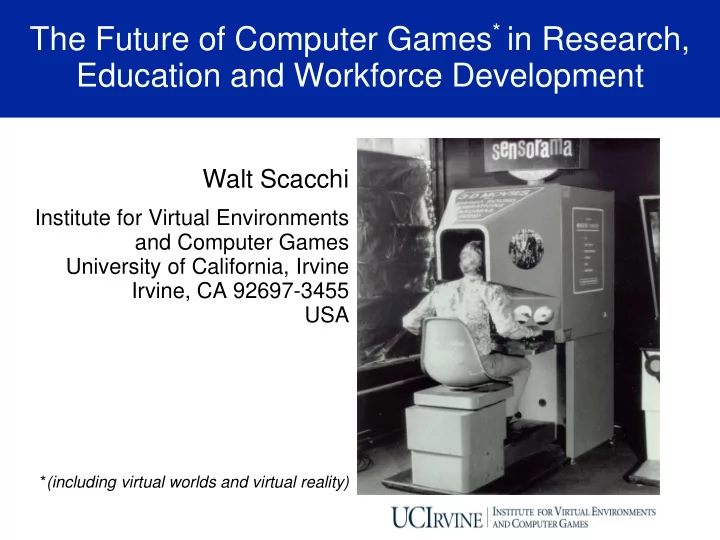
SLIDE 1 The Future of Computer Games* in Research, Education and Workforce Development
Walt Scacchi
Institute for Virtual Environments and Computer Games University of California, Irvine Irvine, CA 92697-3455 USA
*(including virtual worlds and virtual reality)
SLIDE 2 Overview
The Future of Computer Games and Virtual
Worlds—beyond entertainment.
Informal STEM and Arts education Adult training in advanced manufacturing Advanced medical care Commercialization of Space Opportunities for action
SLIDE 3
Future of Research in Computer Games and Virtual Worlds: NSF Workshop Report
SLIDE 4
Modeling and Simulating the design of a Personal Rapid Transit system for Uppsala, Sweden
SLIDE 5 Large Group Virtual Research Conference
Image credit: C. Lopes/Diva Canto
SLIDE 6
DinoQuest Online: Game-Based Virtual World for Informal Life Science Education
SLIDE 7
Informal Classical Music Learning Game Environment: SFSKids.org
SLIDE 8
FabLab: Semiconductor fabrication operations and diagnostics training game world
SLIDE 9
Game-based production system for material transfer processes
SLIDE 10
Opportunity: create a game for decentralized virtual manufacturing system
SLIDE 11
Opportunity: Smart Workers and Augmented Work (with UCI Calit2)
SLIDE 12
Game-based simulator interfaces for immersive medical education: low-cost vs realism?
$500 vs. $5000 vs. $50,000 vs. $500,000 vs. $5,000,000
Virtual human in Surgeon Simulator 2014 (iPad/PC game)
SLIDE 13
Commercial, virtual medical clinic simulator
SLIDE 14
Commercial, high fidelity virtual anatomical training systems
SLIDE 15
Opportunity: develop reusable framework for developing interactive “science missions” for government, industry and public. Sample project: Asteroid Redirection Mission (NASA and Kerbal Space Program) for resource harvesting.
SLIDE 16
Planetary science data visualization and “spherecasting” support: NOAA Science on a Sphere installation in Opensim VW platform Supporting virtual planetary exploration and near-earth objects (space debris, small satellites, near-earth asteroids)
SLIDE 17
Mission Control Room: Vision for Discovery Science Center
SLIDE 18
Advanced training center concept using low-cost game- based virtual world technology
SLIDE 19 Opportunities for Action
Provide seed funds for meetings and stimulate
partnerships between academia, emerging industries, large enterprises, and government agencies.
Provide challenge grants and open competition events
that seek to demonstrate new socio-technical and educational capabilities through computer games and virtual reality.
California's economy and workforce have global
competitors, yet we can further our lead through computer game technology and culture!
SLIDE 20
Research Collaborators
Faculty – Robert Nideffer (RPI), Thomas Alspaugh, Jill Berg, Yunan Chen, Steve
Cramer, Garnet Hertz (Emily Carr U), Alfred Kobsa, Jung-Ah Lee, Crista Lopes, Gloria Mark, Bonnie Nardi, David Redmiles, Richard Taylor, and many others
Research Staff – Craig Brown (NomNom Games), Yuzo Kanomata (IGB), Kari Nies (ISR),
Alex Szeto (American Honda, ISR), and others Students – UCI Video Game Developers Club
SLIDE 21
Acknowledgements
– National Science Foundation, grants #0808783, #1041918, #1256593 – Discovery Science Center, Naval Postgraduate School (Center for Edge Power), Intel, Northrop-Grumman, San Francisco Symphony, UCI (School of Medicine) Anatomy & Neurobiology, (School of Biological Sciences) Neurobiology and Behavior. – Digital Industry Promotion (DIP) Agency, Daegu, South Korea – UCI Video Game Developers Club No review, approval, or endorsement implied.
SLIDE 22 Additional Information and Resources
The Future of Research in Computer Games and Virtual Worlds: NSF Workshop Report, (August 2012).
Collaborative Game Environments for Informal Science Education: DinoQuest and DinoQuest Online, (with R. Nideffer and J. Adams), IEEE Conf. Collaboration Technology and Systems, (CTS 2008), Irvine, CA 229-236, May 2008.
Game-Based Virtual Worlds as Decentralized Virtual Activity Systems, in W.S. Bainbridge (Ed.), Online Worlds: Convergence of the Real and the Virtual, Springer, New York, 225-236, 2010.
Exploring the Potential of Virtual Worlds for Decentralized Command and Control, (with C. Brown and K. Nies), 17th. Intern. Command and Control Research and Technology Symposium (ICCRTS), Paper-096, Fairfax, VA, June 2012.
VirtualWorldSociety.org (Something New!)