
SLIDE 1
THE STORY OF DAYALBAGH EDUCATIONAL INSTITUTE
Inter ernati national
- nal Dialo
Edu ducati cating ng the e Mind, d, Body dy an and d Heart - - PowerPoint PPT Presentation
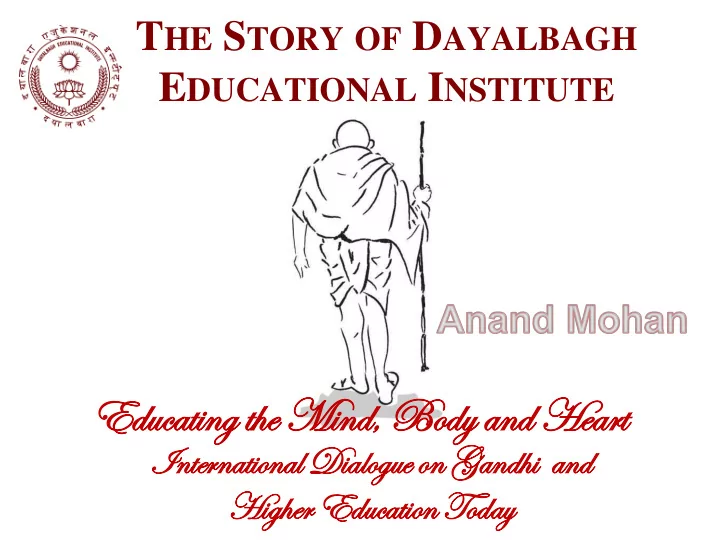
T HE S TORY OF D AYALBAGH E DUCATIONAL I NSTITUTE Edu ducati cating ng the e Mind, d, Body dy an and d Heart art Inter ernati national onal Dialo alogue gue on Gan andh dhi i an and d High gher er Edu duca catio ion n
to nation and community by empowering weaker sections and women
innovation anchored in the principle of achieving more with less.
“A Novel, Multidisciplinary, Value-based, comprehensive education program that aims to bring about Physical, Intellectual, Emotional and Ethical Integration of an individual with a view to evolving a Complete Person who possesses the basic values of Humanism, Secularism, and Democracy and who is capable of giving fuller response to social and environmental changes.”
As His Holiness Mehtaji Maharaj the Sixth Revered Leader of the faith has pointed out, “Neither does wealth flow here, nor does anybody starve here; neither are there big palaces and mansions, nor are there any dilapidated huts here; neither is anyone great or big here, nor anyone small or insignificant; and if anybody here is honoured more than
Dayalbagh belongs to every resident, while no resident has any kind of property in anything here ... This small place, where there is almost no illiterate person and where nobody leads a life of laziness and indolence, is neither a village nor a town and both a village and town.”
DEI Education Policy Sigma Six Q-V Systems Approach Scientific Study of Consciousness and Ultimate Reality Better Worldliness
Societal Contribution leading to National Development
The term Sigma Six Q-V is the enhanced, nonlinear
Moral and Spiritual Values lie at the core of these six qualities.
Mirror image of thoughts and ideas of the Father of Nation can be seen at Dayalbagh
Stri Scientific Methodology, General Knowledge & Current Affairs Cultural & Literary Activities Games & Sports Social Service Cultural Education Agricultural Operations
Rural Development Comparative Study of Religion
DEI - Innovative Education Policy
Compulsory Core Courses: students’ involvement ► Cultural Education: To inculcate a sense of pride in the national ethos and our cultural
heritage, values and traditions. ► General Knowledge and Current Affairs: To nurture a scientific temper and enhance awareness of contemporary developments in the fast changing world of technological advancements. ► Rural Development: To foster a greater understanding and appreciation of rural life and societal needs. ► Agricultural operations: To create an awareness of agricultural processes so that students from purely urban backgrounds are exposed to rural realities. ► Social Service: To inculcate a spirit of brotherhood of man and to engender societal commitment, discipline, ability for hard work, selfless service to society, humility, co-
► Cultural & Literary activities and Games and Sports: To direct the energy of every student into useful channels and develop a high level of self-reliance, self-confidence, maturity and leadership qualities and nurture the spirit of team work. ► Comparative Study of religion: To ingrain an attitude of religious tolerance, humanism and secularism in a world of discord, fear and suspicion.
Labs on Land From Core Courses to Agri-Entrepeneurship Green House and Multi-Climatic Zones Food Security Herbal Medicine
Tree plantation, rich floral bio-diversity, reuse and safe disposal of garbage, curbing plastic use, organic farming and reclamation of waste land, and care about conservation are drivers to attain main goals for sustainable eco-
reducing pollution leaving no carbon footprints. It all starts with the community participation. Dayalbagh offers an excellent example of sustainable development of nature, man and society.
Essen entiall ially, y, all l life e depends on soil……they have e evolved lved togeth ether er
Treated Water is used for irrigation in agricultural fields to the extent of our need, rest is available for others. This sets an example of avoiding exploitation of ground water and thus maintaining of water table. A new systems approach to sustainable development with share and care is desirable.
PONDING OF STP WATER/DRAIN WATER/RAIN WATER:- 9 SITES TO STORE STP/ DRAIN/ RAIN WATERS WERE IDENTIFIED, OUT OF WHICH 3 PONDS HAD BEEN BUILT AND ARE
SERVING TO IRRIGATE CROPS AS WELL AS CONTRIBUTE TO THE RECHARGING OF THE AQUIFERS.
Solar and renewable energy Rural Economic Zone to international markets Innovation and creativity as key performance parameters Community- driven development and participation Women empowerment
Reaching out to the last, the least, the lowest and the lost
National Social Service Village adoption Frugal solutions: development and sharing , nationally & internationally Walk-in medical camps 430±1 project centres :access to the last mile
Multi-Specialty Medical Camps The NSS Unit of Dayalbagh Educational Institute in collaboration with Dayalbagh Saran Ashram Hospital regularly organizes free Multi-specialty Medical Camp on every Sunday from 7:00 am to 10:00 am for the people living in the villages in the vicinity of Dayalbagh. Allopathic, Homeopathic and Ayurvedic treatments are available in this medical
On an average about 450 patients are rendered treatment on every
Hole in the Wall Experiment
In the Medical Camp DEI NSS volunteers regularly conduct ‘Hole in the Wall Experiment’ which attracts a number of children from the adopted villages. The main objective of “Hole in the Wall Experiment” is to quickly promote computer literacy among the masses/economically backward children and bring them at par with the other affluent children who have access to all the facilities. This provides them a great opportunity to become conversant in basic Information and Communication Technology (ICT) skills. Hole-in- the-Wall Experiment emphasizes peer learning. Approximately 70 to 80 children participate in this program in every Camp.
To attain sustainable developmental activities in agreement with the concept of Eco-Village, Dayalbagh Educational Institute has taken initiatives in harnessing the renewable energy through Solar thermal and Solar Photovoltaic (SPV) power plants. The institute has Solar Thermal Cooking systems in all the hostels. The whole university campus is powered by 7 Distributed Roof-Top Solar PV power Plants aggregating to a total of 1000 kW. On a clear day, the entire university campus is completely powered by solar power plants.
Experimental studies
and consciousness are facilitated by the SQUID (Super- conducting Quantum Interference Device) MEG facility in the DEI Centre for Consciousness Studies.
The Superman (Sant-Su) Evolutionary scheme is an experiment in early childhood education and consciousness.
Gandhi believed in an education system that brought the best out of a person's body, mind and spirit.
QUALITATIVE OUTPUTS
Better Worldliness Homo Sapiens to Homo Spiritualis Generative sustainability with zero inflation
Vision of Mahatma Gandhi about making India self- sustained and developed as a value-based community is implemented at Dayalbagh in real terms.
Mahatma Gandhi visited Dayalbagh on 18 September 1929. He greatly admired the way residents of Dayalbagh lead their daily life which was simple, full of devotion and enthusiasm. He appreciated organized layout of the colony, cleanliness, Gaushala and co-ed pattern of education. Swadeshi Movement of Mahatma Gandhi was truly realized at Dayalbagh. Dayalbagh has been a pioneer and pacesetter in many important fields. Significance of small-scale industries to remove unemployment and to increase the per capita income of our country were given due importance since the established of the colony. Dayalbagh started model industries and Dairy, purely swadeshi Industries, as early as 1917 with the same objectives.