Ed Ellis THE SKY IS FALLING! (NO, REALLY, IT IS) The national rail - - PowerPoint PPT Presentation

ed ellis the sky is falling no really it is
SMART_READER_LITE
LIVE PREVIEW

Ed Ellis THE SKY IS FALLING! (NO, REALLY, IT IS) The national rail - - PowerPoint PPT Presentation

RESTRICTING SIGNALS AHEAD Ed Ellis THE SKY IS FALLING! (NO, REALLY, IT IS) The national rail network is in serious danger Railroad management has been lulled to sleep by the need to move energy Truckers are eating our lunch


slide-1
SLIDE 1

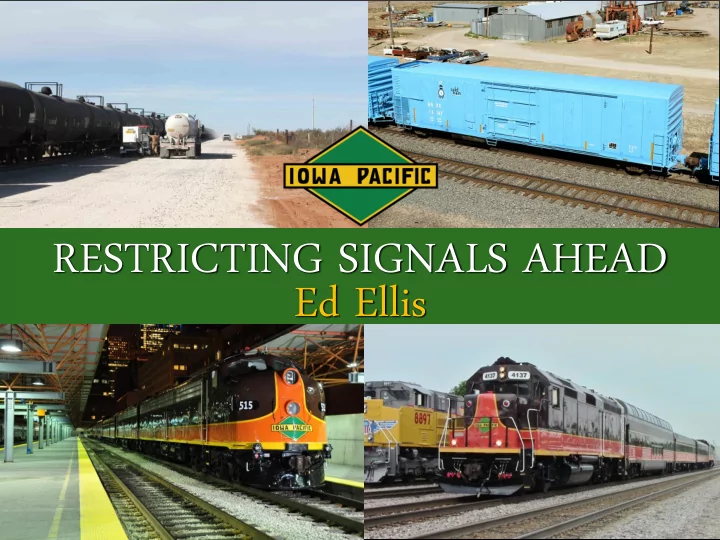
RESTRICTING SIGNALS AHEAD Ed Ellis

slide-2
SLIDE 2
slide-3
SLIDE 3

THE SKY IS FALLING! (NO, REALLY, IT IS…)

  • The national rail network is in serious danger
  • Railroad management has been lulled to sleep by the need to move energy
  • Truckers are eating our lunch
  • The idiots running the government for the past twenty years have made it

worse, and are about to really muck it up.

  • Unless the leadership in the railroads and the government embrace

radical change, parts of the rail network will soon become as unmaintainable as our highway system.

slide-4
SLIDE 4

THE NATIONAL NETWORK IS IN SERIOUS DANGER

  • The railroads spent $25 billion in capital last year, and only grossed $65

billion in revenue, most did not earn their cost of capital. And capital needs are going up:

  • New, more expensive locos to meet regulatory requirements
  • PTC cost overruns
  • Need for customers to rebuild entire crude oil fleet
  • Grave threat to fundamental traffic base
  • Almost half rail tonnage is energy-related
  • Intermodal has taken all the long-haul, high-volume market share available,

can’t grow much more as currently structured

  • So our response is to buy back shares with scarce cash…
slide-5
SLIDE 5
  • “Coal powered the railroads, whose

killer app was moving coal.” – Bruce Sterling, “Ten Technologies that deserve to die.”

  • Much of the network exists to

support coal, without coal the network withers

  • A great deal of throw-weight is

aligned against coal and will be for some time

  • Oil will not replace coal, except

maybe in the short run

  • Coal was 41% of rail tonnage and

21.6% of revenue in 2012

  • What if steam coal goes away

entirely?

RAILROAD MANAGEMENT HAS BEEN LULLED TO SLEEP BY THE NEED TO MOVE ENERGY

slide-6
SLIDE 6

TRUCKERS ARE EATING OUR LUNCH

  • Truck and rail move about the same ton-miles each year
  • Truck revenue = $200 billion
  • Rail revenue = $65 billion
  • Shipment growth is oriented to trucks, not railroads
  • Shorter hauls
  • Smaller quantities
  • Just-in-time
  • Not located on rail
  • Not in intermodal lanes
  • Railroads lose, big time….
  • And what will the driverless truck do to this mix?
slide-7
SLIDE 7
  • "Reader, suppose you were an idiot. And

suppose you were a member of Congress. But I repeat myself." –Mark Twain

  • Positive Train Control, which will not be

ready in 2015, cost overruns

  • Re-regulation, which can destroy capital

investment

  • High-Speed Rail handouts resulting in

studies, but no trains

  • Infrastructure loans (RRIF) locked away

where no one can get them

  • No national rail plan
  • Still building highways that take business

away from private railroads

  • And the regulators insist on another

unproven safety system (electric brakes) for tank cars

I’M FROM THE GOVERNMENT AND I’M HERE TO HELP….

slide-8
SLIDE 8
  • 125th anniversary of the Golden Spike,

May 10, 1869 to May 10, 1993

  • Union Pacific operated a special

train/bus to a special ceremony

  • UP was represented by Drew Lewis
  • SP (Central Pacific) was represented

by Phil Anschutz

  • The President of the Mormon Church

who gave the invocation prayed, “God grant us men of vision like those who built this railroad, and not like those who run the railroads today.”

  • Where is the leadership that can face

the rail industry issues of today?

1993 – PROMONTORY SUMMIT

slide-9
SLIDE 9

HOW DID IT GET THIS WAY?

  • A History Lesson….
  • What did the railroads haul “back in the day” meaning the mid-19th century
  • 1. Passengers
  • 2. Logs
  • 3. Cattle
  • 4. Less-than-carload
  • 5. Stuff that wasn’t going very far (less than 100 miles)
  • Railroads would be long gone if that’s all they ever did
  • In order to survive and grow, the railroads had to change with the times, and had

to change their minds about how to do business

slide-10
SLIDE 10

FIVE THINGS THE RAILROADS NEED TO DO

  • 1. Learn how to make money on shorter and really short hauls
  • 2. Develop the carload network, including low-volume branches, profitably
  • 3. Figure out how to make money running passenger trains
  • 4. Develop ways to capture the food transportation market (fresh and processed)
  • 5. Develop an intermodal model that broadens the rail-based portion of the

network

  • These are all things the railroads will need to do to survive as a national

network, without nationalization

  • How will these and other changes come about?
slide-11
SLIDE 11

Questions?

THANK YOU