
SLIDE 1
Trust Board Sandwell and West Birmingham Hospitals Trust February 2020
ED clinical service presentation
1
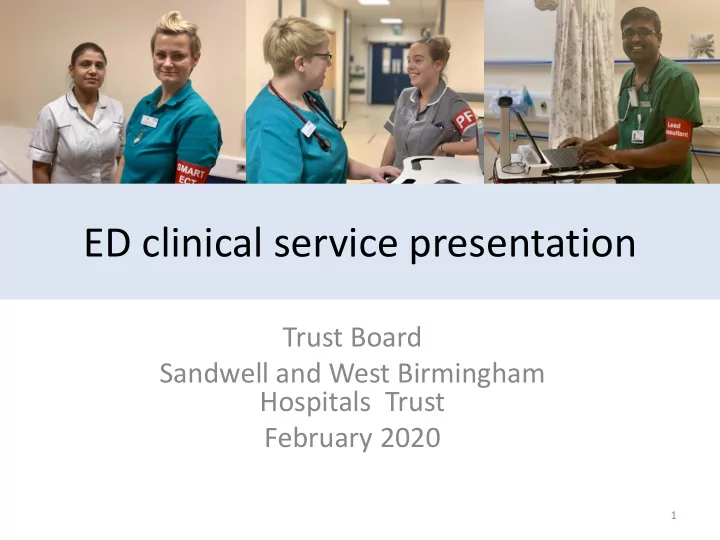
ED clinical service presentation Trust Board Sandwell and West - - PowerPoint PPT Presentation
ED clinical service presentation Trust Board Sandwell and West Birmingham Hospitals Trust February 2020 1 Contents 1. Our Workforce plan 2. Our Improvement plan activities and forecast impact 3. Our CQC plan 4. Risks and incident themes
1
2
Our ED 4 hour performance has grossly deteriorated following introduction of our Unity EPR. November out turned at 71.18%. December we achieved 72.3% and saw an increase of 8% of attendances compared to December 2018. Our aim was to get back to the 81% pre Unity
We currently rank in the bottom quartile nationally. Regional performance wc 16th January was circa 80%. January to date we have delivered 72.97% against the 4 hour target.
3
UNITY GO LIVE
Medical workforce plan - Our workforce plan is based on a fully recruited workforce before Midland Met with enhanced senior decision making. We have recruited a new speciality and site leadership team and have a successful internal registrar training programme which the Trust Board invested in 2 years ago.
4
Grade Site Establishment In post No of vacancies Consultant Cross site 18 16.5 1.5 Total MG Sandwell 18 17 1 Total MG City 18.5 16.5 2 Total SHO Sandwell 16 14.5 1.5 Total SHO City 20 17.5 2.5
10 consultants have been hired in the last 18 months. Consultant interviews will take place in March 2020 with the aim to fully recruit and account for the anticipated retirement profile. Middle grade recruitment is strong with < 10% vacancy rate. By June most of our registrars will have 6 months plus experience with us which should see a positive impact on performance, through better consistency in senior decision making and strengthening clinical leadership, particularly out of hours. The CESR programme currently has 22 Registrars progressing through the programme with 2 completing by August 2020. We have successfully recruited 1 of our CESR Doctors into a Consultant post with more anticipated.
Nursing workforce plans include new roles such as emergency care technicians, phlebotomists and flow coordinators to complement the qualified staff, releasing time to care by covering administration duties and capacity to achieve early diagnostics.
5
We have tried out the following roles and will look to substantiate these in budget setting: 1. Streaming nurse –Experienced nurse to signpost a patient to the right stream for the patient to be seen. This can be to ambulatory services or GP Malling. 2. Phlebotomist in SMART/RAM – This allows for phlebotomy investigations to be completed in the first hour of arrival to enable results to be received and decisions being made within 2hrs of our patients journey. 3. Twilight Paediatric nurse – This allows us to extend our paediatric service until 2am, 3 times a week, to enable our paediatric attenders to be seen in a separate area of Main ED’s – this enables a better experience for our patients and also reduced overcrowding in our adult majors area. 4. Twilight ENP in minors– This enables our ENP service to be extended until 2am, 3 times a week which reduces times to be seen in minors- especially OOH. 5. ECT in minors – We have introduced a band 3 Emergency Care Technician into our minor’s stream 24/7. The ECT carries out wound care, application of plaster of paris and
6. Ambulatory Majors Band 5 nurse – This is a new initiative whereby we have created a seated area within majors. This allows for increased flow through our cubicles and reduction in corridor nursing.
By April we will have 21.8 vacancies ( 12.7% vacancy rate). Half of those vacancies are band 6 – we aim to fully recruit this year.
Triage within 30 minutes wit batch
Pt seen within 1 hour
Plan to admit or discharge within 2 hours
transport
Discharge or admit by 4 hours
and twilight
Bold = Ben Owens recommendations
ED improvement focus is in on early diagnostics and timely decision making.
6
Streaming patients to our on site GP provider lessens the primary care load on the ED. There has been a 16% increase in Streaming patients to Malling GPs across both ED’s from December following a change in contract terms and emphasis on streaming.
7
1431 1334 1338 1424 1216 1267 1353 1632 1773 1613 1535 1371 1548 1552 1583 1812
MAY JUNE JULY AUGUST SEPTEMBER OCTOBER NOVEMBER DECEMBER
There is ongoing clinical pathway work, and training development with our nursing workforce to strengthen the streaming role. There is also an opportunity to increase the number of patients being streamed to Malling between 08.00-10.00, as well as utilising external pre booked GP appointment slots that are available if Malling is full to capacity in the evenings.
Optimisation of streaming and minors in February can prevent a further 5 breaches a day
Time to triage improvement impact shows improvement on both sites and is back to pre Unity baseline.
8 Sandwell City
0.0% 20.0% 40.0% 60.0% 80.0% 100.0% 2019-10-21 2019-10-23 2019-10-25 2019-10-27 2019-10-29 2019-10-31 2019-11-02 2019-11-04 2019-11-06 2019-11-08 2019-11-10 2019-11-12 2019-11-14 2019-11-16 2019-11-18 2019-11-20 2019-11-22 2019-11-24 2019-11-26 2019-11-28 2019-11-30 2019-12-02 2019-12-04 2019-12-06 2019-12-08 2019-12-10 2019-12-12 2019-12-14 2019-12-16 2019-12-18 2019-12-20 2019-12-22 2019-12-24 2019-12-26 2019-12-28 2019-12-30 2020-01-01 2020-01-03 2020-01-05
Patients without Initial Assessment within 30 Minutes (Daily Trend)
% Ave. LCL UCL 0.0% 20.0% 40.0% 60.0% 80.0% 100.0% 2019-10-21 2019-10-23 2019-10-25 2019-10-27 2019-10-29 2019-10-31 2019-11-02 2019-11-04 2019-11-06 2019-11-08 2019-11-10 2019-11-12 2019-11-14 2019-11-16 2019-11-18 2019-11-20 2019-11-22 2019-11-24 2019-11-26 2019-11-28 2019-11-30 2019-12-02 2019-12-04 2019-12-06 2019-12-08 2019-12-10 2019-12-12 2019-12-14 2019-12-16 2019-12-18 2019-12-20 2019-12-22 2019-12-24 2019-12-26 2019-12-28 2019-12-30 2020-01-01 2020-01-03 2020-01-05
Patients without Initial Assessment within 30 Minutes (Daily Trend)
% Ave. LCL UCL
Further improvement in time to triage and time to be seen by a senior decision maker will be achieved through reaching 90% diagnostics < 1 hour and consistent practice of senior decision makers in SMART and RAM.
9 City Bloods < 1hour CT <1 hour X-Ray < 1 hour SMART/RAM 43% 26% 47% SGH Bloods < 1hour CT < 1 hour X-Ray < 1 hour SMART/RAM 85% 62% 78%
launch of SMART principles.
evidence earlier decision making – consistency in practice will be achieved as staff graduate LOS above 6 months and rotas extend the hours until 10pm.
with a focus on triage and lean improvements in diagnostic activities. The leadership team are focussed on supervision and coaching staff though the variability between sites and embedding / extending a consultant time in RAM remains an opportunity to improve results even further. Optimisation of 90% diagnostics < 1 hour and RAM/SMART benefits in February can prevent a further 21 breaches a day
Time to assessment improvement impact has been stubborn in terms of change. Late December and January shows a positive movement but continuing variability. Earlier diagnostics affords the opportunity to make earlier decisions. Emphasis on DTA in 2 hours and managing deviation from defined clinical standards is a key competency that must be demonstrated.
10
0.0% 20.0% 40.0% 60.0% 80.0% 100.0% 2019-11-04 2019-11-06 2019-11-08 2019-11-10 2019-11-12 2019-11-14 2019-11-16 2019-11-18 2019-11-20 2019-11-22 2019-11-24 2019-11-26 2019-11-28 2019-11-30 2019-12-02 2019-12-04 2019-12-06 2019-12-08 2019-12-10 2019-12-12 2019-12-14 2019-12-16 2019-12-18 2019-12-20 2019-12-22 2019-12-24 2019-12-26 2019-12-28 2019-12-30 2020-01-01 2020-01-03 2020-01-05 2020-01-07 2020-01-09 2020-01-11 2020-01-13 2020-01-15 2020-01-17 2020-01-19
Patients not seen within 60 Minutes (Daily Trend)
% Ave. LCL UCL 0.0% 20.0% 40.0% 60.0% 80.0% 100.0% 2019-11-04 2019-11-06 2019-11-08 2019-11-10 2019-11-12 2019-11-14 2019-11-16 2019-11-18 2019-11-20 2019-11-22 2019-11-24 2019-11-26 2019-11-28 2019-11-30 2019-12-02 2019-12-04 2019-12-06 2019-12-08 2019-12-10 2019-12-12 2019-12-14 2019-12-16 2019-12-18 2019-12-20 2019-12-22 2019-12-24 2019-12-26 2019-12-28 2019-12-30 2020-01-01 2020-01-03 2020-01-05 2020-01-07 2020-01-09 2020-01-11 2020-01-13 2020-01-15 2020-01-17 2020-01-19
Patients not seen within 60 Minutes (Daily Trend)
% Ave. LCL UCL
Increasing space to make decisions in ambulatory majors can prevent a further 10 breaches a day
We aim to achieve over 80% performance by end of February.
11
Improvement Time W/C 3/2 W/C 10/2 W/C17/2 W/C 24/2 W/C 2/3 Impact per day Cumulative Cumulative breach reduction 23 a day 43 a day 56 a day Weekly performance forecast 73% 74% 76.5% 80% 83% Utilising GP Slots / focus on OOH
Reception staff to have access to booking slots. Launch communication to clinical teams with focus
triage/streaming. Review conditions presenting OOH to assess
Begin seeing breach reductions
3/day Reduce minors breaches
Trial ENP twilight hours on Mon/Fri and Sat until 2am. Review location for Minors at SGH. Begin seeing breach reductions
2/day Improving time to DTA by 2 hours
SDM in RAM and SMART re-launch at City. SGH consistent use
diagnostics within 1 hour Increase SDM in RAM by 2 hours on each
9/day Improve Decision to discharge by 2 hours
SDM in RAM and SMART re-launch at City. SGH consistent use
diagnostics within 1 hour Increase SDM in RAM by 2 hours on each
8/day at City 4/day at SGH Patients seen within 1 hour
City majors ambulatory area to be completed and functioning. Focus
Ambulatory room at SGH - To free cubicle capacity to allow for throughput of patients in main dept. Focus week on SMART principles at City. Begin seeing breach reductions
10/day Reducing number of admitted breaches
Ward accreditation - Elderly Care Launch of ward accreditation. Partial breach reduction 4/day Further breach reductions as ward accreditation and discharges improve. Improve by reducing 3 breaches per day Further breach reductions as ward accreditation and discharges improve. Improve by reducing 7 breaches per day
7/day at City 3/day at SGH Streaming to AMAA
Scheduling OOH booking slots. Partial breach reduction 4/day Ambulatory Pathways
reducing 4 breaches per day Ambulatory Pathways
reducing 6 breaches per day
10/day
CQC plan 1 - Progress Against Amber and Red Actions include the new paediatric combined ED and assessment facility being built at City. Firstnet implementation was a challenge but has also brought benefits including visibility of results, an accurate timeline with speciality input and has inspired emerging leaders to develop care standardisation.
12
In urgent and emergency care at Sandwell General Hospital:
1.
The trust must ensure that the premises are suitable for the purpose for which they are being used, including in the treatment
R
1.
The trust must ensure there is sufficient numbers of suitably qualified, competent, skilled and experienced persons deployed in
patients 24 hours a day.
A SD2 The trust should review how staff
competencies are delivered and assessed across the department.
A SD3 The trust should review its current
measures for improving compliance against national targets, for example the four hour target to see and discharge, admit
they are fit for purpose.
R SD4 The trust should ensure that any
IT systems in use across the
and allow staff to undertake their roles without jeopardising or delaying
G
CQC plan 2 - Progress Against Amber and Red Actions – mandatory training is 88.5% for all modules and PDRs are 78%. Trajectories are in place to achieve compliance in Q4.
13
In urgent and emergency care at City Hospital:
1.
The trust must ensure that staff are up
to date with all mandatory training.
A
1.
The trust must ensure that sufficient
numbers of substantive staff are on each shift to ensure patients and staff are kept safe.
per site for Middle Grades, 2.5WTE vacancy for SHOs. Focus has been on embedding new teams. Forecast green in Q1.
A SD5
The trust should ensure all staff are up to date with their yearly appraisal.
Forecast green in Q1.
A SD6
The trust should improve recording within patient records including documentation around completing safeguarding and mental capacity pro- forma and improve staff understanding around mental capacity assessments.
which enable ease of assessment of those patients that have a cognitive impairment and enables us to follow best interests process. Forecast green in Q1.
A
Risk Themes
Risk Actions to mitigate
Violence and aggression in ED Risk score: 16 Mitigation: 12
1. SGH Ambulance entrance Key Pad to secure entrance 2. Lock down policy in draft 3. Security group formed with COO to explore body cam usage 4. Emergency alarms in place where panic buttons aren’t 5. Security team mental health trained 6. Review zero tolerance policy
ED Overcrowding and corridor nursing Risk score: 16 Mitigation: 12
1. Refer to ED Improvement Plan 2. Trust escalation process to capacity and initiation of a Trust wide response from all specialities. 3. ED Action cards implemented 4. SMART in RAM implemented
ED nurse staffing with projected leavers. Risk score: 12 Mitigation: 12
1. Rolling Band 5 recruitment 2. Recruitment days for ED 3. National recruitment days 4. Active recruitment 5. Weekly Workforce meetings with projection of new starters medical and nursing 6. Frequent staffing reviews undertaken 7. paper produced of additional roles being covered where there is no established budget e.g. streaming nurse, minors ECT to become substantive to recruit
Reconfiguration of respiratory services from SGH to City and Paediatric reconfiguration Risk score: 12 Mitigation: 9
14
Audit programme and results have improved patient care by changes being implemented in nurse prescribing analgesia for children and adults in pain, achieving early pain treatment. To improve sepsis response times, a bleep holding registrar is dedicated to responding quickly to sepsis alerts.
15
Topic area Clinical Lead
RCEM: Mental Health Dr Rachakatla (City) Dr Elangham (Sandwell)) RCEM: Assessing Cognitive Impairment in Older People Dr Sadhunavar Dr Singh Gill RCEM: Care of Children in the ED Lorna Bagshaw Use of interpreters for both acute and mental health patients. Helen Mallard Compliance with head injury protocol incorporating intoxicated patients Dr Asif Naveed Timeliness of medical assessment of mental health presenting patients Dr Naveen Rachakatla Feverish and febrile illness in children Dr Bagshaw Pain assessment and appropriate prescription and timely administration of medication for children Dr Bagshaw Compliance with metastatic spinal cord compression assessment Dr, Virupaksha Sadhunavar
For Improvement
VTE Prophylaxis for lower limb immobilisation
Results Achieved compliance of 4.7% City and 0% Sandwell against National compliance of 45% for assessment. Action: 1. Patient Information Leaflet has been created in Jan 2020, and been added to the ED intranet web page, and will be added onto UNITY. 2. VTE Pathway has been created and in use
Improved
Pain in Children
Results Achieved national compliance despite being below the National Average Action: 1. Achieved compliance by developing PGDs allowing them to record the pain score and prescribe pain relief. 2. Implementing the use if alarms an alerts on parents phones to prompt re-doing the pain score after 30-45 mins of the initial pain relief being given. 3. Re-audit is scheduled for Feb 2020
We track daily consistency in care measures for both adults and children. This programme has driven improvements that include daily assurance of observation frequency and improved handover standards. Successful results are driving an improvement culture with staff are identifying new audit measures for further improvement.
16
SGH ADULT Yes No N/A Total Yes OBS O/A 12 12 100.00% News 1 1 100.00% Pain Score O/A 11 1 11 100.00% Pain Reviewed (if applicable) 5 7 5 100.00% Named Nurse Signed 12 1 13 92.31% Care Round (if applicable) 9 3 9 100.00% VIP Chart (if cannula insitu) 6 6 6 100.00% SBAR (If Admitted) 5 5 5 100.00% Sepsis Box Ticked 1 10 1 100.00% City ADULT Yes No N/A Total Yes OBS O/A 65 65 100.00% News 65 65 100.00% Pain Score O/A 59 2 4 61 96.72% Pain Reviewed (if applicable) 62 3 65 95.38% Named Nurse Signed 65 65 100.00% Care Round (if applicable) 46 18 1 64 71.88% VIP Chart (if cannula insitu) 31 11 23 42 73.81% SBAR (If Admitted) 54 10 1 64 84.38% Sepsis Box Ticked 12 53 65 100.00% SGH- PAEDS Yes No N/A Total Yes Nurse Assigned 30 30 100.00% Handover to Ward 6 6 100.00% Obs on arrival 13 13 100.00% Pain Score (in assessment 30 30 100.00% Pain Relief 13 13 100.00% SCR Check 30 30 100.00% Parent Guardian 5 5 100.00% HV/School Nurse 4 4 100.00% City- PAEDS Yes No N/A Total Yes Nurse Assigned 35 5 35 100.00% Handover to Ward 21 19 21 100.00% Obs on arrival 35 5 35 100.00% Pain Score (in assessment 34 6 34 100.00% Pain Relief 21 19 21 100.00% SCR Check 30 10 30 100.00% Parent Guardian 18 22 18 100.00% HV/School Nurse 6 35 6 100.00%
Patient experience and feedback from adult patients shows 76% positive feedback from our
promote patient dignity and positive patient experience in our departments.
17
1. ‘Hello my name is’ – re-launching: staff
introducing themselves to patients, and asking the patient how they would like to be addressed, having ensuring a named nurse for each patient.
2. At Streaming having a sign in multiple languages stating: ‘If you would like to
speak in private please state to the streaming nurse’. This is to promote patient privacy at the front desk.
3. Dementia/Distraction cubicle at SGH –
Exploring use of distraction therapy boxes, including dementia dolls and distraction gadgets and music therapy.
4. Long Stay ED patients: Essential Packs–
creating an essentials pack for vulnerable and frail adults which include deodorant, soap, flannels, toothbrush and toothpaste.
Patient experience for children and their families will benefit from the new combined ED and assessment unit due to open in April 2020.
18
Reconfiguration:
Assessment Unit (PAU) in one areas
for children
experience for our paediatric experience The integrated unit will enable 15 children that currently arrive over night City ED to be treated in a dedicated children's environment. Pathways will achieve earlier transfer
patient treatment to Sandwell.
External visits have noted the positive staff engagement and resilience to deliver change. Engagement activities through the pioneer project have improved engagement from 67.71% to 71.82%.
1. ‘Say hello to me’ Initiative: to support staff who are new to the Trust or even the NHS. 2. A positivity box has been installed to recognise acts of kindness and high standards of care. 3. Monthly newsletters are also being rolled
achieved in an often busy and challenging area 4. The team were proud to be shortlisted twice in the Trust WeLearn poster competition: i) 2 week cancer referral pathway from ED to specialities won the peoples
diagnosed 2 cancers weeks earlier than the previous pathway back to a GP. ii) ‘Hello my name is’ initiative
19