Chapter 6 Service Quality Shin Ming Guo NKFUST Service Gaps - - PDF document

chapter 6 service quality
SMART_READER_LITE
LIVE PREVIEW

Chapter 6 Service Quality Shin Ming Guo NKFUST Service Gaps - - PDF document

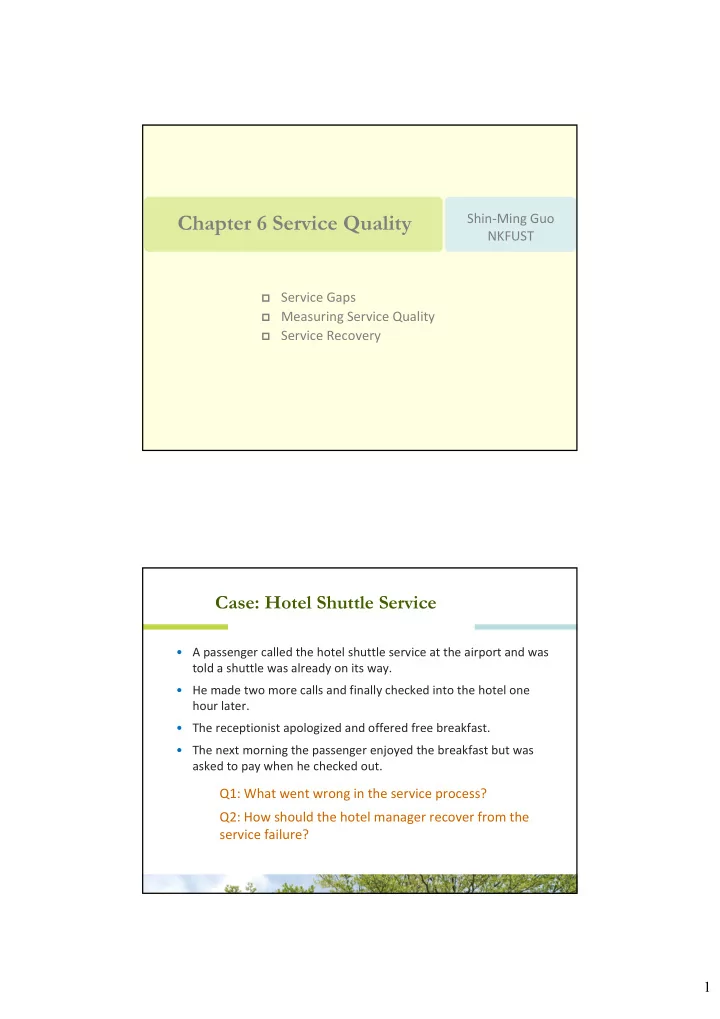
Chapter 6 Service Quality Shin Ming Guo NKFUST Service Gaps Measuring Service Quality Service Recovery Case: Hotel Shuttle Service A passenger called the hotel shuttle service at the airport and was told a shuttle was already


slide-1
SLIDE 1

1

Chapter 6 Service Quality

 Service Gaps  Measuring Service Quality  Service Recovery

Shin‐Ming Guo NKFUST

Case: Hotel Shuttle Service

  • A passenger called the hotel shuttle service at the airport and was

told a shuttle was already on its way.

  • He made two more calls and finally checked into the hotel one

hour later.

  • The receptionist apologized and offered free breakfast.
  • The next morning the passenger enjoyed the breakfast but was

asked to pay when he checked out.

Q1: What went wrong in the service process? Q2: How should the hotel manager recover from the service failure?

slide-2
SLIDE 2

2

Dimensions of Service Quality

  • Reliability: Perform promised service dependably and

accurately.

  • Responsiveness: Willingness to help customers promptly.
  • Assurance: Ability to convey trust and confidence.
  • Empathy: caring for customers, understanding customer’s

needs.

  • Tangibles: Physical facilities and facilitating goods.

3

Service Gap

4

= Perceptions

  • Expectations

Does this bank Is speed of service important? provide fast service? Word of mouth Personal needs Past experience Expected service Perceived service Service Quality Dimensions Reliability Responsiveness Assurance Empathy Tangibles Service Quality Assessment

  • 1. Expectations exceeded

ES<PS (Quality surprise)

  • 2. Expectations met

ES~PS (Satisfactory quality)

  • 3. Expectations not met

ES>PS (Unacceptable quality)

slide-3
SLIDE 3

3

Types of Service Gap

5

Measuring Service Gap

6

 SERVQUAL: a two‐part instrument that pairs an

expectation statement with a corresponding perception statement to measure the five dimensions of service quality.

 Walk‐through Audit: a operations oriented

survey to evaluate service gaps between a customer’s perception and a manager’s perspective.

slide-4
SLIDE 4

4

7

SERVQUAL

EXPECTATIONS PERCEPTIONS This survey deals with your opinions of banks. Please show the extent to which you think banks should posses the following features. Please circle a number that best shows your expectations about institutions offering bank services The following statements relate to your feelings about the XYZ bank that you chose. Please show the extent to which you believe XYZ has the feature described in the statement. Please circle a number that shows your perceptions about XYZ bank Strongly Strongly Strongly Strongly Disagree Agree Disagree Agree 1 2 3 4 5 6 7 1 2 3 4 5 6 7 (E) (P) Gap Score P - E Tangibles Tangibles

  • E1. Excellent banking companies will

have modern looking equipment.

  • P1. XYZ bank has modern looking

equipment.

  • E2. The physical facilities at excellent

banks will be visually appealing.

  • P2. XYZ Bank’s physical facilities

are visually appealing.

  • E3. Employees at excellent banks will

be neat appearing.

  • P3. XYZ Bank’s reception desk

employees are neat appearing.

SERVQUAL Importance-Performance Analysis

Service Gap Importance  Expectation Performance  Perception Cost Reduction

slide-5
SLIDE 5

5

Walk-through Audit

9 10

slide-6
SLIDE 6

6

Measuring Service Quality

  • Satisfaction/Success Ratio
  • Complaint Ratio
  • Retention Ratio
  • First Response Time
  • Total Response Time
  • Stock Out Ratio
  • Due Date Performance
  • Data Accuracy

Classification of Service Failures

12

Server Errors

Task: Doing work incorrectly Treatment: Failure to listen to customer Tangible: Failure to wear clean uniform

Customer Errors

Preparation: Failure to bring necessary materials Encounter: Failure to follow system flow Resolution: Failure to signal service failure

slide-7
SLIDE 7

7

Example: Pizza Delivery

  • A pizza store offer delivery service to campus
  • area. Student newspaper has just published an

article that criticizes the store for poor service.

  • The store has kept all customer

complaint records. What should the manager do?

13

Step 1: Define Critical Quality Characteristics

14

  • Reliability: Wrong orders
  • Responsiveness: Late Deliveries, Cold Food
  • Assurance: Drop pizza, Unable to answer questions
  • Empathy: Forget to mention special deals
  • Tangibles: Taste
slide-8
SLIDE 8

8

Step 2: Measure the Process

15

0.04 0.06 0.08 0.1 0.12 0.14 0.16 0.18 1 2 3 4 5 6 7 8 9 10 11 12 Time (months) % of complaints

Run Chart

Step 3: Analyze the Process

16

Total=251 complaints 50 100 150 200 250 late deliveries wrong

  • rder

cold food taste

  • ther

number of complaints 0.2 0.4 0.6 0.8 1 cumulative %

slide-9
SLIDE 9

9

Step 4: Cause and Effect Diagram

17

Cost of Quality

18

Failure costs Detection costs Prevention costs

External failure: Process control Quality planning Loss of future business Peer review Training program Negative word‐of‐mouth Supervision Quality audits Liability insurance Customer comment card Data acquisition Legal judgments Inspection Recruitment Interest penalties Supplier evaluation Internal failure: Scrapped forms Rework Recovery: Expedite disruption Labor and materials

External Failure Costs Detection Costs Prevention Costs Internal Failure Costs

Costs of Quality

slide-10
SLIDE 10

10

Service Recovery

19

A Service Recovery is satisfying a previously dissatisfied customer and making them a loyal customer.

About 60% of the complainers would stay as customers if their problem was resolved and 95% would stay if the problem was resolved quickly. A customer who has had a problem resolved by a company will tell about 5 people about their situation. A dissatisfied customer will tell between 10 and 20 other people about their problem.

Level of Customer Dissatisfaction

20

5 10 15 20 25 30

Average number of people told

slide-11
SLIDE 11

11

Service Recovery Framework

21

Approaches to Service Recovery

22

 Case‐by‐case addresses each customer’s complaint

individually but could lead to perception of unfairness.

 Systematic response uses a protocol to handle complaints

but needs prior identification of critical failure points and continuous updating.

 Early intervention attempts to fix problem before the

customer is affected.

 Substitute service allows rival firm to provide service but

could lead to loss of customer.

slide-12
SLIDE 12

12

Southwest Flight 1380

  • On 4/17/2018, Southwest Flight 1380 was scheduled to fly

from New York to Dallas. When the engine on the left wing broke, the plane made an emergency landing in Philadelphia.

  • When it was all over, the pilot came out of the cabin and

walked through the aisle and talked with passengers to make sure they were all right.

  • Passengers received a letter from Southwest three days later.

"We value you as our customer and hope you will allow us another opportunity to restore your confidence in Southwest… we are sending you a check in the amount of $5,000 to cover any of your immediate financial needs."

United Express Flight 3411

  • On April 9, 2017, O'Hare airport police forcibly removed a

passenger from the aircraft, after he refused to give up his seat to make room for four airline employees who needed to travel to the destination.

slide-13
SLIDE 13

13

Service Guarantee: Customer View

25

 Unconditional (L.L. Bean)  Easy to understand and communicate

(Bennigan’s)

 Meaningful (Mobile phone service)  Easy to invoke (Internet shopping)  Easy to collect (Amazon)

Service Guarantee: Management View

26

Service Guarantees As Design Drivers

 Focuses on customers (British Airways)  Sets clear standards (FedEx)  Guarantees feedback (Proactive approach)  Promotes an understanding of the service delivery

system (Bug Killer)

 Builds customer loyalty by making expectations explicit

slide-14
SLIDE 14

14

Summary

 Most quality programs fail for one of two reasons:

they have systems without passion, or passion without system. ― Tom Peters

 Pay attention to norms and rituals  Training to anticipate possible situations.  Customers are the ultimate judges of a service’s value.  Let the punishment fit the crime in service recovery

27