Economics of Cow Dung a commercialized VC with a huge Green Jobs - - PowerPoint PPT Presentation

economics of cow dung
SMART_READER_LITE
LIVE PREVIEW

Economics of Cow Dung a commercialized VC with a huge Green Jobs - - PowerPoint PPT Presentation

Economics of Cow Dung a commercialized VC with a huge Green Jobs potential Green Jobs in Asia Regional Conference, 29-31 August 2012 Surabaya, Indonesia Hideki Kagohashi, Enterprise Development Specialist, ILO DWT for South Asia Presentation


slide-1
SLIDE 1

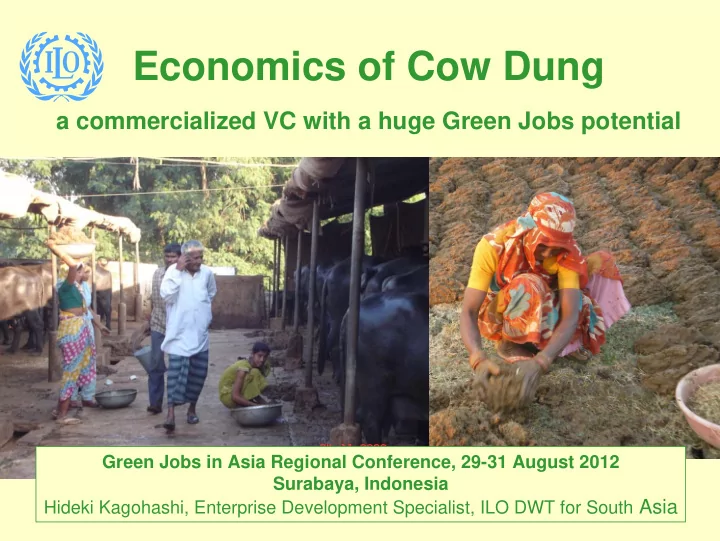
Economics of Cow Dung

a commercialized VC with a huge Green Jobs potential

Green Jobs in Asia Regional Conference, 29-31 August 2012 Surabaya, Indonesia Hideki Kagohashi, Enterprise Development Specialist, ILO DWT for South Asia
slide-2
SLIDE 2

Presentation structure

1. Why the number matters 2. Why creating 2 million GJs is possible 3. How the analysis was conducted 4. Why energy policy is an employment policy 5. Why 2 million GJs are not yet there 6. What’s next

2

slide-3
SLIDE 3

1. Why the number matters

2. Why creating 2 million GJs is possible 3. How the analysis was conducted 4. Why energy policy is an employment policy 5. Why 2 million GJs are not yet there 6. What’s next

3

slide-4
SLIDE 4

Highlights of the ILO study (forthcoming) The dung economy in India supports

  • Presently: Approx. 1.5 million jobs

Many not decent jobs

  • Potentially: 2.0 million additional Green

(and decent) Jobs can be created

– if right policy choices are made – if transformation is managed with care

4

slide-5
SLIDE 5

… larger than total RE jobs of any single country/union

Source) REN21 (2012) with inputs from the IRENA and the ILO Green Jobs Programme

5

slide-6
SLIDE 6

… comparable to the size of large public employment prog

6

  • South Africa’s Expanded Public Works

Programme (EPWP) has created one million work opportunities over five years. EPWP Phase II (2009-2014) sought to create two million full time equivalent jobs.

  • To respond to the financial crisis of early

2000, Argentina implemented the Plan Jefes y Jefas de Hogar (Jefes), providing job

  • pportunities to 2 million unemployed heads
  • f household in 2003.

But jobs created are temporal.

slide-7
SLIDE 7

1. Why the number matters

2. Why creating 2 million GJs is possible

3. How the analysis was conducted 4. Why energy policy is an employment policy 5. Why 2 million GJs are not yet there 6. What’s next

7

slide-8
SLIDE 8

A buffalo produces 3 ℓ oil/day

8

30 kg dung = 3 ℓ oil 15 ℓ milk

slide-9
SLIDE 9

Rising oil price reveals dung value

9

Source) ILO (forthcoming) Economics of Cow Dung

slide-10
SLIDE 10

Dung Contractor

Sell to brick kilns Dung clearn up and collection Dung cake making Contract with dairy farms Lease his land to a middleman Hire labour

Commercialized Dung Value Chain

slide-11
SLIDE 11

Jabalpur urban dairy cluster location

11

Dairy Cluster at Pariyat, Jabalpur 1.2 MW 1.2 MW Biogas plant Biogas plant

slide-12
SLIDE 12

Individual vs. contractor model

Contractors lease their

  • wn land
  • r get a plot of dairy farm

for dung cake making Individuals without extra plots of land use road side for dung cake making

slide-13
SLIDE 13

1/3 of dairy jobs are in the dung sector

13

(3,500) (1,730)

in Jabalpur

Source) ILO estimates

slide-14
SLIDE 14

14

Source) ILO estimates

Composition of jobs in the dairy sector

in Jabalpur

slide-15
SLIDE 15

Important facts & assumptions in calculating current employment

  • Commercially usable dung comes from

(confined) animal feeding operations (AFO and CFAO) in the urban/peri-urban dairy

  • clusters. 100% of buffalo population and 25%
  • f cattle and mixed breed fall under this

category.

  • Dung of a Cow is 10 kg/day, a Calf 5 kg/day

and a Buffalo 15 kg/day.

  • 50 % of dung not used in a productive way.

15

slide-16
SLIDE 16

National dimension of present employment in the dung sector

Type of Jobs in dung sector Estimation based on Jabalpur cluster Cleaners and collectors 950,000 (1.9 m half time jobs) Dung cake makers 400,000 Compost makers 41,000 Transport & management 37,000 Small biogas construction 85,000 Total 1,513 million

16

slide-17
SLIDE 17

17

Suggested changes in the dung VC

Interventions

100% dung clean up and collection X Dung cake making Biogas electricity generator ALMP Formalization

  • f workers;

OSH guidelines Analysis & dialogue to adjust energy pricing policies Vermin compost making Growing market of

  • rganic farming

Sell electricity to grid Milk processing & chilling

slide-18
SLIDE 18

Employment impact of full productive use of dung

18

Potential Green Jobs creation Estimation Dung collectors and cleaners for additional 660,000 tons 1.24 million Transport & dung management in urban clusters for additional 660,000 tons 55,000 Electricity plants of 1MW x 5000 incl. fertilizer production from slurry 950,000 Construction and maintenance of additional 10 million small biogas plants 140,000 Total 2.385 million Jobs lost in dung cake making

  • 400,000

Total net employment gain 1.985 million

slide-19
SLIDE 19

RE may not be labour intensive but part of the VC can be

19

Source) ILO calculation

slide-20
SLIDE 20

Biogas + compost will make more value than dung cake

20

Source) ILO calculation

slide-21
SLIDE 21

1. Why the number matters 2. Why creating 2 million GJs is possible

3. How the analysis was conducted

4. Why energy policy is an employment policy 5. Why 2 million GJs are not yet there 6. What’s next

21

slide-22
SLIDE 22

Summary of how we did it

1. Map VC and system 2. Count jobs and extrapolate 3. Identify bottlenecks and ways to address them IMPORTANT: RE market is policy- and subsidy-

  • driven. “Commercialization” approach for

massive replication of key technologies (to boost GJs) would rely on the level playing field and political decisions.

22

slide-23
SLIDE 23

ILO’s VCD process made green

  • Structured participatory diagnosis and action

planning

  • VC steering committee by local stakeholders
  • Put the circular/recycling channel and policy

elements as part of the analysis

Start

  • up

work shop Res ults Wor ksho p Interview s Focus group discussions Pres enta tion Build

  • up

Hyp

  • the

sis Wor ksho p Imple- mentatio n 8 - 12 weeks 4 - 6 weeks 1 2 3 4 5 6 Modules

23

slide-24
SLIDE 24

Value chain map w/ feedback loops

24

Small farmer <50 cattle Medium farmer 50‐500 cattel Large farms >500 Milk Dung Milk vendors Outlet shops Cooperatives Priavte Daries Small (2m3) medium (100kW) & large (1MW) biogas plant

Natural resources (Water, Energy, Hay, Healthy Ecosystem, Cultural Value)

Dumped & washed away Dung cake contractors Vermin compost makers Lost Economic activity (waste & pollution) IMPACT ON Economic activity (Elect.Fuel, Water, Fodder) USE OF Ministry of Energy Ministry of Dairy Ministry of Environment Milk policy Renewable Energy policy

  • Env. policy

Banks, Business service providers

  • incl. Cooperatives

Market demand for Milk, Energy & Fertilizer Unions and Employers Organizations

People and Employment, Values and Norms

slide-25
SLIDE 25

1. Why the number matters 2. Why creating 2 million GJs is possible 3. How the analysis was conducted

4. Why energy policy is an employment policy

5. Why 2 million GJs are not yet there 6. What’s next

25

slide-26
SLIDE 26

The Large-scale biogas digesters

  • Expected to absorb 53% of the dung in the peri-

urban area (1,500 MT per day)

– Contributes to reducing pollution, but not completely – Other measures (dung capture from river, dairy zoning)

  • Slurry from the biogas digester can be used for

vermin compost

  • Not commercially feasible even with the subsidy

– PPA rate is temporarily set low (Rs.3.36/kwh) while PPA rate for the solar technology is 5-6 times higher (Rs.14- 17/kwh). – Power shed prevents from meeting the CDM target

26

slide-27
SLIDE 27

118 countries have RE policy targets

Source) REN21 (2012)

27

slide-28
SLIDE 28

92 countries enacted feed-in policies

Source) REN21 (2012)

28

slide-29
SLIDE 29

Electrification advancing but unevenly

Source) REN21 (2012)

29

  • China >99.5%
  • Philippines 84%
  • Sri Lanka 76.6%
  • India 75%
  • Indonesia 65.1%
  • Rural Bangladesh 63.4%
  • Pakistan 62%
  • Afghanistan 16%
  • Myanmar 13%
  • Nepal 10%
  • Rural Micronesia 4%
slide-30
SLIDE 30

Policy feedback

  • Provides feedback for the discussion at the

GJ task force

– Promote commercial replication of biogas plants

  • PPA rate comparing total benefits and mapping the

commercialization scenario

  • Balancing jobs and subsidized energy for the poor

– ALMP to help dung workers to move to the biogas and compost sector – Formalize workers and make jobs decent

30

slide-31
SLIDE 31

1. Why the number matters 2. Why creating 2 million GJs is possible 3. How the analysis was conducted 4. Why energy policy is an employment policy

5. Why 2 million GJs are not yet there

6. What’s next

31

slide-32
SLIDE 32

Brazil – biogas feasible

  • Biogas generated electricity is cheaper

than the grid price (less subsidized), so large farms generate electricity for self- use.

– Grid price (USD 18 cents /kwh) + demand charge for transformer + taxes +fees = up to USD 40 cents /kwh – Biogas generation cost: USD 17 cents /kwh

32

slide-33
SLIDE 33

Nepal & Pakistan – biogas feasible

  • Grid is unreliable. Power availability

hour is low (up to 16 hours per day power cut in dry season), which forces many people to use diesel generators.

  • Biogas generated electricity is cheaper

than the diesel.

– Diesel generation cost: USD 0.35 / kwh Biogas generation cost: USD 0.10 / kwh

33

slide-34
SLIDE 34

India (Jabalpur case) – large biogas plant not feasible?

  • Grid reliability is improving. Presently

22 hours per day in urban Jabalpur.

  • Biogas generated electricity is cheaper

than diesel but costlier than the grid.

– Grid price is INR 5 / kwh. (USD 0.10 / kwh) – Diesel generation cost: USD 0.32/kWh – Biogas: INR 10 / kwh. (USD 0.18 / kwh)

34

slide-35
SLIDE 35

Population relying on traditional biomass for cooking

Source) REN21 (2012)

35

slide-36
SLIDE 36

India (Jabalpur case) – small biogas plants f/ cook stove

  • High rate of non-functional plants

– Competing energies: firewood, propane gas – Premature start of use

Diagnosed process bottlenecks and generated a problem solving guide

36

slide-37
SLIDE 37

1. Why the number matters 2. Why creating 2 million GJs is possible 3. How the analysis was conducted 4. Why energy policy is an employment policy 5. Why 2 million GJs are not yet there

6. What’s next

37

slide-38
SLIDE 38

Implications to further research

1. Diesel dependency area map of India

– Crossing this with major dairy clusters in urban centres, we will get a rough number of target farms for commercially viable electricity generation from the biogas digesters

2. Detailed review of the subsidized price of grid electricity vis-à-vis RE PPA on-grid and

  • ff-grid.

– International comparison among Brazil, Nepal and Pakistan could be part of the study.

38

slide-39
SLIDE 39

Way forward

  • 1. Explore policy and implementation

space within the RE, energy and daily policies in India.

  • 2. Explore dairy sector opportunities in
  • ther countries through research and

pilot.

  • 3. Explore other sectors with great GJ

potential.

39