
SLIDE 1
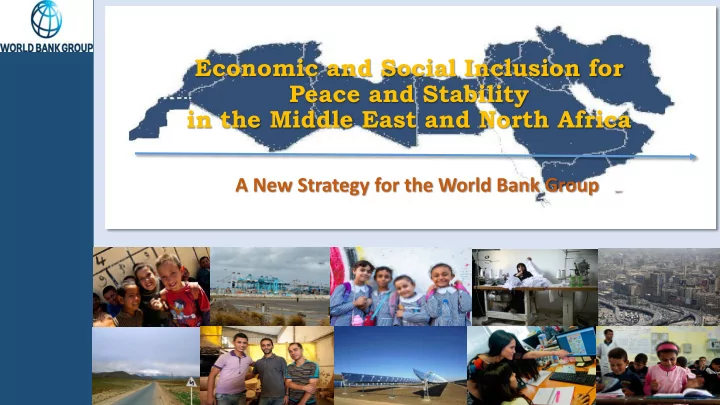
Economic and Social Inclusion for Peace and Stability in the Middle East and North Africa
A New Strategy for the World Bank Group
1
Economic and Social Inclusion for Peace and Stability in the Middle - - PowerPoint PPT Presentation
Economic and Social Inclusion for Peace and Stability in the Middle East and North Africa A New Strategy for the World Bank Group 1 Introduction - Why a New Strategy? What is Different? Why Now? 1. Pillars of the Strategy the 4
A New Strategy for the World Bank Group
1
Economic and Social Inclusion for Peace and Stability in the Middle East and North Africa
1.
2.
3.
4.
5.
2
Why a New Strategy? What’s Different? Why Now?
3
In 2011, reflecting widespread optimism that the Arab Spring would herald a transition to pluralism and greater social and economic inclusion, the WBG introduced a new strategy for MENA…But the transitions since have turned out to be much more painful and violent than expected…
Why a New Strategy?
The Syria Crisis is the biggest displacement crisis of this century with most refugees being young, poor, and uneducated…
Source: UNICEF Syria Crisis Dashboard, June 2015
The last two years have seen a tremendous uptick in violence in MENA, which has the highest number of terrorist incidents and casualties in the world today
Source: Global Terrorism Database: http://www.start.umd.edu/gtd/
Fragility has become the new reality for MENA since 2011, with civil conflict engulfing Syria, Iraq, Yemen, and Libya while other countries face security concerns from terrorism… 4
The deteriorating situation in the region has prompted us to develop a new strategy – one that aims at using development to promoting peace and social stability in the MENA region
Why a New Strategy…?
There are at least 2 reasons for this shift:
Ending poverty and boosting shared prosperity in MENA requires peace and stability - for development to take place in MENA the WBG has to help reverse the
current trends in the region and establish conditions for inclusive growth
Conflict and violence in MENA are having huge spill-over effects in terms of refugees, conflict, and terrorism – confronting them through development
initiatives that promote peace and stability is therefore a global public good, which requires a global coalition to achieve it
5
While many of the areas of engagement appear similar to the old strategy, the purpose will be different and there are several significant shifts in emphasis in terms of how we operate…
What is different? From To
Working around conflict and instability on particular thematic areas Targeting peace and stability directly as the new lines
Relying largely on lending and advisory work, with some degree of convening Deepening partnerships and convening far more, especially with regional partners (e.g. IsDB) and non- state actors Predominantly financing infrastructure and services through public investment via the WB Much stronger push to foster private investment in infrastructure and other services through the IFC and MIGA while strengthening regulatory environment Exclusive focus on country-by-country approach Complement this by expanding the focus to regional programs such as in water, energy, and education Relying on WBG own resources In addition leverage WBG resources to crowd in international resources using innovative financing mechanisms
Strategic Shifts in our Engagement
6
The strategy is well-suited to the WBG at this time for many reasons…
Why Now? In other words:
BUSINESS AS USUAL IS NOT AN OPTION!
The overall development landscape informed by the SDGs recognizes the need to confront global challenges such as fragility and conflict together by leveraging the convening power of multi-lateral institutions like the WBG The WBG has increasing knowledge and experience in the areas of fragility and conflict as well as social accountability building on the WDR 2011, GPSA, and other initiatives This is a One WBG strategy – so that the combined forces of the WB, IFC, and MIGA will be brought to bear on this challenge The creation of Global Practices facilitates the delivery of global public goods by leveraging the full potential of the new organizational model But the most important reason for embarking on the new strategy is that without concerted action to promote economic and social inclusion for peace and stability, violence and conflict will continue to corrode the economies, societies, and lives of the people in MENA
7
The Four “R”s
8
Drawing on the lessons from WDR 2011, any strategy to promote peace and stability has to work on two fronts…
Address Underlying Causes of Conflict & Violence Mitigate Urgent Consequences of Conflict & Violence
These two are inter-related and can feed off each other
Recovery and Recon- struction Renewing the social contract Regional Cooperation Resilience to IDP/refugee shocks
Economic and Social Inclusion for Peace and Stability in MENA
The first two pillars address underlying causes, while the latter two tackle the immediate consequences… From these, and taking into account the WBG mandate and comparative strengths we arrived at these four mutually reinforcing pillars… 9 For example:
voice (esp. youth, gender)
natural resources
For example:
human capital
resources and basic services
Despite some differences, most MENA countries adopted a similar development model – where the state provided jobs, free health and education, and large subsidies…
Services despite being free and accessible were of low quality, yielding poor development outcomes The inability of the public sector to absorb labor and the lack of private sector jobs (partly due to capture) led to MENA having the largest unemployment rates in the world, particularly for women Voice and accountability in MENA were among the lowest in the world Infrastructure shortages mounted and constrained an already distorted private sector (e.g. power)
Production lost due to outages (% sales); Source: World Bank Enterprise Surveys Source: PISA Math Scores 2012
The Arab Spring and its aftermath have shown that this ‘social contract’ was broken and unsustain- able. These very issues are now feeding into more instability in the region…
Unemployment Rate (%); Source: World Development Indicators
10
10 20 30 40 50 60 70 80 MENA Africa SAR ECA LAC EAP Accountability/Conflict of Interest Voice
Source: Global Integrity Report 2011
Renewing the Social Contract
MENA now needs a new social contract - built on greater citizen trust; more effective protection of the poor and vulnerable; inclusive and accountable service delivery; and a stronger private sector that can create jobs and opportunities for MENA’s youth… The WBG can help MENA countries renew the social contract in at least 3 areas
private sector development
market demands
promote formal job creation
business policies to foster entrepreneurship
supporting lagging regions
institutions for more efficient and effective service delivery
accountability institutions
greater private sector investment in infra and services via IFC and MIGA
Protection system
stories (incl. via third sector providers)
and legislation (e.g. access to information, etc.)
aspects of sectoral governance
accountability
among stakeholders for sensitive policy reforms
feedback
11
Renewing the Social Contract
Despite a common language, culture, history, and common threats and challenges, MENA remains the least integrated region in the world…
0.1 0.2 0.3 0.4 0.5 0.6 0.7 0.8 ECA and all EU EAP LAC MENA SAR SSF
Intraregional Integration across Regions (share of total)
Trade FDI Migration Remittances
Fragmented political and economic regional policies, lack of progress in reducing barriers to trade, and poor logistics have significantly hindered integration in MENA Various regional organizations exist, though they have been ineffective at promoting greater regional integration 12
Regional Cooperation
With the goal of promoting regional cooperation, the WBG will focus initially on key areas where the potential for strong partnerships are emerging…
Cross-border externalities Cross-country learning for reform
By engaging on key sectors, and working closely alongside partners, the WBG can play an important role in:
In addition to these three initiatives, the Bank Group will continue to pursue integration in trade and investment building on previous analytical work
13
Regional Cooperation
The Syrian conflict has produced one of the largest refugee crises in the post- WWII era, but displacement challenges are growing rapidly in North Africa and Yemen as well: Refugees: 4 mn Syrian 5 mn Palestinian 250,000 Somalis/others (Yemen) estd. 1 mn (unregistered) Libyans in Tunisia Internally displaced, of which: 7 mn in Syria 4 mn in Iraq 1.1 mn in Yemen Over 400,000 in Libya
MENA hosts largest number of displaced people in the World – over 15 million (with over 50% women and children) – and this consequence of the instability in the region poses one of the biggest threats to long term resilience of MENA countries…
Source: Joseph Willits (Twitter) and The Guardian
US$ S$ 5. 5.5 5 billi billion
refugees and host communities in 2015 (Egypt, Iraq, Jordan, Lebanon, Turkey, and at regional level)
S$ 1. 1.8 8 billi billion
which almost US$1 billion to address needs of host communities; 1 1 pe percentage po poin int dr drop
in GDP GDP growth in 2013 [IMF]
2014): US$ S$ 2. 2.6 6 billi billion
17% increase in poverty
Estimates of the economic costs of this displacement are daunting… and are impacting countries beyond the region…
Source: Al Jazeera
The demographic profile of refugees, as well as the fact that the average length of stay for refugees worldwide is 17 years, has major implications for their development needs and those of hosting communities…
Profile of refugees in Jordan and Lebanon distinct from pre-crisis Syrian and host populations:
14
Resilience to refugee/IDP shocks
The goal of the resilience pillar will be to promote the welfare of refugees, IDPs, and host communities in the MENA region focusing on building trust and sustainable solutions for displaced people…
Which will be applied in different forms of support:
Sequenced interventions to help refugees, IDPs, and host communities:
Using a resilience-based developmental approach that:
vulnerabilities and risks,
tensions),
reduced poverty, and shared prosperity.
Mobilization of financial support and policy reforms from international community using
15
Resilience to refugee/IDP shocks
The intensity, duration, and level of destruction of the conflicts and civil wars, as well as the growth slowdowns as a result of political instability and violence, highlight the need for a major recovery and reconstruction effort in MENA…
Estimates of the size and scale of reconstruction needs are staggering:
rebuilding war-torn Syria will cost $170 bn (increasing by the day). Cost for Libya, more than $200 bn over next 10 Years. Humanitarian needs alone for Yemen are around $274 mn and rising
In Gaza estimate over $1.4 bn in the loss of physical structures; $1.7 bn in economic loss. For four cities in Iraq, estimate the total damage in transport, water/sanitation, municipal buildings and housing to be up to $443 mn. In six cities in Syria, estimate damage in energy, housing, health, education, WASH, roads, agriculture estimated to be up to $4.3 bn
50% in 2015, lowering GDP by 3.5%
the Gaza 2014 and Iraq 2015)
stream analysis helps implement rapid interventions Primacy of understanding social, institutional and political economy constraints to sustained recovery Complemented by in-conflict preliminary damage and needs assessment using satellite imagery and remote sensing
including civil society organizations and the private sector is absolutely critical
resolution of conflicts
Some emerging lessons from ongoing work in MENA:
16
Reconstruction & Recovery
Given the scale of destruction the WBG will need to adopt a ‘dynamic’ approach to reconstruction and recovery that brings in external partners, leverages large scale financing, and move beyond humanitarian response to longer-term development…
The principles:
17
The approach:
Reconstruction & Recovery
Programs, Partnerships, Finance, Knowledge
18
Regional priorities will translate into country strategies and programs, building on systematic country diagnostics…
Regional priorities will cascade down to the project level with a line of sight to the overall goal of using inclusive development to contribute to peace and stability: 19
Programs
The heterogeneity of the MENA region will imply that different pillars will be more or less relevant in different clusters of countries… There will naturally be certain sectors and areas that receive greater focus than others…
MORE OF: LESS OF:
infrastructure development
engagement
don’t address quality issues
knowledge and lending products
The magnitude of the challenge facing the region, and its global implications mean that partnerships are arguably the most important instrument for delivering the strategy…
Partnerships Three Kinds of Partnerships will be developed:
Financial Partnerships
Knowledge Partnerships
subsidies with cash transfers - will require advocacy role
facilitate this form of partnership Advocacy Partnerships
20
With respect to financing, the WBG will continue to expand its investment in the region…but in addition to our own funds, the core focus will be on leveraging and mobilizing global resources to meet the extraordinary financing needs of the region…
Finance
21
WBG own lending will be geared toward renewing the social contract… For example:
public goods over private goods (e.g. sanitation)
the policy and regulatory environment for private sector investment
accountability
inclusion
Our knowledge work (including our growing RAS program) will be of prime importance in informing and mobilizing the support for the strategy and will lead (rather than follow)
Knowledge Examples of knowledge work:
Renewing the Social Contract Regional Integration Resilience to refugee/IDP shocks Reconstruction & Recovery
Geared towards:
22
Risks, Challenges, Monitoring and Evaluation (M&E)
23
By its very nature, this is a high risk strategy that will require us to be dynamic and adaptive…
Risks & Challenges
environments Security and Operational risks
Reputational Risks
community’s best efforts, the conflict gets worse with disastrous economic and social consequences External/Conflict Risks Examples of the challenges: Possible mitigation measures:
actors in places without de facto governments
flexibility to take risks
particularly youth groups
transparency in engagements
increasing crisis in region
24
M&E for the strategy will need to combine traditional project level results with impact level data on peace and social stability…
Monitoring & Evaluation
With support from LLI we will explore the use of Big Data and Sentiment/Social Network Analysis to get real time attitude data and combine this with perception survey data
Input and
results indicators will focus on contributions to the 4 pillars of the strategy that reflect our
At impact level we will track indicators associated with greater peace and social stability with help from FCV Group
25
A New Strategy for the World Bank Group
26