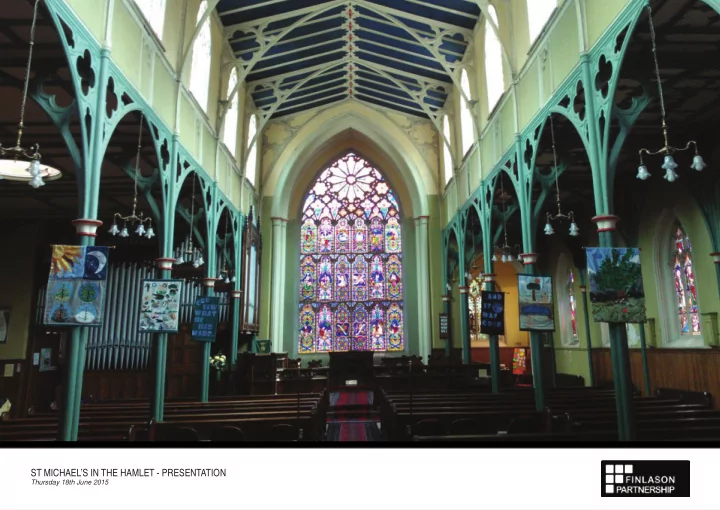
SLIDE 1
ST MICHAEL’S IN THE HAMLET PRESENTATION
Thursday 18th June 2015
ST MICHAEL’S IN THE HAMLET - PRESENTATION
Thursday 18th June 2015
SLIDE 2
FPL Architects
Accredited specialists in Conservation and Historic Buildings
SLIDE 3 FPL Architects
Accredited specialists in Conservation and Historic Buildings
INTRODUCING FINLASON PARTNERSHIP LTD... Specialists in Conservation and Listed Buildings
Finlason Partnership Limited (FPL) is an architectural practice
- ffering architects services to a wide range of client types on both
a local & national basis from offjces in Hale, Cheshire, at the edge
- f Manchester. FPL is a trusted RIBA Chartered Practice and on
the AABC Register of Architects Accredited in Building Conservation We have a wide range of experience with:
- Grade I;
- Grade II*;
- Grade II; and
- Scheduled Monuments.
Breadth of experience and skills...
- Liverpool connections – working in city for past 15 years.
- Liverpool City Council and Diocese.
- Historic England, English Heritage, HLF and others – well known
to senior members. FPL has a particular specialism in the conservation and repair of historic and listed buildings, with numerous projects live on site at any given time. FPL’s AABC registration provides clients with the assurance that as skilled conservation architects our involvement protects the historic built environment from damaging interventions devised by people not skilled in historic building conservation and adaptation.
SLIDE 4
FPL Architects
Accredited specialists in Conservation and Historic Buildings
INTRODUCING FINLASON PARTNERSHIP LTD... Specialists in Conservation and Listed Buildings
SLIDE 5 FPL Architects
Accredited specialists in Conservation and Historic Buildings
INTRODUCING FINLASON PARTNERSHIP LTD... Our Other Work
Other sectors we are actively involved in...
- Residential
- Commercial
- Retail
- Ecclesiastical
- Education
- Sports and Leisure
- Healthcare
- Industrial
We have completed and are working on projects with a complete range of size and requirements across the North West and the UK. Overview...
- 20-years in business,
- Six staff (incl. 1 clerical) plus consultants,
- ‘Hands-on’ director involvement – Alex and Martyn,
- CAD and modeling skills,
- Background wholly in multi-disciplinary design practice,
- Commonly offer ‘one-stop shop’ but accommodate all needs;
- Usual method of working provides an important insight.
Delivering on time and within budget...
- Understanding & agreeing common objectives,
- Project management – brief taking & recording,
- Pre-planning, programming, monitoring and managing effort,
resources & expectations,
- Understanding needs, tasks and outcomes,
- Including input of other professions – timely & appropriate advice;
- Cost control – the partnership approach.
SLIDE 6
FPL Architects
Accredited specialists in Conservation and Historic Buildings
WHAT HAS BEEN ACHIEVED SO FAR... Overview time line: 2004 to date
Implementing the Vision Plan
2013/14
Kitchen and Vestry Refurb
2011
Tower Roof Repairs
2007
Main Roof Repairs (Phases 1 and 2)
2015
Repairing the Baptistery
2006
Replaced the Heating System
2004
FPL Appointed Previous Repair Work Carried Out
2006
Investigations: Columns and Floors
2007
Quinquennial Inspection
2013
Quinquennial Inspection
2013
Vision Plan Development
SLIDE 7
FPL Architects
Accredited specialists in Conservation and Historic Buildings
WHAT HAS BEEN ACHIEVED SO FAR... Overview: FPL Modelling
SLIDE 8 FPL Architects
Accredited specialists in Conservation and Historic Buildings
WHAT HAS BEEN ACHIEVED SO FAR... Phase 1 & 2: Main Roof Repairs - Before
Budget: ₤400,000 Construction: April - October 2007 Works included:
- Complete removed existing nave roof
- Re-roofed the nave roof
- New lead-work to nave roof
- Re-pointed nave brickwork
- Repairs to the cast iron clerestory windows
- Re-render entire clerestory
- Repair of cast ironwork
- New gutters, rainwater pipes and associated details to nave
- General repainting and decoration of nave and clerestory
SLIDE 9 FPL Architects
Accredited specialists in Conservation and Historic Buildings
WHAT HAS BEEN ACHIEVED SO FAR... Phase 2: Main Roof Repairs - During
Budget: ₤400,000 Construction: April - October 2007 Works included:
- Complete removed existing nave roof
- Re-roofed the nave roof
- New lead work to nave roof
- Re-pointed nave brickwork
- Repairs to the cast iron clerestory windows
- Re-render entire clerestory
- Repair of cast ironwork
- New gutters, rainwater pipes and associated details to nave
- General repainting and decoration of nave and clerestory
SLIDE 10 FPL Architects
Accredited specialists in Conservation and Historic Buildings
WHAT HAS BEEN ACHIEVED SO FAR... Phase 2: Main Roof Repairs - After
Budget: ₤400,000 Construction: April - October 2007 Works included:
- Complete removed existing nave roof
- Re-roofed the nave roof
- New lead work to nave roof
- Re-pointed nave brickwork
- Repairs to the cast iron clerestory windows
- Re-render entire clerestory
- Repair of cast ironwork
- New gutters, rainwater pipes and associated details to nave
- General repainting and decoration of nave and clerestory
SLIDE 11 FPL Architects
Accredited specialists in Conservation and Historic Buildings
WHAT HAS BEEN ACHIEVED SO FAR... Phase 3: Tower Repairs - Before
Budget: ₤250,000 Construction: February - July 2011 Works included:
- Dismantle, repair, reconstruction and re-erection of eight pinnacles
and frames
- Removal of existing stainless steel roof
- New stainless steel support structure
- Construction of a new shallow pyramidal lead roof
- Perimeter lead box gutter with four outlets
- New access hatches
SLIDE 12 FPL Architects
Accredited specialists in Conservation and Historic Buildings
WHAT HAS BEEN ACHIEVED SO FAR... Phase 3: Tower Repairs - During
Budget: ₤250,000 Construction: February - July 2011 Works included:
- Dismantle, repair, reconstruction and re-erection of eight pinnacles
and frames
- Removal of existing stainless steel roof
- New stainless steel support structure
- Construction of a new shallow pyramidal lead roof
- Perimeter lead box gutter with four outlets
- New access hatches
SLIDE 13
FPL Architects
Accredited specialists in Conservation and Historic Buildings
WHAT HAS BEEN ACHIEVED SO FAR... Phase 3: Tower Repairs - Design
SLIDE 14 FPL Architects
Accredited specialists in Conservation and Historic Buildings
WHAT HAS BEEN ACHIEVED SO FAR... Phase 3: Tower Repairs - After
Budget: ₤250,000 Construction: February - July 2011 Works included:
- Dismantle, repair, reconstruction and re-erection of eight pinnacles
and frames
- Removal of existing stainless steel roof
- New stainless steel support structure
- Construction of a new shallow pyramidal lead roof
- Perimeter lead box gutter with four outlets
- New access hatches
SLIDE 15 FPL Architects
Accredited specialists in Conservation and Historic Buildings
WHAT IS UNDERWAY... Phase 4: Baptistery Repairs
Budget: ₤85,000 Construction: TBC Works included:
- Strip stainless steel roofjng and 2 roof lights in effected area
- Renew all lead fmashings at abutments and parapet gutters
- Masonry pointing at tower abutment
- New roof light coverings
- Work to 3 No Aisle parapets – iron work and stone pinnacles
- Structural repairs to exposed roof – timber members and
connections to the iron frame
- Repair work to circular roof lights internally and re-plastering
- New stainless steel roofjng
SLIDE 16
FPL Architects
Accredited specialists in Conservation and Historic Buildings
ST MICHAEL’S HISTORIC IMPORTANCE... Context of Liverpool’s Iron Churches
Liverpool is the birthplace of the use of cast iron in churches. Monastery, Alcobaca, Portugal First structural use of cast iron 1752 1765 St Petersburg (recorded by Casanova) House using iron from foundations to roof 1779 Iron Bridge, Coalbrookdale First bridge constructed with cast iron 1772 St Anne’s Church, Liverpool First use of cast iron for minor structural columns 1775 St James’, Toxeth Park, Liverpool Iron columns used for supporting the galleries 1795 St Alkmund, Shrewsbury First use of cast iron tracery 1814 St George’s Church, Everton, Liverpool Unprecedented use of cast iron structurally and decoratively 1815 St Michael’s in the Hamlet, Aigburth, Liverpool Unprecedented use of cast iron for external walls, including patented iron slate cladding technique 1834 The Church Commission approved the use of cast iron in churches, 20 years after St Georges was completed
SLIDE 17
FPL Architects
Accredited specialists in Conservation and Historic Buildings
ST MICHAEL’S HISTORIC IMPORTANCE... Context of Liverpool’s Iron Churches
1772 - St Anne’s – Demolished (no sign of previous church) 1775 - St James’ – Second building to have iron structural columns after St Anne’s 1814 - St George’s – Cragg and Rickman fjrst ‘Iron Church’ 1815 - St Michael in the Hamlet – Cragg and Rickman second ‘Iron Church’ 1816 - St Philip’s – Demolished (Plaque exists remembering Cragg and Rickman) third and fjnal ‘Iron Church’ 1817 - St Marys – Demolished (still part of the outer wall remaining) Other important buildings/locations: 1864 - Oriel Chambers - Worlds fjrst metal frame glass curtain wall St Michael’s in the Hamlet – Five villas Cragg built, all are Grade II Listed Mersey Iron Foundry – John Cragg’s Iron Foundry St Anne’s St James in the City St Marys Oriel Chambers St George’s St Michael’s in the Hamlet Mersey Iron Foundry St Philip’s
SLIDE 18 FPL Architects
Accredited specialists in Conservation and Historic Buildings
ST MICHAEL’S HISTORIC IMPORTANCE... Cragg’s and Rickman
John Cragg was the proprietor of the Mersey Iron Foundry, which manufactured iron structures which were at the leading edge of technology and took a while to become accepted. Cragg aspired to exploit and use iron much more extensively and push it to its limits. Cragg’s was devoted to church and he saw the growth of population and the need for more churches to be the ideal area for his cast iron. As early as 1809 Cragg was looking for opportunities to incorporate prefabricated ironwork into the structure of buildings. Originally worked with architect Joseph Gandy for a church where he had bought land which would become St Michael’s in the Hamlet. Before this Cragg had an opportunity in Everton and employed Thomas Rickman to design St Georges Church. The design incorporated an unprecedented use of iron structurally and decoratively...using a cast iron frame with cast iron window frames and tracery and a complete iron interior. Using some of the same moulds Cragg and Rickman completed their second church, St Michael’s in the Hamlet between 1813 -
- 1815. Cast iron was used even more extensively for walls, parapets,
battlements, pinnacles, hood moulds and other details. The iron plinth used for the foundation allowed buildings to be constructed
The last Iron Church by Cragg and Rickman was St Philip’s, Hardman Street, Liverpool, closed in 1882. Rickman’s other Liverpool churches include St Marys, Birkenhead, 1817, which the V & A house some of the iron tracery.
SLIDE 19 FPL Architects
Accredited specialists in Conservation and Historic Buildings
ST MICHAEL’S HISTORIC IMPORTANCE... The ‘Iron and Slate Church’
St Michael’s in the Hamlet was constructed between 1813 - 1815. Cast iron was used even more extensively for walls, parapets, battlements, pinnacles, hood moulds and other details. The iron plinth used for the foundation allowed buildings to be constructed
Cast iron use:
- Foundation Plinth
- Walls
- Parapets
- Battlements
- Pinnacles
- Hood Moulds
- Tracery
- Clerestory Cladding
- Window and Door Surrounds
- Columns
- Arches
- Church Fence
One of the fjrst examples of prefabricated and modular architecture which was designed to easily accommodate extensions, exemplifjed in 1897 when the north aisle was ‘seamlessly doubled in width’ (Pevsner). Described by English Heritage as one of the earliest and most thorough uses of industrial materials in a major building it used modular sizes of slates to span the cast iron roof trusses forming the ceiling soffjts and roof covering.
SLIDE 20 FPL Architects
Accredited specialists in Conservation and Historic Buildings
ST MICHAEL’S HISTORIC IMPORTANCE... Signifjcance
St Michael’s has been know as the Iron Church, however it would be more fjtting for it to be known as the Iron and Slate Church as it was not only an infmuential and important piece of architecture due to its use of cast iron alone, but had patented slate technology which has infmuenced the development of slate roofs. November 21st 1809 Specifjcation of the Patent granted to John Cragg of Liverpool, in the County Palatine of Lancaster; for certain improvements in the casting of iron roofs for houses, warehouses, and other buildings, and in covering the same with slates. November 29th 1813 Patent granted to John Cragg of Liverpool, in the County Palatine
- f Lancaster; for certain improvements in the facing of exterior and
interior walls of Gothic or other structure.
Minimum side lap Side lap Side lap Side lap Normal double lap slating Double lap rag slating Patent single lap slating
Rawlinson Patent Slating (1772): Reduced quantity of slate by 50% by laying the slates single lapped and simply butting up the sides, the perpendicular joints are left open but leaks are prevented by bedding slate strips in a ‘mastic’ or glaziers putty Cragg Patent Slating (1909): Invented the cast iron slating roof structure below the slate roof and the way the slates were attached to the iron through rivets or pegs St Michael’s in the Hamlet Slating
SLIDE 21
FPL Architects
Accredited specialists in Conservation and Historic Buildings
ST MICHAEL’S HISTORIC IMPORTANCE... Case Study: Our work at St George’s, Everton
St Michael’s and St Georges have extremely similar technology as both were projects by Cragg’s and Rickman. Many of the cast iron moulds were used on both churches. St Michael’s having been designed fjrst (although constructed second) was used as the basis for the design of St Georges. FPL have just completed Phase 1: Urgent Roof Repairs at St George’s Church, which has very similar patent slate roofjng.
SLIDE 22
FPL Architects
Accredited specialists in Conservation and Historic Buildings
ST MICHAEL’S HISTORIC IMPORTANCE... Case Study: Our work at St George’s, Everton
St Michael’s and St Georges have extremely similar technology as both were projects by Cragg’s and Rickman. Many of the cast iron moulds were used on both churches. St Michael’s having been designed fjrst (although constructed second) was used as the basis for the design of St Georges. FPL have just completed Phase 1: Urgent Roof Repairs at St George’s Church, which has very similar patent slate roofjng.
SLIDE 23
FPL Architects
Accredited specialists in Conservation and Historic Buildings
WHAT DO WE DO WITH ST MICHAEL’S? There is plenty of work still to be done...
SLIDE 24
FPL Architects
Accredited specialists in Conservation and Historic Buildings
WHAT DO WE DO WITH ST MICHAEL’S? There is plenty of work still to be done...
SLIDE 25
FPL Architects
Accredited specialists in Conservation and Historic Buildings
WHAT DO WE DO WITH ST MICHAEL’S? There is plenty of work still to be done...
SLIDE 26
FPL Architects
Accredited specialists in Conservation and Historic Buildings
WHAT DO WE DO WITH ST MICHAEL’S? There is plenty of work still to be done...
SLIDE 27
FPL Architects
Accredited specialists in Conservation and Historic Buildings
MAKING ST MICHAEL”S FIT FOR TOMORROW ... Vision Plan: Strategy Overview
SLIDE 28
FPL Architects
Accredited specialists in Conservation and Historic Buildings
MAKING ST MICHAEL”S FIT FOR TOMORROW ... Vision Plan: Relocating the Font
SLIDE 29
FPL Architects
Accredited specialists in Conservation and Historic Buildings
MAKING ST MICHAEL”S FIT FOR TOMORROW ... Vision Plan: Proposed Crèche/Flexible Space
SLIDE 30
FPL Architects
Accredited specialists in Conservation and Historic Buildings
THE IRON TRAIL... Linking the Iron Churches
St Anne’s St James in the City St Marys Oriel Chambers St George’s St Michael’s in the Hamlet Mersey Iron Foundry St Philip’s 1772 - St Anne’s – Demolished (no sign of previous church) 1775 - St James’ – Second building to have iron structural columns after St Anne’s 1814 - St George’s – Cragg and Rickman fjrst ‘Iron Church’ 1815 - St Michael in the Hamlet – Cragg and Rickman second ‘Iron Church’ 1816 - St Philip’s – Demolished (Plaque exists remembering Cragg and Rickman) third and fjnal ‘Iron Church’ 1817 - St Marys – Demolished (still part of the outer wall remaining) Other important buildings/locations: 1864 - Oriel Chambers - Worlds fjrst metal frame glass curtain wall St Michael’s in the Hamlet – Five villas Cragg built, all are Grade II Listed Mersey Iron Foundry – John Cragg’s Iron Foundry
SLIDE 31
FPL Architects
Accredited specialists in Conservation and Historic Buildings