I like to start off these talks by asking the audience: What does - - PDF document

i like to start off these talks by asking the audience
SMART_READER_LITE
LIVE PREVIEW

I like to start off these talks by asking the audience: What does - - PDF document

I like to start off these talks by asking the audience: What does peace mean to you? Peace is a concept that defies a simple definition. I am willing to guess that thousands of ideas about peace just surfaced in our heads. . This is the


slide-1
SLIDE 1

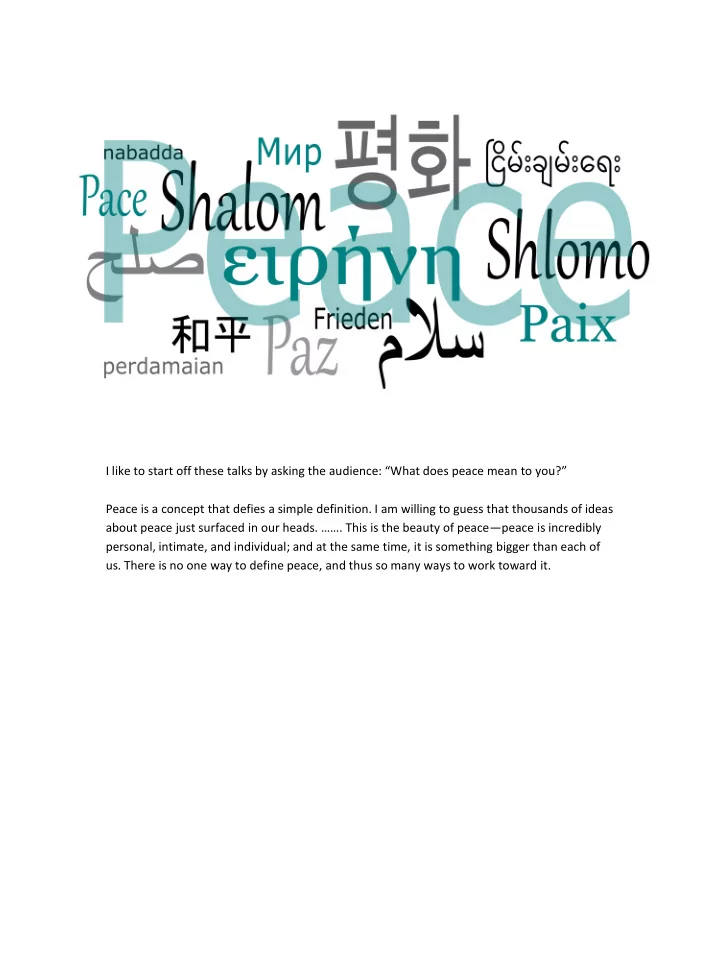
I like to start off these talks by asking the audience: “What does peace mean to you?” Peace is a concept that defies a simple definition. I am willing to guess that thousands of ideas about peace just surfaced in our heads. ……. This is the beauty of peace—peace is incredibly personal, intimate, and individual; and at the same time, it is something bigger than each of

  • us. There is no one way to define peace, and thus so many ways to work toward it.
slide-2
SLIDE 2

While Rotary as an organization has been committed to peace from its very start -- with a seat at the forming of the UN, in the creation of UNESCO, and to date, high level consultative status with UN Economic and Social Council -- peace hasn’t always been taken very seriously. Years ago, if you mentioned “peace” in conversations with international governing bodies, multilateral organizations, and politicians, you might at best be greeted with a raised eyebrow, and at worst, with laughter and eye rolling. But things are changing, and organizations like Rotary, in partnership with organizations like the Institute for Economics and Peace, are shifting the conversation on just what peace is (and isn’t), how peace is practiced, and how peace is measured.

2

slide-3
SLIDE 3

Instead of simply trying to achieve an absence of violence (or “negative peace”), Rotary has been focused on building “Positive Peace”—the attitudes, institutions, and structures that create and sustain peaceful societies. Rotary does this through its very membership, uniting individuals like yourselves in a common cause, and through its six (and soon to be seven) Areas of Focus

slide-4
SLIDE 4

The Rotary Foundation and Rotarians worldwide foster Positive Peace by supporting thousands of projects and programs, aligning with the UN’s Sustainable Development goals— addressing some of humanity’s most pressing issues. Considered through a Positive Peace lens, all six Areas of Focus are interconnected—they address social, economic, and political factors and relations—and consider the interrelated facets of human development.

slide-5
SLIDE 5

Turning our attention to the Peace and Conflict Prevention and Resolution Area of Focus is the vanguard of Rotary’s peace work – the Rotary Peace Fellowship program. This is Rotary’s “peace force” of more than 1200 leaders working in more than 100 countries in nongovernmental organizations large and small, foundations, government, and law

  • enforcement. Peace Fellows like:
slide-6
SLIDE 6

Abdikheir Ahmed, a Canadian of Somali origin, who now contributes to making Canada a more welcoming place, advocating for policies

slide-7
SLIDE 7

that empower refugees and immigrants to achieve their full potential in their new home.

slide-8
SLIDE 8

Amanda Martin, director of an innovative Community Transformation Center with Etta Projects, a public health organization addressing

slide-9
SLIDE 9

water, sanitation, and disease prevention in rural Bolivia working hand in hand with community health promoters and leaders.

slide-10
SLIDE 10

And Carlos Juarez, who witnessed increasing violence in his hometown of Acapulco, Mexico,

  • rganized neighbors to advocate for political action,
slide-11
SLIDE 11

and now directs the Institute for Economics and Peace in Mexico.

slide-12
SLIDE 12

I am proud to be counted among the ranks of these Peace Fellows, each of us with our own area of focus—together, cultivating the conditions for peaceful societies to flourish. As for my story… I grew up overseas, the daughter of civilians working for the US military— very aware of difference, privilege, and power from a young age. This awareness stayed with me as a university student—and I wanted to do something. I volunteered to lead an International Service Team to Guatemala and the Rotary Foundation—an organization I had never heard of before—made the trip possible with a Volunteer Service Grant.

slide-13
SLIDE 13

During my time in Guatemala, I was deeply impacted by a women’s textile cooperative, Ixoq aj Kemool—28 weavers who depended on their earnings to send their kids to school. At their request, a friend and I started a project in the US to sell the weavers’ handicrafts at a fair wage. That small project launched my career in international development: inspiring me to advocate for social justice for small-scale producers and community-driven development in the Global South. The Guatemala Service Team led to work with Equal Exchange, a fair trade coffee, tea, and chocolate company; and later, in academia, with gender studies, nonviolence studies and leadership studies at Kansas State University

slide-14
SLIDE 14

and ultimately with the Asian University for Women in Chittagong, Bangladesh—an institution dedicated to cultivating women leaders. These early career jobs allowed me to experience economic and community development at various levels

slide-15
SLIDE 15

—from the field, to the boardroom, to the classroom. But I reached a point where I knew I needed specific skills, knowledge, and connections to go further—to have a deeper impact on a global level. And the Rotary Peace Fellowship at the University of Queensland in Brisbane, Australia provided that opportunity.

slide-16
SLIDE 16

My Master’s in International Studies: Peace and Conflict Resolution, equipped me with the tools necessary to critically analyze and re-think development approaches—to be a more effective practitioner. And upon finishing the Fellowship, I was more hungry than ever to be back in the field, preventing conflict and building peace via community-driven development.

slide-17
SLIDE 17

I joined Coffee Kids, a US-based nonprofit dedicated to improving livelihoods for coffee farming communities in Latin America through health, education, food security, microfinance, and capacity building projects. In my job as International Program Coordinator, I worked one-

  • n-one with grassroots partner organizations to help them implement and measure the

impact of projects they themselves designed and carried out. Coffee Kids’ partners and project participants taught me a lot that I hadn’t learned in the

  • classroom. About entrepreneurship; about relationship building and trust; about building

capacities and resiliency in individuals and organizations in the face of challenges. About just what sustainability really means – and you have to ask the community you are working with that question to get a real answer. This work at Coffee Kids inspired me, along with my former boss

slide-18
SLIDE 18

to launch True Roots International, a consulting organization providing project management services for US and Canadian donor organizations carrying out development projects in Latin America. We started True Roots based on 15+ years working with grassroots organizations in different parts of the world. Like Rotarians who do these sorts of projects globally - we understood that many of these

  • rganizations know what they need to improve conditions in their communities, but often

lack the resources and connections to do so.

18

slide-19
SLIDE 19

And my work as a consultant providing monitoring and evaluation services to a Mexico Positive Peace Workshop, supported by Rotary and IEP in 2017… This 2017 PPW in Mexico was made possible by a Rotary Global Grant, and brought together more than 300 Rotaractors, university students, and youth leaders to learn about principles of positive peace and social change. My work at the time involved measuring the impact of this Workshop - which undeniably demonstrated that participants applied their new knowledge and skills gained at the training to local peacebuilding projects and collaboration networks. Specifically in the multiplier effect, with the information and skills gained in this project impacting over 16,000 other individuals around Mexico. This led me to my current work with the Rotary Foundation, as the Coordinator for the Partnership between Rotary and the Institute for Economics and Peace. Combining Rotary’s grassroots global network with IEP’s data measuring peace and their Positive Peace framework – creating tools and materials for 1.2 million Rotarians worldwide, making peace more tangible and actionable. At the cornerstone of this partnership is a focus on building knowledge, skills, and networks in Positive Peace in not just Mexico, but expanding this globally.

19

slide-20
SLIDE 20

Key partnership activities include Positive Peace Workshops for youth in both Mexico and Colombia in 2019

20

slide-21
SLIDE 21

Bringing together Rotarians, professional peacebuilding organizations, other volunteer

  • rganizations, and Rotary Peace Fellows.

21

slide-22
SLIDE 22

As a result of these workshops, the young people are organizing themselves regionally and carrying out actions or creating projects based on the Pillars of Positive Peace.

22

slide-23
SLIDE 23

And at present - in order to help make Positive Peace more tangible for Rotarians, the Rotary-IEP Partnership created the Positive Peace Activator Program. Between 2020 and 2022, 150 new Positive Peace Activators will be trained in six regions around the world. Who are the Positive Peace Activators? Rotarians, Rotary Peace Fellows, Rotaractors, and other Rotary stakeholders: Selected through a competitive process and who demonstrate a clear commitment to peacebuilding; some are Rotarian volunteers and others are full-time peacebuilding professionals. Attend an intensive 20-hour training on the Positive Peace methodology and framework. Make a two-year commitment to provide training, education, and support to Rotarians. We’ve completed our first training of Activators for the USA and Canada in January 2020 and will be training our Latin American Cohort in October of 2020.

slide-24
SLIDE 24

And what are Activators doing – specifically in response to COVID-19? Here are 2 examples. Lorelei Higgins Rotary Positive Peace Activator and Rotary Peace Fellow Lorelei Higgins provides an example of how an individual or organization can utilize systems thinking and simultaneously apply the Pillars of Positive peace in a very real, locally focused way. Lorelei works in the City of Calgary (Canada) Office. She is the lead for “Community Connections” and her team is responsible for ensuring that the offers, requests and resources related to the pandemic are connected in a meaningful way. Within her work, she is aligning the Pillars of Positive Peace and the overall local pandemic response, utilizing a SOAR (“Strengths, Opportunities, Aspirations, and Results”) analysis and asset mapping. Specifically: Lorelei has analyzed which pillars are being employed more than others in the evolving pandemic response in her city; she has analyzed the gaps in the current response efforts to see which pillars are not being addressed; and she is looking at which pillars will need to be employed for longer term recovery plans and building resilience post- COVID19. As a Métis person, Lorelei also sees a strong connection between the systems thinking the pillars require, and her own Indigenous worldviews of interconnectedness. In her words: “Positive peace has never mattered more. How we approach this pandemic will inform the society we live in post-

  • pandemic. Now is the time to lead, with courage, and to try out different analyses and approaches,

seeing where the pillars interact. What does your community need more of? What can you shift around to create more balance so the presence of one pillar can be more pronounced than previously?” María Julia Moreyra Rotary Positive Peace Activator and Rotary Peace Fellow María Julia Moreyra is a member of the

24

slide-25
SLIDE 25

And think about projects your district can support: here are two examples GG1640672: Strengthening capacities for Peacebuilding This International Training Institute, co-created with Rotary and Mediators Beyond Borders, was held in Jakarta, Indonesia, and designed to support and prepare women in Southeast Asia to thrive as leaders in peacebuilding. The training aimed to increase their capacity in mediation and negotiation, as well as developing a global network of women peace leaders in the Association of Southeast Asian Nations. Unresolved traumas of factional violence, as well as interfaith, interethnic, and international conflicts, present recurrent obstacles to the personal and economic wellbeing of individuals, organizations, communities, and

  • governments. In addition, a one-day training for local NGOs was organized by Rotary, with

assistance from the Department of Justice, to address issues of peace and conflict resolution facing the Jakarta community. This project has also been implemented in South America.

  • Peace in Chicago Schools Project

This project brought Rotary together with two Chicago, Illinois, USA, schools to develop an integrated approach to providing Chicago youth with tools and strategies to achieve inner and

  • utward peace, as well as successfully addressing conflict situations in their lives, homes, and
  • community. This was achieved through a variety of techniques, including training youth how

to release and manage their stress and negative emotions, how to resolve conflict through the restorative justice programs, and how to build leadership skills through integrated sports programming.
slide-26
SLIDE 26

So as you can see, Rotary is doing so much to support peacebuilding work. This is where Rotarians’ investment is key. It’s one thing to build wells and schools – and another to build skills and networks of young people who are on the ground, addressing pressing issues in the context they know best - and building peace. This is where Rotary’s peace work comes full circle. Some might resort to hopelessness in the face of violence, war, and conflict – when we read the newspaper or watch the news. But we as Rotarians do not have that luxury. But we are seeing a return on investment on Rotary’s peace work, and we must maintain HOPE that this positions Rotary as THE organization to make peace a reality, globally. In conclusion, just by being Rotarians, you are doing concrete work to support peace in your district.

slide-27
SLIDE 27

And there is so much your district can do: Support the Rotary Peace Fellowship Program. Create a Peace Chair in your District. Seek out ideal candidates and provide strong guidance through the application process.

slide-28
SLIDE 28

Join and become active in the Rotarian Action Group for Peace, an organization offering guidance and resources to further collective Rotary peace efforts

slide-29
SLIDE 29

Propose and fund peace projects via district grants and global grants and ask a Rotary Peace Fellow to assist!

slide-30
SLIDE 30

Plug into the new Rotary - Institute for Economics and Peace Partnership, linking IEP’s empirical peace research to Rotary’s grassroots work in communities around the globe

slide-31
SLIDE 31

Join the Rotary Positive Peace Academy: Learn how to promote peace in your community through this free, self-paced, online training course for Rotarians. You can also host a Club & District Positive Peace Presentation: using a PowerPoint presentation and facilitation guide at Rotary club meetings and district conferences (20-40 minutes in length, respectively) available via the Rotary-IEP partnership webpage on the Rotary.org website. Think about hosting your own Positive Peace project or workshop in the future. A Positive Peace Workshop curriculum and facilitation guide will be available to all Rotarians in about a month. Consider engaging with an Activator for a presentation or training on Positive Peace – get in touch with me to find out more. If all that is too much for you, then can I at least get you to do one thing? This doesn’t involve significant amounts of money or time – it’s something that even the busiest of you can commit to. And this is to consider your role in peace.

31

slide-32
SLIDE 32

As Desmond Tutu says: “My humanity is bound up in yours, for we can only be human together.” In other words, “my peace is tied to your peace.” This means that what each of you do in your personal and Rotary life—individual efforts—add up to collective movement and change. So, if there is only one thing that sticks with you today—let it be this: each of you is a

  • peacebuilder. Peace work is not just something relegated to government officials, high-level
  • fficials at the UN, or even just Rotary Peace Fellows. Peace is something that each of us can

and must “do.”

slide-33
SLIDE 33

33