
SLIDE 1
8/22/2016 1
ECC Excels
ECC’s Strategic Plan
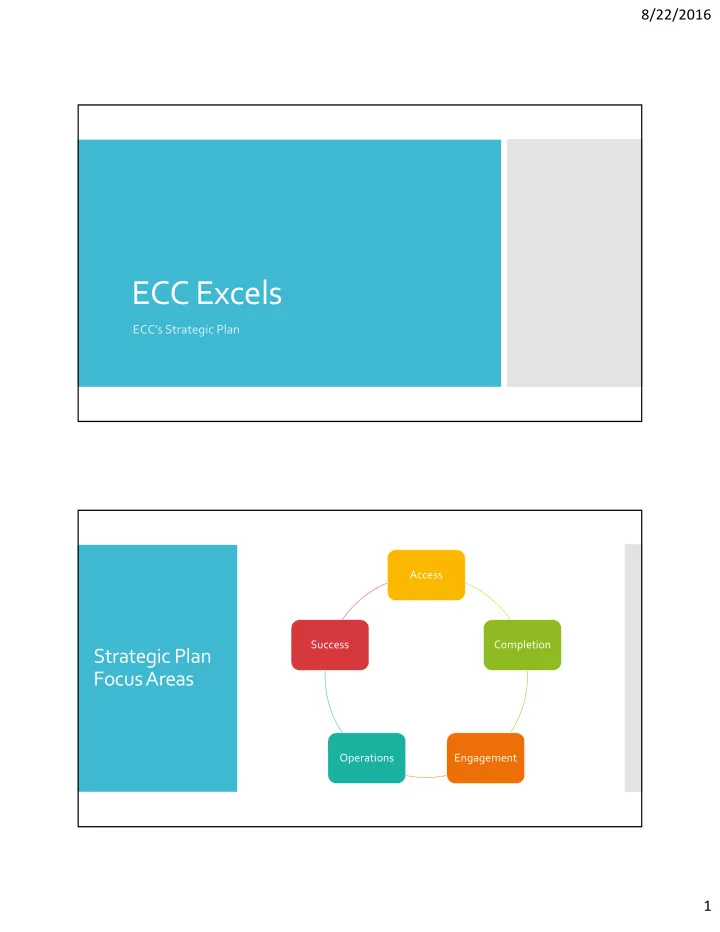
Strategic Plan Focus Areas
Access Completion Engagement Operations Success
ECC Excels ECCs Strategic Plan Access Success Completion Strategic - - PDF document
8/22/2016 ECC Excels ECCs Strategic Plan Access Success Completion Strategic Plan Focus Areas Operations Engagement 1 8/22/2016 1. Enrollment: Moderate increase of 1.75% annually starting in 2017 2018 (flat enrollment in 2016 2017)
8/22/2016 1
ECC’s Strategic Plan
Access Completion Engagement Operations Success
8/22/2016 2
starting in 2017‐2018 (flat enrollment in 2016‐2017)
rate from 10.1% to 18.4%
year graduation rate
2020‐21
years
Accessibility: is there an aggressive plan to address disabled access? Is #1 clear? Cost: Is a rational tuition plan feasible? Curriculum: Will the college create a dedicated seed fund in the current fiscal climate? Distance Learning: Is staffing adequate to support goals? Employee Diversity: Are the diversity goals too aggressive? Intake: Is there adequate IT support to automate communication?
8/22/2016 3
Completion Workflows: How aggressive should the transition to self‐service be? Data: How close are we to a 360‐degree view? Distance Learning Success: Does the college have a strategic and comprehensive understanding of the future of online learning? Student Placement: Should the college move to eliminate placement testing and stand‐alone developmental courses? Should there be more aggressive use of embedded remediation? Support: Are faculty advisors being effectively utilized for support purposes?
Civic Engagement: What kinds of measurements are possible beyond a fiscal impact analysis? Employee Development and Engagement: How difficult will it be to establish periodic and consistent training on the academic side? Student Engagement: Is the single initiative aggressive enough? Workforce Development: How can we operationalize the use of the Office as an academic program incubator?
8/22/2016 4
Administrative Processes: Can faculty resistance to losing spaces and rooms be overcome when adopting a zero‐based schedule? Are all units currently equipped with adequate management expertise to perform workflow and process analysis? Facilities: Are supervisors consistently in the loop on facilities changes? Does it make sense to pursue a School of Nursing in the current fiscal climate? Finance: Is this sufficient given the Middle‐States mandate to clearly connect resource allocation to assessment and planning? Quality: Do offices have the management expertise to think in terms of performance indicators? What kind of training would be required to accomplish these goals? Is this area aggressive enough in the area of academic assessment? Technology: Is there an effective management structure to review facilities proposals?
Workforce Success and Job Linkage: Have we properly envisioned the future of college‐workforce connections? Is this an area which requires longer‐term visionary focus? Successful Transfer: Is there a centralized transfer function at the college that will take ownership of transfer success?