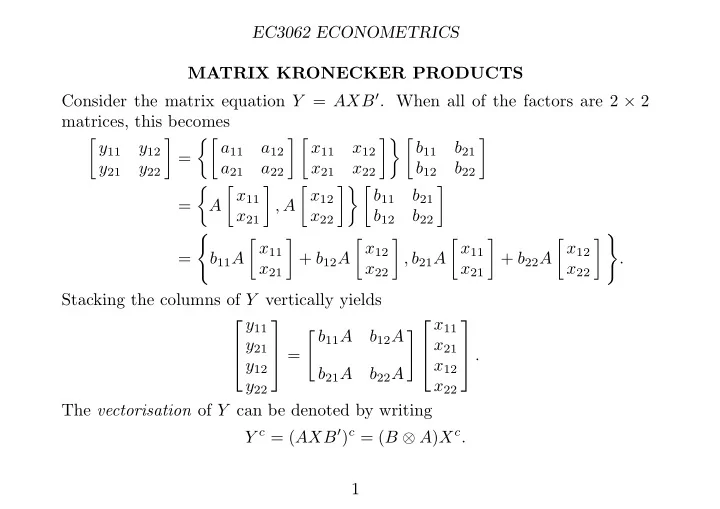
SLIDE 1 EC3062 ECONOMETRICS MATRIX KRONECKER PRODUCTS Consider the matrix equation Y = AXB′. When all of the factors are 2 × 2 matrices, this becomes
y12 y21 y22
a12 a21 a22 x11 x12 x21 x22 b11 b21 b12 b22
x21
x22 b11 b21 b12 b22
x21
x22
x21
x22 . Stacking the columns of Y vertically yields y11 y21 y12 y22 = b11A b12A b21A b22A x11 x21 x12 x22 . The vectorisation of Y can be denoted by writing Y c = (AXB′)c = (B ⊗ A)Xc. 1
SLIDE 2 EC3062 ECONOMETRICS The Kronecker product of the matrices A and B is defined by A ⊗ B = a11B a11B . . . a1nB a21B a21B . . . a2mB . . . . . . . . . am1B am2B . . . amnB . The following rules govern Kronecker products: (i) (A ⊗ B)(C ⊗ D) = AC ⊗ BD, (ii) (A ⊗ B)′ = A′ ⊗ B′, (iii) A ⊗ (B + C) = (A ⊗ B) + (A ⊗ C), (iv) λ(A ⊗ B) = λA ⊗ B = A ⊗ λB, (v) (A ⊗ B)−1 = (A−1 ⊗ B−1). The product is non-commutative, which is to say that A⊗B = B⊗A. However,
A ⊗ B = (A ⊗ I)(I ⊗ B) = (I ⊗ B)(A ⊗ I). 2
SLIDE 3
EC3062 ECONOMETRICS ECONOMETRIC PANEL DATA The Unrestricted Model with Common Regressors Consider M firms or individuals indexed by j = 1, . . . , M. These react differ- ently to the same measured influences, as indicated by the parameters αj and β.j. The set of T realisations of the jth equation can be written as (8) y.j = αjιT + Xβ.j + ε.j. This is a classical regression equation that can be estimated by OLS. The full set of M such equations can be compiled as the system: y.1 y.2 . . . y.M = ιT . . . ιT . . . . . . . . . ... . . . . . . ιT α1 α2 . . . αM + X . . . X . . . . . . . . . ... . . . . . . X β.1 β.2 . . . β.M + ε.1 ε.2 . . . ε.M . Using the Kronecker product, this can be rendered as (10) Y c = (IM ⊗ ιT )α + (IM ⊗ X)Bc + Ec. 3
SLIDE 4 EC3062 ECONOMETRICS The General Model A useful elaboration is to allow the matrix X to vary between the M
- equations. Then, in place of the variables xtk, there are elements xtkj bearing
the individual-specific subscript j. Then, equation (9) is replaced by (11) y.1 y.2 . . . y.M = ιT . . . ιT . . . . . . . . . ... . . . . . . ιT α1 α2 . . . αM + X1 . . . X2 . . . . . . . . . ... . . . . . . XM β.1 β.2 . . . β.M + ε.1 ε.2 . . . ε.M . For example, the equations, explaining farm production in M regions, may com- prise explanatory variables whose measured values vary from region to region. The jth equation of the general model can be written as (12) y.j = ιT αj + Xjβ.j + ε.j. 4
SLIDE 5
EC3062 ECONOMETRICS The Model with Individual Fixed Effects Within this model, some restrictions can be imposed. Thus (13) Hβ : β.1 = β.2 = · · · = β.M, asserts that the slope parameters of all M of the regression equations are equal. This condition gives rise to the following model: (14) y.1 y.2 . . . y.M = ιT . . . ιT . . . . . . . . . ... . . . . . . ιT α1 α2 . . . αM + X1 X2 . . . XM β + ε.1 ε.2 . . . ε.M , Here, each of the M equations has a particular value for the intercept. This system of equations can be rendered as (15) Y c = (IM ⊗ ιT )α + Xβ + Ec, where X′ = [X′
1, X′ 2, . . . , X′ M]. It is common, in many many textbooks, to write
(IM ⊗ ιT ) = D for the so-called matrix of dummy variables associated with the intercept terms. 5
SLIDE 6
EC3062 ECONOMETRICS The Pooled Model A further hypothesis is that all of the intercepts have the same value: (16) Hα : α1 = α2 = · · · = αM. It is unlikely that one would maintain this hypothesis without asserting Hβ at the same time. The combined hypothesis Hγ = Hα ∩ Hβ gives rise to (17) y.1 y.2 . . . y.M = ιT ιT . . . ιT α + X1 X2 . . . XM β + ε.1 ε.2 . . . ε.M . This system of equations can be rendered as (18) Y c = ιMT α + Xβ + Ec, where, as before, X′ = [X′
1, X′ 2, . . . , X′ M] and where ιMT is a long vector consist-
ing of MT units. This has the structure of the equation of a classical regression model, for which OLS is efficient. 6
SLIDE 7 EC3062 ECONOMETRICS The Least-Squares Estimation: the General Unrestricted Model We assume that the disturbances εtj are distributed independently and identically, with E(εtj) = 0 and V (εtj) = σ2 for all t, j. Then, the equations of the general model of (11) are separable, and the jth equation may be estimated efficiently by OLS. The regression can be applied directly to the individual equations of (11). Alternatively, the intercept terms can be eliminated by taking the deviations of the data about their respective sample means. Then, the estimates for the jth equation are (19) ˆ β.j =
j(I − PT )Xj
−1X′
j(I − PT )y.j
and ˆ αj = ¯ yj − ¯
β.j, where (20) I − PT = I − ιT (ι′
T ιT )−1ι′ T
is the operator that transforms a vector of T observations into the vector of their deviations about the mean. 7
SLIDE 8 EC3062 ECONOMETRICS The intercept terms would be eliminated by premultiplying the full system of equations by (24) W = IM ⊗ (IT − PT ) = IMT − (IM ⊗ PT ) = IMT − D(D′D)−1D′. The residual sum of squares from the jth regression is given by (21) Sj = y′
.j(I − PT )y.j − y′ .j(I − PT )Xj{X′ j(I − PT )Xj}−1X′ j(I − PT )y.j.
From the separability of the M regressions, it follows that the residual sum of squares, obtained from fitting the multi-equation model of (11) to the data, is (22) S =
Sj. 8
SLIDE 9
EC3062 ECONOMETRICS Estimation of the Model with Individual Fixed Effects Now, consider fitting the model under (14), which arises from the general model (11) when the slope parameters of the regressions are the same in every region. Then, the efficient estimates are obtained by treating the system of equations as a whole. To eliminate the intercept terms, the individual equations y.j = αjιT + Xjβ +εj are multiplied by the operator I −PT , to create deviations of the data about sample means: (25) (I − PT )y.j = (I − PT )Xjβ + (I − PT )εj, The equation at time t is (26) ytj − ¯ yj = (x.tj − ¯ x.j)β + (εtj − ¯ εj). To obtain an efficient estimate of β, the full set of TM mean-adjusted equa- tions must be taken together. Once the estimate of β available, the individual intercept terms can be obtained. 9
SLIDE 10 EC3062 ECONOMETRICS The efficient system-wide estimates for the slope parameters and the intercepts are (27) ˆ βW =
j
X′
j(I − PT )Xj
−1
j
X′
j(I − PT )yj
IM ⊗ (IT − PT )
−1 X′ IM ⊗ (IT − PT )
and ˆ αj = ¯
xj ˆ βW , j = 1, . . . , M, where X′ = [X′
1, X′ 2, . . . , X′ M] and y′ = [y′ .1y′ .2, . . . , y′ .M]. Here, ˆ
βW is the result
- f applying OLS to an equation derived by premultiplying (14) by the matrix
W of (24), to annihilate the intercept terms. The residual sum of squares from fitting the model of (14) is given by (28) Sβ = y′Wy − y′WX(X′WX)−1X′Wy, where W = IM ⊗ (IT − PT ). The estimator ˆ βW of (27) makes use only of the information conveyed by the deviations of the data points from their means within the M groups. For this reason, it is often called the within-groups estimator. 10
SLIDE 11 EC3062 ECONOMETRICS The operator that averages over the sample of T observations is PT = ιT (ι′
T ιT )−1ι′ T . Applying it to the generic equation of (14) gives
(29) PT y.j = PT ιT α.j + PT Xjβ + PT εj
ιT ¯ y = ιT αj + ιT ¯ x.jβ + ¯ ιT εj. This equation comprises T redundant repetitions of the equation (30) ¯ yj = α + ¯ x.jβ + (αj − α + ¯ εj), where α =
j αj/M is a global or averaged intercept term, and where the
deviation of the jth intercept αj from global value has been joined with the averaged disturbance term. Having gathering together the M equations of this form, an ordinary least- squares estimate of β, denoted ˆ βB can be obtained which is described as the between-groups estimator. This estimator uses only the information conveyed by the variation amongst the M group means. 11
SLIDE 12
EC3062 ECONOMETRICS The Pooled Estimator Finally, consider fitting the model of (17) which, on the basis of the hy- pothesis Hγ, makes no distinction between the structures of the M equations. Let PMT denote the projector PMT = ιMT (ι′
MT ιMT )−1ι′ MT , where ιMT is the
summation vector of order MT. Then, the estimators of the parameters of the model can be written as (31) ˆ βG = {X′(I − PMT )X}−1X′(I − PMT )y ˆ α = ¯ y − ¯ xˆ β. The residual sum of squares from fitting the restricted model of (17) is given by (32) Sγ = (y − αιMT − X ˆ β)′(y − αιMT − X ˆ β). 12
SLIDE 13
EC3062 ECONOMETRICS The Tests of the Restrictions In order to test the various hypotheses, the following results are needed, which concern the distribution of the residual sum of squares from each of the regressions that have been considered: (33) 1. 1 σ2 S ∼ χ2{MT − M(K + 1)}, 2. 1 σ2 Sβ ∼ χ2{MT − (K + M)}, 3. 1 σ2 Sγ ∼ χ2{MT − (K + 1)}. The number of degrees of freedom in each of these cases is easily explained. It is simply the number of observations available in the vector y′ = [y′
.1, y′ .2, . . . , y′ .M]
less the number of parameters that are estimated in the particular model. 13
SLIDE 14 EC3062 ECONOMETRICS The hypothesis Hβ can be tested by assessing the loss of fit from imposing the restrictions β1 = β2 = · · · = βM. The loss is given by Sβ − S. This is measured in comparison with residual sum of squares S from the unrestricted
- model. The appropriate test statistic is
(34) F =
(M − 1)K
MT − M(K + 1)
which has a F distribution of (M −1)K and MT −M(K+1) degrees of freedom. If the hypothesis Hβ is accepted, then one might proceed to test the more stringent hypothesis Hγ = Hβ ∩ Hα which entails the additional restrictions of Hα : α1 = α2 = · · · = αM. The relevant test statistic is (35) F =
M − 1
MT − (K + M)
which has a F distribution of M − 1 and MT − (K + M) degrees of freedom. The numerator of this statistic embodies a measure of the loss of fit that comes from imposing the additional restrictions of Hα. 14
SLIDE 15 EC3062 ECONOMETRICS The statistic of (35) tests the hypothesis Hγ within the context of an as- sumption that Hβ is true. One might decide to test additionally, or even alterna- tively, the joint hypothesis Hγ = Hα ∩Hβ within the context of the unrestricted
- model. The relevant statistic in that case would be given by
(36) F =
(M − 1)(K + 1)
MT − M(K + 1)
The possibility has to be considered that, having accepted the hypotheses Hβ and Hα on the strength of the values the F statistics under (34) and (35), we shall then discover that value of the statistic of (36) casts doubt on the joint hypothesis Hγ = Hβ ∩ Hα. The possibility arises from the fact that critical region of the test of Hγ can never coincide with the critical region of the joint test implicit in the sequential
- procedure. However, if the critical value of the test Hγ has been appropriately
chosen, then such a conflict in the results of the tests is an unlikely eventuality. 15
SLIDE 16
EC3062 ECONOMETRICS Models with Two-way Fixed Effects The model of Hβ can be elaborated by including the parameters γt which represent the temporal variation that is experienced by all J individuals. Assuming a common slope parameter, the system of equations as a whole is (38) Y c = µιMT + Xβ + (ιM ⊗ IT )γ + (IM ⊗ ιT )δ + Ec. The matrix [ιMT , X, ιM ⊗ IT , IM ⊗ ιT ], containing the regressors is singular, because of the linear dependence between the columns of [ιMT , ιM ⊗IT , IM ⊗ιT ]. This dependence is evident from the equation (39) (ιM ⊗ IT )(1 ⊗ ιT ) = (IM ⊗ ιT )(ιM ⊗ 1) = ιMT . Therefore, the parameters µ, β, γ, δ will not be estimable as a whole unless some restrictions are introduced. It is natural to impose the conditions that ι′
T γ = t γt = 0 and that ι′ MT δ = j δj = 0.
The parameters γ, δ, µ can be eliminated by premultiplying the equation (39) by the matrix (40) W = [IMT − (IM ⊗ PT )][IMT − (PM ⊗ IM)] = IMT − (IM ⊗ PT ) − (PM ⊗ IM) + (IM ⊗ PT )(PM ⊗ IM). 16
SLIDE 17
EC3062 ECONOMETRICS The two factors of W commute. The first factor IMT − (IM ⊗ PT ) annihilates the term (IM ⊗ιT )δ. The second factor IMT −(PM ⊗IM) annihilates (ιM ⊗ IT )γ. However, since W is a symmetric idempotent matrix, it can be written in the form of W = QQ′, where Q is a matrix of order MT × (MT − M − T) consisting or orthonormal vectors. Therefore, the equation may, be transformed, with equal effect, by premultiplying it by Q′ to obtain the system (41) Q′Y c = Q′Xβ + Ec. The latter fulfils the assumptions of the classical linear model. It follows that the efficient estimator of β is given by (42) ˆ β = (X′QQ′X)−1X′QQ′y = (X′WX)−1X′Wy. 17
SLIDE 18
EC3062 ECONOMETRICS Models with Random Effects An alternative way of accommodating temporal and individual effects is to regard them as random variables rather than as fixed constants. These effects, which are now part of the disturbance structure of the model, must be uncorrelated with the systematic part of its structure. A set of T realisations of all M equations is now written as (44) y = µιMT + Xβ + (ιM ⊗ IT )ζ + (IM ⊗ ιT )η + ε. It is assumed that the random variables ζt, ηj and εtj are independently distributed with expectations of zero and with V (ζt) = σ2
ζ, V (ηj) = σ2 η and
V (εtj) = σ2
ε. Then, the dispersion matrix of the vector of disturbances is
(45) Ω = σ2
ζ(ιMι′ M ⊗ IT ) + σ2 η(IM ⊗ ιT ι′ T ) + σ2 εIMT .
A special case is when σ2
ζ = 0, which is when there is no intertemporal
variation in the disturbances. Then (46) Ω = σ2
η(IM ⊗ ιT ι′ T ) + σ2 εIMT
= IM ⊗ (σ2
εIT + σ2 ηιT ιT ) = IM ⊗ V.
18
SLIDE 19 EC3062 ECONOMETRICS It can be confirmed by direct multiplication that the inverse of the matrix V = σ2εIT + σ2
ηιT ιT is
(47) V −1 = 1 σ2
ε
σ2
η
σ2
ε + Tσ2 η
ιT ι′
T
The inverse of the matrix Ω of (35) has a somewhat complicated structure. It takes the form of the form of (48) Ω−1 = 1 σ2
ε
{IMT −λ1(ιMι′
MT ⊗ IT ) + λ2(IM ⊗ ιT ι′ T ) + λ3(ιMι′ MT ⊗ ιT ιT )}
where λ1 = σ2
ζ(σ2 ε − Mσ2 ζ)−1,
λ2 = σ2
η(σ2 ε − Tσ2 η)−1,
λ3 = λ1λ2(2σ2
ε + Mσ2 ζ + Tσ2 η)(σ2 ε + Mσ2 ζ + Tσ2 η)−1.
19
SLIDE 20 EC3062 ECONOMETRICS Feasible Least-Squares Estimator of the Random Effects Model In order to realise the generalised least squares estimators of the random effect models, it is necessary to derive estimators of the variances σ2
ζ, σ2 η and
σ2
ε of the error components. For simplicity, we shall continue to assume that
σ2
ζ = 0. Then, the appropriate estimator can be derived from the the within-
groups and between groups estimators associated with the fixed effects model
- f equation (9). The estimators are
(49) ˆ σ2
ε = (y − X ˆ
βW )′(y − X ˆ βW ) MT − (K + M) , ˆ σ2
B = (y − X ˆ
βB)′(y − X ˆ βB) M − K and ˆ σ2
η = ˆ
σ2
B − ˆ
σ2
ε
T . 20