
SLIDE 1
Eastpoint Planning Study Public Presentation
30 October 2012
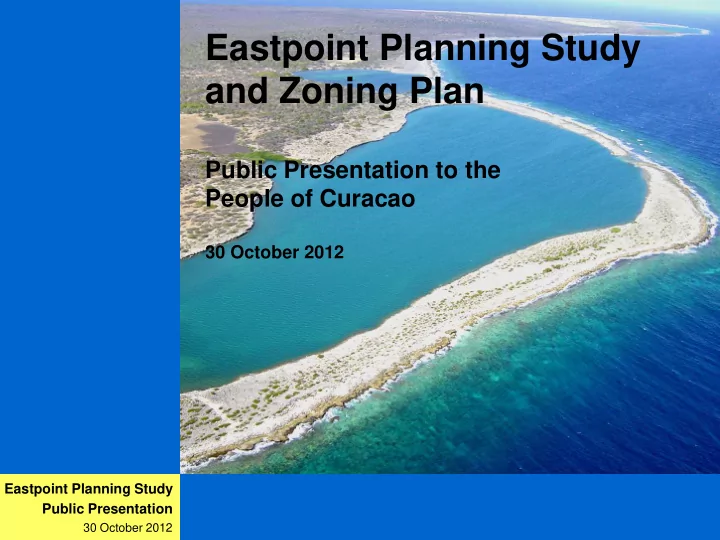
Eastpoint Planning Study and Zoning Plan
Public Presentation to the People of Curacao
30 October 2012
Eastpoint Planning Study and Zoning Plan Public Presentation to the - - PowerPoint PPT Presentation
Eastpoint Planning Study and Zoning Plan Public Presentation to the People of Curacao 30 October 2012 Eastpoint Planning Study Public Presentation 30 October 2012 Agenda Approach Site Overview Environmental Assessment Results of
Eastpoint Planning Study Public Presentation
30 October 2012
30 October 2012
Eastpoint Planning Study Public Presentation
30 October 2012
Approach Site Overview Environmental Assessment Results of Environmental Assessment Infrastructure Assessment Site Analysis Environmental Principles Planning Principles Development Objectives Proposed Zoning Plan Recommendations for Sustainable Development Conclusion
Agenda
Eastpoint Planning Study Public Presentation
30 October 2012
1. Preparation of an Environmental and Ecological Assessment Report and an Infrastructure Assessment and Sustainability Report. 2. Preparation of a Site Analysis to provide a basic understanding of the site, both potential development areas as well as sensitive areas to be designated as conservation / open lands 3. The reports and Site Analysis were used in the evaluation of preliminary development scenarios 4. Preparation of Environmental Principles and Develop- ment Objectives influencing the proposed plan. 5. Preparation of alternative Zoning Plans, evaluation of pros and cons, and refinement and preparation of the final Zoning Plan 6. Preparation of recommendations for sustainable development in order for Eastpoint to be as self supporting as possible
Approach
Eastpoint Planning Study Public Presentation
30 October 2012
Site Overview – Oostpunt / Awa di Oostpunt
Eastpoint Planning Study Public Presentation
30 October 2012
Site Overview – Salinja Cabes (near Awa di Oostpunt) Xxxxxxxxxxxxxxxxxx
Eastpoint Planning Study Public Presentation
30 October 2012
Site Overview – Oost Seinpost looking east to Seru Grande Xxxxxxxxxxxxxxxxxx
Eastpoint Planning Study Public Presentation
30 October 2012
Site Overview – View from Oost Seinpost over Fuik area towards the Duivelsklip and the Caribbean Sea Xxxxxxxxxxxxxxxxxx
Eastpoint Planning Study Public Presentation
30 October 2012
Site Overview – Fuik Baai looking east Xxxxxxxxxxxxxxxxxx
Eastpoint Planning Study Public Presentation
30 October 2012
Site Overview – North coast plateau Xxxxxxxxxxxxxxxxxx
Eastpoint Planning Study Public Presentation
30 October 2012
The planning teams literature search and field investigations culminated in the development of an Environmental Assessment Report which addressed the following broad subject areas:
The report is based on research, review of the existing scientific literature, and meetings and discussions with the landowner and local experts. The planning team also conducted site visits as follows:
spent on site by Langan scientists and engineers)
Environmental Assessment
Eastpoint Planning Study Public Presentation
30 October 2012
Research, field investigations, studies and surveys enabled documentation and more accurate identification of critical natural resources including but not limited to :
confirmed by daytime and nocturnal bat surveys
Crested Caracara; American Kestrel; Caribbean Flamingo and White- tailed Hawk
This research enabled the team to identify potential existing and future threats to the resources and develop preliminary conservation recommendations to protect and conserve these important natural resources as part of the overall Planning Study.
Environmental Assessment
Eastpoint Planning Study Public Presentation
30 October 2012
Water
and expect to be able to serve future Eastpoint demand
Power Supply & Renewable Energy
and expect to be able to serve future Eastpoint demand
Telecommunications
future Eastpoint demand
Solid Waste
collection service as necessary to serve future Eastpoint demand
developments and would likely be re-used as irrigation water
Infrastructure Assessment
Eastpoint Planning Study Public Presentation
30 October 2012
Stormwater
volumes and flow rates so as not to increase existing discharges to receiving waters
runoff quality so as to minimize erosion and sedimentation to receiving water
Traffic and Transportation
access roads from the Ring to Eastpoint will be gradually widened from 2 to 4 lanes along the two major routes:
Liberia / Weg Naar Sta. Barbara
Montana / Kaminda Jose C. Anthonia / Weg Naar Fuik
Infrastructure Assessment
Eastpoint Planning Study Public Presentation
30 October 2012
Site Analysis
Eastpoint Planning Study Public Presentation
30 October 2012
Site Analysis Site Analysis – Enlargement North section of Eastpoint, including St. Joris Baai, Landhuis Klein St. Joris, and portion of north coast
Eastpoint Planning Study Public Presentation
30 October 2012
Site Analysis Site Analysis – Enlargement Southwest section of Eastpoint, from Fuik Baai to Awa Blanku, including Oost Seinpost and Seru Grande
Eastpoint Planning Study Public Presentation
30 October 2012
Site Analysis Site Analysis – Enlargement Southeast section of Eastpoint, Awa Blanku to Oostpunt / Awa di Oostpunt and portion of north coast
Eastpoint Planning Study Public Presentation
30 October 2012
Environmental Principles
No development in tidal, brackish, freshwater wetlands or salinjas. No development in mangrove swamps. No development in major drainage swales; 100 m buffer corridor along swales. Treat natural rainfall as a valuable and precious natural resource. No development on peaks, hilltops, ridgelines, or other unique and important geological features. No development on steep slopes. Limited development within lagoons for water-related uses, such as marinas or south seas type bungalows over the water. No other development within lagoons. No development on narrow barrier beaches. Establish wildlife corridors that connect habitats throughout Eastpoint. No impacts on the offshore coral reefs. No impacts on resident bats or resident or migratory birds. Preserve important historical and cultural artifacts and sites. No development immediately around Landhuis Fuik or Landhuis Klein Sint Joris.
Eastpoint Planning Study Public Presentation
30 October 2012
Planning Principles
Lower elevations without sea views are not well suited for real estate development. Mountain peaks, crests, and ridgelines should be kept in their natural state. Lower elevations can be used for minor land uses. Hotels should be “clustered” since they tend to complement each other. Hotels must have a beach in order to compete in an island resort environment. No homes or residential areas should be accessed directly from primary roads. Retail, entertainment and tourist venues should be located near the hotels. Main roads to hotels and destination venues should be as direct as possible. Golf should be “links” type courses, with fairways incorporating natural terrain. No development in, and minimal disturbance of, natural drainage corridors. Open space / conservation areas should be contiguous, with few road crossings. Agricultural uses should be placed in the lower elevations of the site. Agriculture should be contiguous and have separate access. Project should be phased such that new construction does not conflict with previously developed phases.
Eastpoint Planning Study Public Presentation
30 October 2012
Development Objectives
Plan and develop Eastpoint as a community where locals live, work, and play. Accommodate locations for “village centers” with mixed-use development. Realize the site’s real estate potential by locating tourism along the south coast. Tourist hotels should be adjacent to, and around, the lagoons. Luxury residential should be near the lagoons and along the south coast. Locate higher density “urban areas” on the slopes along the south coast. Plan Eastpoint development according to sustainable design principles. Provide a marina in Fuik Bay, which already has deepwater access to the sea. Consider boat access into Lagun Blancu. Limited development within lagoons for water-related uses, such as marinas or south seas type bungalows over the water. Water in which development is allowed to be designed “Tourism.” Other undeveloped areas to be designated as “Water.” Maintain Awa Blancu and Awa di Oostpunt without motorized boat access. Accommodate two “players” destination golf courses on the north coast and one “community” golf course in the interior of the site.
Eastpoint Planning Study Public Presentation
30 October 2012
Development Objectives
Road system to have multiple points of entry, include a main roadway to the south coast, and have internal loops for flexibility and better traffic distribution. 75 hectares to be transferred from the Maal family to the government adjacent to Fuik.
Eastpoint Planning Study Public Presentation
30 October 2012
Proposed Zoning Plan
Eastpoint Planning Study Public Presentation
30 October 2012
Proposed Zoning Plan Proposed Zoning Plan – Enlargement (North) North section of Eastpoint, including St. Joris Bay, Landhuis Klein St. Joris, and portion of north coast
Eastpoint Planning Study Public Presentation
30 October 2012
Proposed Zoning Plan – Enlargement (Southwest) Southwest section of Eastpoint, from Fuik Baai to Awa Blanku, including Oost Seinpost and Seru Grande
Eastpoint Planning Study Public Presentation
30 October 2012
Proposed Zoning Plan – Enlargement (Southeast) Southeast section of Eastpoint, Awa Blanku to Oostpunt / Awa di Oostpunt and portion of north coast
Eastpoint Planning Study Public Presentation
30 October 2012
Summary of Recommendations for Sustainable Development
Water
Renewable Energy
Telecommunications
Solid Waste
Wastewater
Traffic and Transportation
Eastpoint Planning Study Public Presentation
30 October 2012
Stormwater
Summary of Recommendations for Sustainable Development
Eastpoint Planning Study Public Presentation
30 October 2012
46.1% of the land is designated in the Zoning Plan as “non- developable” (Conservation, Park, Open Lands, or Water) The Zoning Plan respects the natural systems and environmental areas present on site. In fact, it adds to these by providing new “linkages” to connect existing ecological areas. 53.9% of the land is “developable.” However, this is a bit misleading, as four of the eight land uses are mostly or partly green (Conservation / Tourism Support (golf); Conservation / Rural Habitation Support (wind farm); Agriculture; and Roads, which will be partly green). Approximately 72% of the site will remain undeveloped and green, which is a remarkably high percentage and high level of commitment to the environment. The Zoning Plan balances the physical capabilities of the land with the realities of development.
Conclusion