
Habitat
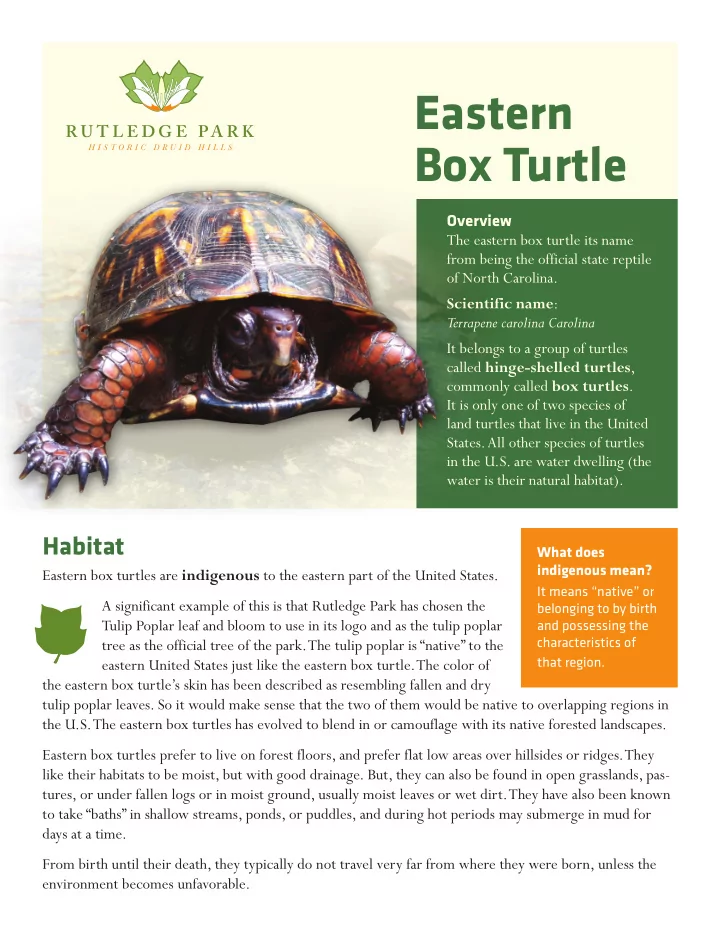
Eastern box turtles are indigenous to the eastern part of the United States. A significant example of this is that Rutledge Park has chosen the Tulip Poplar leaf and bloom to use in its logo and as the tulip poplar tree as the official tree of the park. The tulip poplar is “native” to the eastern United States just like the eastern box turtle. The color of the eastern box turtle’s skin has been described as resembling fallen and dry tulip poplar leaves. So it would make sense that the two of them would be native to overlapping regions in the U.S. The eastern box turtles has evolved to blend in or camouflage with its native forested landscapes. Eastern box turtles prefer to live on forest floors, and prefer flat low areas over hillsides or ridges. They like their habitats to be moist, but with good drainage. But, they can also be found in open grasslands, pas- tures, or under fallen logs or in moist ground, usually moist leaves or wet dirt. They have also been known to take “baths” in shallow streams, ponds, or puddles, and during hot periods may submerge in mud for days at a time. From birth until their death, they typically do not travel very far from where they were born, unless the environment becomes unfavorable. Overview The eastern box turtle its name from being the official state reptile
- f North Carolina.
Scientific name: Terrapene carolina Carolina It belongs to a group of turtles called hinge-shelled turtles, commonly called box turtles. It is only one of two species of land turtles that live in the United
- States. All other species of turtles
in the U.S. are water dwelling (the water is their natural habitat).
Eastern Box Turtle
What does indigenous mean?
It means “native” or belonging to by birth and possessing the characteristics of that region.