Genetic data can be used to Genetics in Conservation clarify - - PDF document

genetic data can be used to genetics in conservation
SMART_READER_LITE
LIVE PREVIEW

Genetic data can be used to Genetics in Conservation clarify - - PDF document

Genetic data can be used to Genetics in Conservation clarify species status Kemps Ridley Turtle Olive Ridley Turtle Can be used to clarify species status Genetic variability is needed to respond to environmental change Heterozygosity or high


slide-1
SLIDE 1

Genetics in Conservation

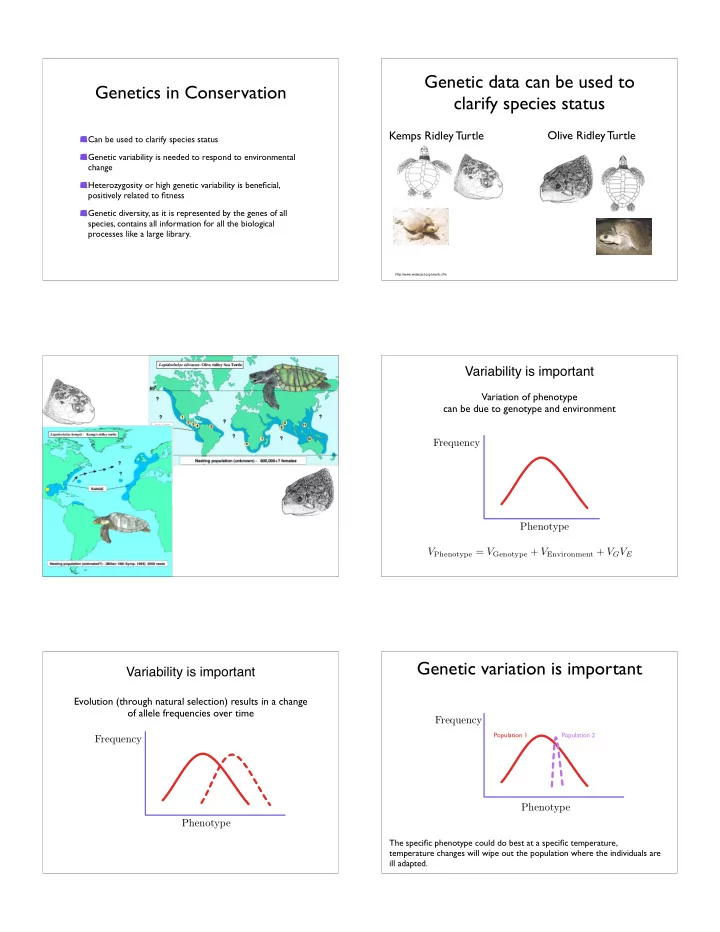
Can be used to clarify species status Genetic variability is needed to respond to environmental change Heterozygosity or high genetic variability is beneficial, positively related to fitness Genetic diversity, as it is represented by the genes of all species, contains all information for all the biological processes like a large library.

Genetic data can be used to clarify species status

http://www.widecast.org/sea/lo.cfm

Kemps Ridley Turtle Olive Ridley Turtle

Variability is important

Variation of phenotype can be due to genotype and environment VPhenotype = VGenotype + VEnvironment + VGVE Phenotype Frequency

Variability is important

Evolution (through natural selection) results in a change

  • f allele frequencies over time

Phenotype Frequency

Genetic variation is important

Population 2 Population 1

Phenotype Frequency

The specific phenotype could do best at a specific temperature, temperature changes will wipe out the population where the individuals are ill adapted.

slide-2
SLIDE 2

Thelen, G. C., Allendorf, F. W.. 2001: HETEROZYGOSITY-FITNESS CORRELATIONS IN RAINBOW TROUT: EFFECTS OF ALLOZYME LOCI OR ASSOCIATIVE OVERDOMINANCE?. Evolution: Vol. 55, No. 6, pp. 1180–1187.

fitness trait

Individual Heterozygosity Population size

Number of individuals in a population tells us whether we need to be concerned about the future of the population. How to measure? Census population size: total number of individuals in a population Effective population size: total number of individuals that contribute to future generations

Modeling populations

N haploid individuals assign each individual an allele, for example A or a. each individual produces lots and lots of gametes new N individuals are picked randomly out of that gamete pool

Modeling populations

1 2 3 4 5 8 7 6 9

Model population through time

50 100 150 200 10 20 30 40 50

Generations Chromosomes

Random Genetic Drift

Generations

50 100 150 200 10 20 30 40 50

Chromosomes

slide-3
SLIDE 3

Random Genetic Drift

Generations Chromosomes

50 100 150 200 10 20 30 40 50

Random Genetic Drift

Generations Chromosomes

Population size is an important number

A random-mating population of diploid individuals looses by chance alleles, it looses at a rate of 1/(2N) where N is the number of diploid individuals: Small populations loose alleles faster than large populations, If the population is infinitely large then the frequency of different alleles stays the same.

Random genetic drift