EASM 2014 the program aligns with an OCOGs organizational changes - - PDF document

easm 2014
SMART_READER_LITE
LIVE PREVIEW

EASM 2014 the program aligns with an OCOGs organizational changes - - PDF document

Knowledge Management in Organizing Committees of Olympic Games Submitting author: Ms Darlene MacDonald University of Ottawa, Health Sciences/Human Kinetics Ottawa, K1N 6N5 Canada All authors: Darlene MacDonald (corresp) Type: Scientific


slide-1
SLIDE 1

Knowledge Management in Organizing Committees of Olympic Games

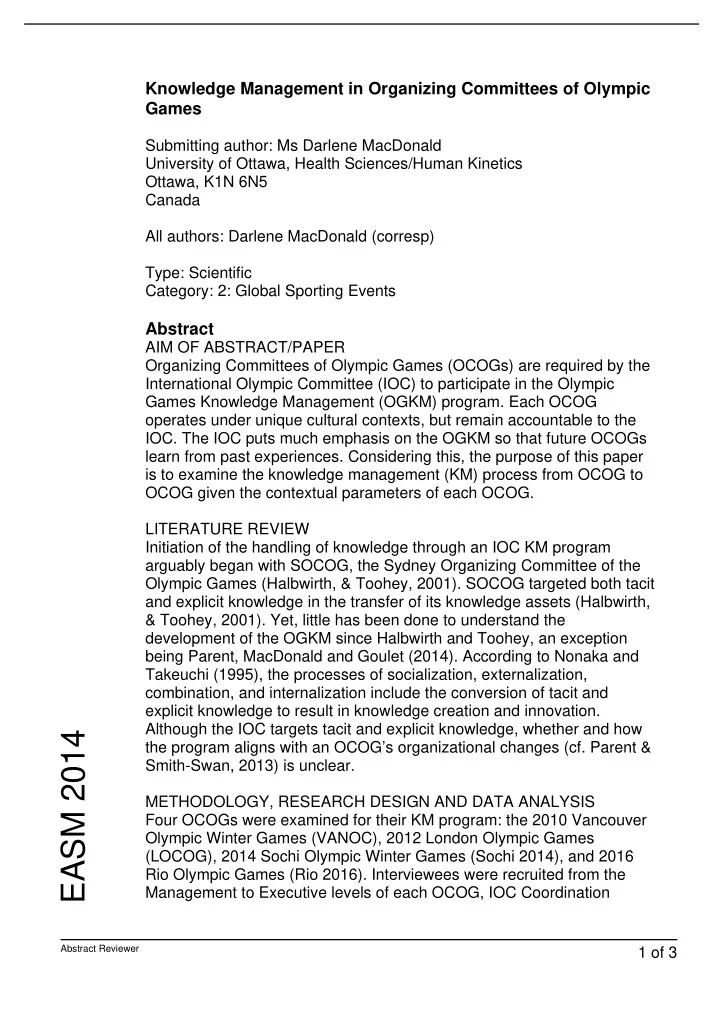
Submitting author: Ms Darlene MacDonald University of Ottawa, Health Sciences/Human Kinetics Ottawa, K1N 6N5 Canada All authors: Darlene MacDonald (corresp) Type: Scientific Category: 2: Global Sporting Events

Abstract

AIM OF ABSTRACT/PAPER Organizing Committees of Olympic Games (OCOGs) are required by the International Olympic Committee (IOC) to participate in the Olympic Games Knowledge Management (OGKM) program. Each OCOG

  • perates under unique cultural contexts, but remain accountable to the
  • IOC. The IOC puts much emphasis on the OGKM so that future OCOGs

learn from past experiences. Considering this, the purpose of this paper is to examine the knowledge management (KM) process from OCOG to OCOG given the contextual parameters of each OCOG.

  • LITERATURE REVIEW

Initiation of the handling of knowledge through an IOC KM program arguably began with SOCOG, the Sydney Organizing Committee of the Olympic Games (Halbwirth, & Toohey, 2001). SOCOG targeted both tacit and explicit knowledge in the transfer of its knowledge assets (Halbwirth, & Toohey, 2001). Yet, little has been done to understand the development of the OGKM since Halbwirth and Toohey, an exception being Parent, MacDonald and Goulet (2014). According to Nonaka and Takeuchi (1995), the processes of socialization, externalization, combination, and internalization include the conversion of tacit and explicit knowledge to result in knowledge creation and innovation. Although the IOC targets tacit and explicit knowledge, whether and how the program aligns with an OCOG’s organizational changes (cf. Parent & Smith-Swan, 2013) is unclear.

  • METHODOLOGY, RESEARCH DESIGN AND DATA ANALYSIS

Four OCOGs were examined for their KM program: the 2010 Vancouver Olympic Winter Games (VANOC), 2012 London Olympic Games (LOCOG), 2014 Sochi Olympic Winter Games (Sochi 2014), and 2016 Rio Olympic Games (Rio 2016). Interviewees were recruited from the Management to Executive levels of each OCOG, IOC Coordination 1 of 3

Abstract Reviewer

EASM 2014

slide-2
SLIDE 2

Commissions for VANOC, LOCOG, and Sochi2014, and from the IOC OGKM department. Interviews included a section on KM practices targeting both tacit and explicit knowledge. OCOG members interviewed included native and those with either international or large-scale event

  • experience. Questions asked focused on both tacit and explicit

knowledge transfer in relation to Nonaka and Takeuchi’s (1995) knowledge spiral. Twenty interviews, lasting an average of 44 minutes, were conducted by phone or Skype, given the geographical spread of the

  • participants. Interviewing stopped when saturation was reached in each

OCOG. Interviews were transcribed and then analysed using thematic analysis by the qualitative data analysis software Atlas.ti. Interviewee statements were highlighted using deductive coding for knowledge management concepts while inductive coding was used for emerging patterns (Miles & Huberman, 1994). Coded passages were grouped into axial codes, which then led to the higher-order themes (i.e., the results).

  • RESULTS

Each OCOG accepted the components of the OGKM program with no alterations or additional components from what was required by the IOC; however, the program was found lacking in its usefulness during the initial stages of the OCOG’s lifecycle as it failed to target the executive

  • management. Additionally, although the existence of knowledge

transferred from previous OCOGs through the OGKM was available to the workforce, interviewees stated that there was no concerted attempt by management to ensure that OCOG members learned or applied that

  • knowledge. Furthermore, an important aspect of knowledge transfer

involved the inclusion of Games gypsies in the workforce in addition to industry experts for efficient, innovative, and unique Games.

  • DISCUSSION, IMPLICATIONS AND CONCLUSIONS

It appears that each OCOG accepted the OGKM through participation in program components and establishing an information/knowledge management department/functional area. The OCOG workforce may be introduced to the OGKM components and made aware of the resources available, but the OCOGs generally do not seem to make any further attempts to ensure that knowledge transfer occurs. However, it was clear that hiring Games gypsies combined with industry experts and an indigenous workforce, bolstered knowledge transfer and use.

  • This study highlights evolution of knowledge management since SOCOG

and the benefit of combining cultures through hiring a mix of locals, experts, and Games gypsies to learn from past OCOGs. Thus, the OGKM success is not only about the components of the program but who is hired as well. By hiring a workforce with diverse event experiences, managers can ensure a certain standard and consistency is met between editions (thanks to the OGKM and Games gypsies), but with an element of uniqueness/innovation as well (thanks to the locals 2 of 3

Abstract Reviewer

EASM 2014

slide-3
SLIDE 3

and experts). The study does have limitations, in that it only uses

  • interviews. As such, further research (i.e., quantitative analyses, using a

broader sample, interviews with other hierarchical levels, or participant

  • bservation) is warranted, which could help us understand the degree of

influence of culture on an organizing committee, and thus perhaps the limitations of an international knowledge management and transfer system.

References

REFERENCES

  • Halbwirth, S., & Toohey, K. (2001). The Olympic Games and knowledge

management: A case study of the Sydney Organising Committee of the Olympic Games. European Sport Management Quarterly, 1(2), 91-111.

  • Miles, M. B., & Huberman, A. M. (1994). Qualitative data analysis: An

expanded sourcebook (2nd ed.). Thousand Oaks, CA: Sage Publications.

  • Nonaka, I. & Takeuchi, H. (1995). The Knowledge-Creating Company.

New York, NY: Oxford University Press.

  • Parent, M. M., MacDonald, D., & Goulet, G. (20143). The theory and

practice of knowledge management and transfer: The case of the Olympic Games. Sport Management Review. http://dx.doi.org/10.1016/j.smr.2013.06.002, 17(2), 205-218.

  • Parent, M. M. & Smith-Swan, S. (2013). Managing Major Sports Events:

Theory and Practice. London: Routledge. 3 of 3

Abstract Reviewer

EASM 2014