SLIDE 1
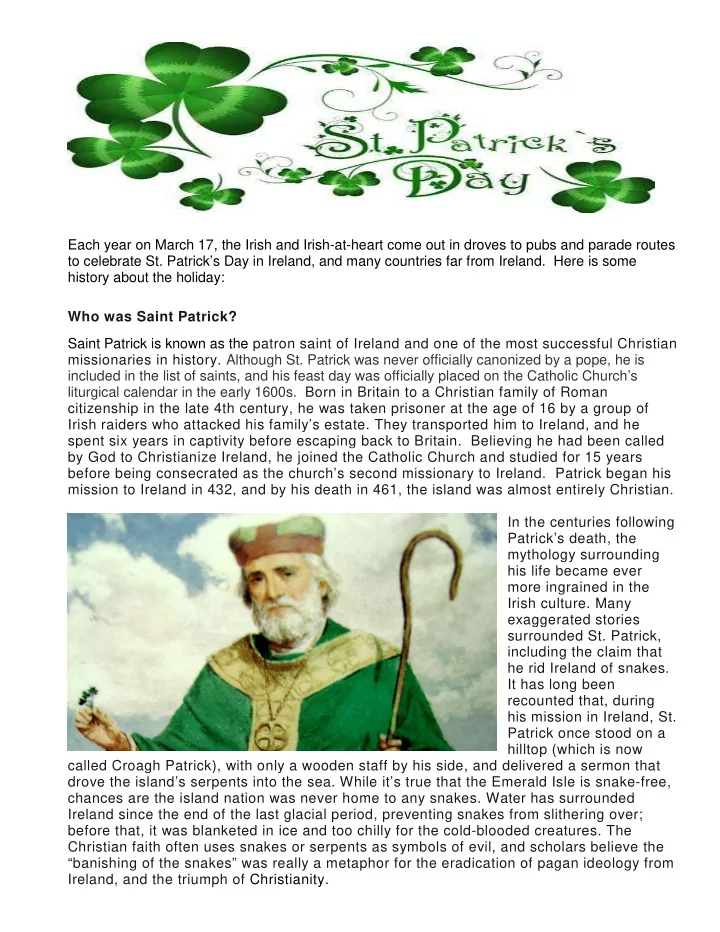
Each year on March 17, the Irish and Irish-at-heart come out in droves to pubs and parade routes to celebrate St. Patrick’s Day in Ireland, and many countries far from Ireland. Here is some history about the holiday: Who was Saint Patrick? Saint Patrick is known as the patron saint of Ireland and one of the most successful Christian missionaries in history. Although St. Patrick was never officially canonized by a pope, he is included in the list of saints, and his feast day was officially placed on the Catholic Church’s liturgical calendar in the early 1600s. Born in Britain to a Christian family of Roman citizenship in the late 4th century, he was taken prisoner at the age of 16 by a group of Irish raiders who attacked his family’s estate. They transported him to Ireland, and he spent six years in captivity before escaping back to Britain. Believing he had been called by God to Christianize Ireland, he joined the Catholic Church and studied for 15 years before being consecrated as the church’s second missionary to Ireland. Patrick began his mission to Ireland in 432, and by his death in 461, the island was almost entirely Christian. In the centuries following Patrick’s death, the mythology surrounding his life became ever more ingrained in the Irish culture. Many exaggerated stories surrounded St. Patrick, including the claim that he rid Ireland of snakes. It has long been recounted that, during his mission in Ireland, St. Patrick once stood on a hilltop (which is now called Croagh Patrick), with only a wooden staff by his side, and delivered a sermon that drove the island’s serpents into the sea. While it’s true that the Emerald Isle is snake-free, chances are the island nation was never home to any snakes. Water has surrounded Ireland since the end of the last glacial period, preventing snakes from slithering over; before that, it was blanketed in ice and too chilly for the cold-blooded creatures. The Christian faith often uses snakes or serpents as symbols of evil, and scholars believe the “banishing of the snakes” was really a metaphor for the eradication of pagan ideology from Ireland, and the triumph of Christianity.
SLIDE 2 Familiar with the Irish language and culture, scholars believe that St. Patrick chose to incorporate traditional rituals into his lessons of Christianity instead of attempting to eradicate native Irish nature-based pagan beliefs. For instance, he used bonfires to celebrate Easter since the Irish were used to honoring their gods with fire. He also superimposed a sun, a powerful Irish symbol, onto the Christian cross to create what is now called a Celtic cross. Perhaps the most well-known legend is that he explained the Holy Trinity (Father, Son and Holy Spirit) using the three leaves of a native Irish clover, the shamrock- a sacred plant in ancient Ireland representing the rebirth of spring.
- St. Patrick’s Day Celebration in Ireland
Since around the 9th or 10th century, the people in Ireland have been observing the Roman Catholic feast day of St. Patrick on March 17, the anniversary of his death in the 5th century. Until the 1700s, St. Patrick’s Day was only celebrated in Ireland. It wasn’t until 1903 that St. Patrick’s Day became a national holiday in Ireland, with banks and stores closed for the day.
- St. Patrick’s Day usually occurs in the middle of Lent, and Lenten prohibitions against the
consumption of meat and alcohol are waived on St. Patrick’s Day. Traditionally, the St. Patrick’s Day observance is mostly a religious one. Most, if not all, practicing Christians in Ireland attend church in quite prayer in the morning, as it’s a Holy Day of Obligation. The family gathers in the afternoon, in their home with a few friends, to dance and sing to traditional music, and feast on modest food and drink. A traditional meal of Irish bacon (a lean, smoked pork loin similar to Canadian bacon or ham), and cabbage is often served. The celebration offers a welcome respite from traditional abstinence, and other sacrifices, many faithful Catholics honor during the normally somber time
- f Lent---without the raucous
revelry of today’s American celebrations.
SLIDE 3 It is worth noting that in Ireland, beef was only eaten by the wealthy. Working class Irish, when they had meat at all, would have eaten pork. Because there was no way of storing fresh meat, they made pork into bacon. This was done at home by simply brining it, or preserving it with salt. (Nowadays corned beef is widely available in Ireland, but Irish bacon and cabbage is still far more popular). When impoverished Irish immigrants arrived in New York City’s Lower East Side, they began to substitute salt-cured beef (corned beef) for Irish bacon. It was purchased dirt cheap as leftover provisions from the ships returning from the tea trade in China and similar to the Irish bacon they were used to. And so, the traditional Irish Saint Patrick’s Day meal of Irish bacon and cabbage became corned beef and cabbage in America. Eventually, St. Patrick’s feast day evolved into a greater celebration including not only St. Patrick, but also Irish culture, history, and traditions. By the 17th century, as a result of the Penal Laws in Ireland, the shamrock had become a symbol of emerging Irish nationalism. As the English began to seize Irish land and make laws against the use of the Irish language and the practice
- f Catholicism, many Irish began to wear the
shamrock as a symbol of their heritage pride and their displeasure with English rule. When the Irish began to see St. Patrick’s Day as a means to promote Irish culture, the tradition of wearing shamrocks began to be a popular practice on St. Patrick’s Day. A small bunch of shamrocks would be worn on their left breast, which was known as wearing of the green, to signify their Irish heritage and its traditional connection with St. Patrick. All
- ver Ireland, shamrocks are blessed in ceremonies known
as the Blessing of the Shamrock by either local Priests or Bishops for the St. Patrick’s Day display. It has also become a tradition for the Irish prime minister to present a bowl of live shamrocks, in a Waterford Glass bowl, to the President of the United States in the White House every St. Patrick’s Day as a symbol of the close ties between the two countries. After all, the 2017 U.S. Census shows about 33 million Americans are of Irish ancestry, compared to 6.6 million on the island of Ireland itself. In Ireland, the alcohol consumed on St. Patrick’s Day is known as Póta Phádraig or
- St. Patrick’s Pot, and the Irish tradition
known as drowning the shamrock involves making a toast to St. Patrick then tossing a shamrock over your shoulder for good luck (which is conveniently being worn on your shoulder). In America, wearing of the green on St. Patrick’s Day became wearing green clothes –accompanied by an American tale that if you wear green, you become invisible to leprechauns; and if they see you, because you are not wearing green, they will pinch you. Ouch!
SLIDE 4
- St. Patrick’s Day has become associated with alcoholic beer
and spirts, and is known today as a drinking holiday by many. In fact, it is estimated that 13 million pints of Guinness (alone) will be consumed on St. Patrick’s Day around the world---that’s 819% more often than any other day of the year! However, St. Patrick's Day is only the fourth most popular drinking day in America, and falls behind New Year's Eve, Christmas, and the Fourth of July. If you choose to drink this St. Patrick’s Day, or any day, please do so responsibly and do not drink and drive. 73 people were killed in drunk driving crashes over St. Patrick’s Day holiday in 2018. That's approximately one fatal crash every 30 minutes, and 62 % of those fatal car crashes involved a drunk driver. There is no other day in the year in which the drunken Irish stereotype is more pronounced than on St. Patrick’s Day. While there is no denying that the Irish like their drink, and alcoholism in is a significant health problem in Ireland, it was in America that the party atmosphere of St. Patrick’s Day grew. In fact, until 1973 Irish laws mandated that pubs be closed
- n the holy day of March 17th. Before the drinking ban was repealed, there was only one
place in Ireland where you could buy a drink on St. Patrick’s Day: The Royal Dublin Dog Show! The Dog Show would see a wide attendance, with not just dog lovers attending, but also writers and politicians and anybody else who wanted to do more than eat chocolate and sweets on this
- ne cheat day during Lent. In fact, a 2001 article in the New York Times stated, “Dublin was the
dullest place on earth to spend St. Patrick's Day.” The party atmosphere of Saint Patrick’s Day only spread to Ireland after the arrival of television when the Irish could see all the fun being had across the ocean. Beginning in 1995, the Irish government began a national campaign to use interest in St. Patrick’s Day to drive tourism and showcase Ireland and Irish culture to the rest of the world. Today, approximately 1 million people annually take part in Ireland‘s St. Patrick’s Festival in Dublin, a multi-day celebration featuring parades, concerts, outdoor theater productions and fireworks shows---and only in Dublin are you likely to find a green beer in Ireland on
- St. Patrick’s Day. In contrast, more than one-hundred St. Patrick’s Day parades are held
across America, with the largest celebrations in New York and Boston. And each year, the New York City St. Patrick’s Day parade draws nearly 3 million spectators, and almost every bar in America serves green beer! . Irish sayings, quotes, proverbs and toasts There's one thing that most Irishmen have in common---the gift of gab. From famous scribes such as Oscar Wilde and Jonathan Swift, to that guy at the end of the bar, the sons and daughters of Erin are often blessed with an ability to spin yarns and spout witticisms. It is part of their culture. Irish sayings go back thousands of years, and they serve to pass on wisdom and wit to younger
- generations. If you are not blessed with the gift of gab, you could pilgrimage to Ireland's Blarney
Stone and kiss it to gain the gift of eloquence, according to legend. Or you could simply use some of these colorful expressions for a toast on St. Patrick’s Day:
SLIDE 5 Wherever you go and whatever you do, may the luck of the Irish be there with you. May you always have a clean shirt, a clear conscience, and enough coins in your pocket to buy a pint! Here's to a long life and a merry one. A quick death and an easy one. A pretty girl and an honest
- ne. A cold pint and another one!
May you get all your wishes but one, so that you will always have something to strive for! May you have the hindsight to know where you've been, the foresight to know where you are going, and the insight to know when you have gone too far. May neighbors respect you, trouble neglect you, the angels protect you, and heaven accept you. May you have warm words on a cold evening; a full moon on a dark night; and the road downhill all the way to your door. Here’s to the health of your enemies’ enemies! May the grass grow long on the road to Hell for want of use. May the roof above you never fall in, and those gathered beneath it never fall out. May you live as long as you want, and never want as long as you live. May the wind always be at your back. Here’s to Hell! May the stay there be as fun as the way there! May you be at the gates of heaven an hour before the devil knows you’re dead. May you live to be 100 years, with one extra year to repent. May the saddest day of your future be no worse than the happiest day of your past. May your days be many and your troubles be few. May all God’s blessings descend upon you. Here's to me, and here's to you. And here's to love and laughter. I'll be true as long as you. And not one moment after. May you die in bed at 95, shot by a jealous spouse. May the most you wish for be the least you get. Bless us with good food, the gift of gab, and hearty laughter. May the love and joy we share be with us ever after. May you live a long life, full of gladness and health, with a pocket full of gold as the least of your wealth.
SLIDE 6
May the dreams that you hold dearest be those that come true. May the kindness you spread, keep returning to you May you only grow old in the face. May you never forget what is worth remembering, nor ever remember what is best forgotten. May your troubles be less, and your blessings be more, and nothing but happiness come through the door. If misfortune should ever follow you, may it never catch up. May the hinges of our friendship never grow rusty. May the only ups and downs you face in life occur under the sheets. May your home always be too small to hold all your friends. May the road rise up to meet you, May your hand always be stretched out in friendship and never in want. May your pockets be heavy and your heart be light. May good luck pursue you each morning and night. To all the days here and after--- May they be filed with fond memories and laughter. The English version of Éire go Brách, literally meaning “Ireland till the end of time” in the Irish language.