E4180: Network Security Henning Schulzrinne Columbia University, - - PDF document

e4180 network security
SMART_READER_LITE
LIVE PREVIEW

E4180: Network Security Henning Schulzrinne Columbia University, - - PDF document

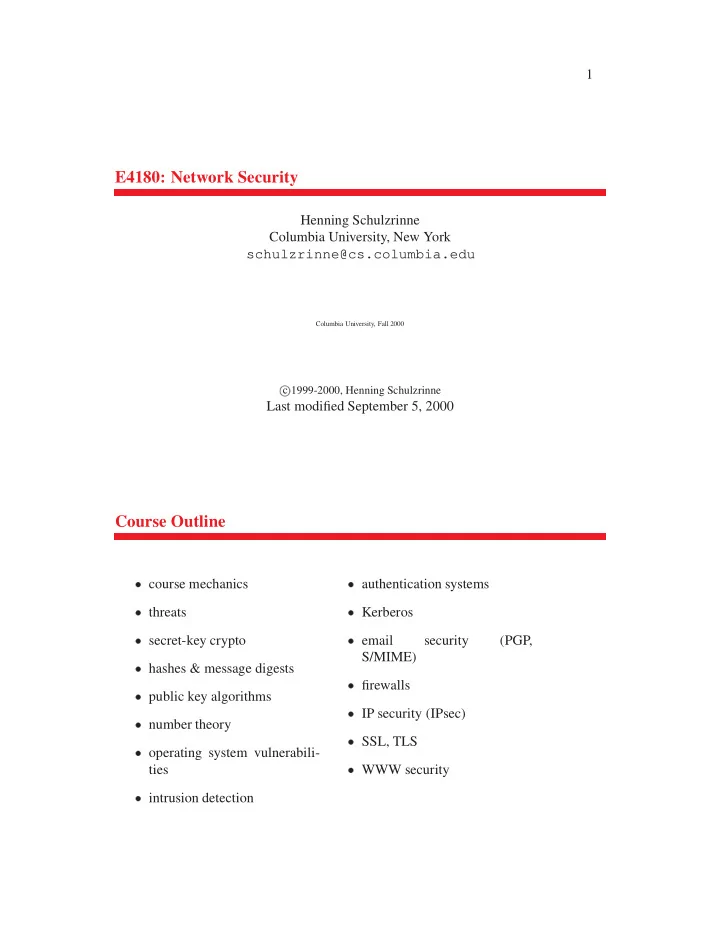
1 E4180: Network Security Henning Schulzrinne Columbia University, New York schulzrinne@cs.columbia.edu Columbia University, Fall 2000 1999-2000, Henning Schulzrinne c Last modified September 5, 2000 Course Outline course mechanics


slide-1
SLIDE 1

1

E4180: Network Security

Henning Schulzrinne Columbia University, New York schulzrinne@cs.columbia.edu

Columbia University, Fall 2000

c

1999-2000, Henning Schulzrinne

Last modified September 5, 2000

Course Outline

course mechanics threats secret-key crypto hashes & message digests public key algorithms number theory
  • perating system vulnerabili-

ties

intrusion detection authentication systems Kerberos email

security (PGP, S/MIME)

firewalls IP security (IPsec) SSL, TLS WWW security
slide-2
SLIDE 2

2

The Course Alphabet Soup

DES, IDEA, Blowfish, AES, RSA SSL, TLS, OTP IPsec, AH, ESP CHAP, PAP, RADIUS, AAA PGP, S/MIME, ssh

Course Goals

descriptive: what’s out there skill-oriented ➠ programming assignments critical: what’s wrong with..., how else can we do this? interactive: discussion, questions encouraged (and considered in grade...) work-in-progress...➠ web site, mailing list, newsgroup
slide-3
SLIDE 3

3

Am I in the Right Room?

This course does not address:

“How do I break into the CIA webserver?” “Should cryptography be exported to Transylvania?” “Are Galois fields isomorphic?” “How do I apply artificial intelligence to encryption?”

You should know (➠ self-assessment test)...

general networking concepts (packets, CL vs. CO, ...) TCP vs. UDP HTML vs. HTTP C or C++; Java may be used where possible

Course Mechanics

WWW page: http://www.cs.columbia.edu/security/ Mailing list: cs4180@cs.columbia.edu for announcements, a web board for discussion Assignments: 5, with questions + small programming problems Slides: PostScript and PDF on web page; use psnup to create 2 slides/page Grading: Assignments 30%, midterm 30%, final 35%, class participation (in person

  • r by email) 5%
slide-4
SLIDE 4

4

Course Policies

see web page! Zero tolerance for cheating: you cheat, you visit Dean of Students. May discuss homework problems with fellow students, but solve individually. Declared collaboration: points / N Nondeclared collaboration ➠ 0, cheating. Auditing: must get 50% of homework credit to pass.

Course Text

Course texts:

Charlie Kaufman, Radia Perlman and Mike Speciner, Network Security - Private

Communication in a Public World, Prentice Hall, Englewood Cliffs, New Jersey,

  • 1995. ISBN 0-13-061466-1
Bruce Schneier, Applied Cryptography (2nd ed.), John Wiley, 1996. ISBN

0-471-11709-9. (optional)

slide-5
SLIDE 5

5

Reference Books

William R. Cheswick and Steven M. Bellovin, Firewalls and Internet Security,

Addison Wesley, 1994. ISBN 0-201-63357-4

James F. Kurose and Keith W. Ross, Computer Networking: A Top-Down

Approach Featuring the Internet, Addison Wesley, 2000. ISBN 0-471-11709-9.

  • D. E. Comer, Internetworking with TCP/IP, vol. 1. Englewood Cliffs, New Jersey:

Prentice Hall, 3rd ed., 1995.