E4.1 Graph Problems P, NP Automata Theory Theory Polynomial - - PowerPoint PPT Presentation

e4 1 graph problems
SMART_READER_LITE
LIVE PREVIEW

E4.1 Graph Problems P, NP Automata Theory Theory Polynomial - - PowerPoint PPT Presentation

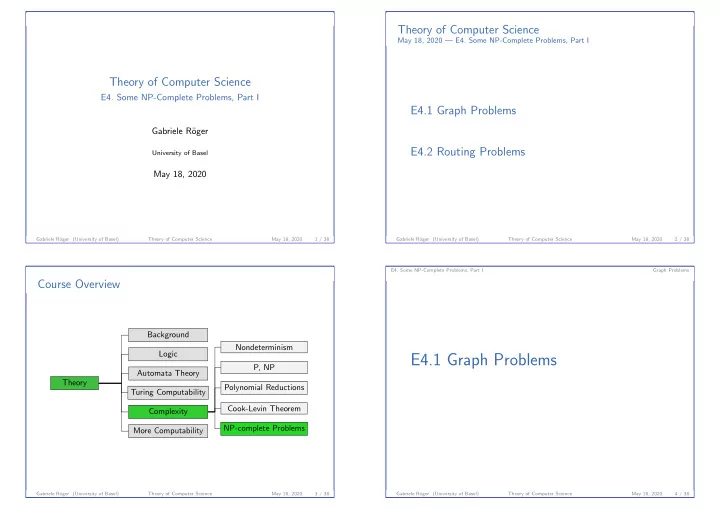
Theory of Computer Science May 18, 2020 E4. Some NP-Complete Problems, Part I Theory of Computer Science E4. Some NP-Complete Problems, Part I E4.1 Graph Problems Gabriele R oger E4.2 Routing Problems University of Basel May 18, 2020


slide-1
SLIDE 1

Theory of Computer Science

  • E4. Some NP-Complete Problems, Part I

Gabriele R¨

  • ger

University of Basel

May 18, 2020

Gabriele R¨

  • ger (University of Basel)

Theory of Computer Science May 18, 2020 1 / 38

Theory of Computer Science

May 18, 2020 — E4. Some NP-Complete Problems, Part I

E4.1 Graph Problems E4.2 Routing Problems

Gabriele R¨

  • ger (University of Basel)

Theory of Computer Science May 18, 2020 2 / 38

Course Overview

Theory Background Logic Automata Theory Turing Computability Complexity Nondeterminism P, NP Polynomial Reductions Cook-Levin Theorem NP-complete Problems More Computability

Gabriele R¨

  • ger (University of Basel)

Theory of Computer Science May 18, 2020 3 / 38

  • E4. Some NP-Complete Problems, Part I

Graph Problems

E4.1 Graph Problems

Gabriele R¨

  • ger (University of Basel)

Theory of Computer Science May 18, 2020 4 / 38

slide-2
SLIDE 2
  • E4. Some NP-Complete Problems, Part I

Graph Problems

3SAT ≤p Clique

SAT 3SAT Clique IndSet VertexCover DirHamiltonCycle HamiltonCycle TSP SubsetSum Partition BinPacking

Gabriele R¨

  • ger (University of Basel)

Theory of Computer Science May 18, 2020 5 / 38

  • E4. Some NP-Complete Problems, Part I

Graph Problems

Clique

Definition (Clique) The problem Clique is defined as follows: Given: undirected graph G = V , E, number K ∈ N0 Question: Does G have a clique of size at least K,

  • i. e., a set of vertices C ⊆ V with |C| ≥ K

and {u, v} ∈ E for all u, v ∈ C with u = v? German: Clique

Gabriele R¨

  • ger (University of Basel)

Theory of Computer Science May 18, 2020 6 / 38

  • E4. Some NP-Complete Problems, Part I

Graph Problems

Clique is NP-Complete (1)

Theorem (Clique is NP-Complete) Clique is NP-complete.

Gabriele R¨

  • ger (University of Basel)

Theory of Computer Science May 18, 2020 7 / 38

  • E4. Some NP-Complete Problems, Part I

Graph Problems

Clique is NP-Complete (2)

Proof. Clique ∈ NP: guess and check. Clique is NP-hard: We show 3SAT ≤p Clique. ◮ We are given a 3-CNF formula ϕ, and we may assume that each clause has exactly three literals. ◮ In polynomial time, we must construct a graph G = V , E and a number K such that: G has a clique of size at least K iff ϕ is satisfiable. construction of V , E, K on the following slides. . . .

Gabriele R¨

  • ger (University of Basel)

Theory of Computer Science May 18, 2020 8 / 38

slide-3
SLIDE 3
  • E4. Some NP-Complete Problems, Part I

Graph Problems

Clique is NP-Complete (3)

Proof (continued). Let m be the number of clauses in ϕ. Let ℓij the j-th literal in clause i. Define V , E, K as follows: ◮ V = {i, j | 1 ≤ i ≤ m, 1 ≤ j ≤ 3} a vertex for every literal of every clause ◮ E contains edge between i, j and i′, j′ if and only if

◮ i = i′ belong to different clauses, and ◮ ℓij and ℓi′j′ are not complementary literals

◮ K = m

  • bviously polynomially computable

to show: reduction property . . .

Gabriele R¨

  • ger (University of Basel)

Theory of Computer Science May 18, 2020 9 / 38

  • E4. Some NP-Complete Problems, Part I

Graph Problems

Clique is NP-Complete (4)

Proof (continued). (⇒): If ϕ is satisfiable, then V , E has clique of size at least K: ◮ Given a satisfying variable assignment choose a vertex corresponding to a satisfied literal in each clause. ◮ The chosen K vertices are all connected with each other and hence form a clique of size K. . . .

Gabriele R¨

  • ger (University of Basel)

Theory of Computer Science May 18, 2020 10 / 38

  • E4. Some NP-Complete Problems, Part I

Graph Problems

Clique is NP-Complete (5)

Proof (continued). (⇐): If V , E has a clique of size at least K, then ϕ is satisfiable: ◮ Consider a given clique C of size at least K. ◮ The vertices in C must all correspond to different clauses (vertices in the same clause are not connected by edges). exactly one vertex per clause is included in C ◮ Two vertices in C never correspond to complementary literals X and ¬X (due to the way we defined the edges). ◮ If a vertex corresp. to X was chosen, map X to 1 (true). ◮ If a vertex corresp. to ¬X was chosen, map X to 0 (false). ◮ If neither was chosen, arbitrarily map X to 0 or 1. satisfying assignment

Gabriele R¨

  • ger (University of Basel)

Theory of Computer Science May 18, 2020 11 / 38

  • E4. Some NP-Complete Problems, Part I

Graph Problems

Clique ≤p IndSet

SAT 3SAT Clique IndSet VertexCover DirHamiltonCycle HamiltonCycle TSP SubsetSum Partition BinPacking

Gabriele R¨

  • ger (University of Basel)

Theory of Computer Science May 18, 2020 12 / 38

slide-4
SLIDE 4
  • E4. Some NP-Complete Problems, Part I

Graph Problems

IndSet

Definition (IndSet) The problem IndSet is defined as follows: Given: undirected graph G = V , E, number K ∈ N0 Question: Does G have an independent set of size at least K,

  • i. e., a set of vertices I ⊆ V with |I| ≥ K

and {u, v} / ∈ E for all u, v ∈ I with u = v? German: unabh¨ angige Menge

Gabriele R¨

  • ger (University of Basel)

Theory of Computer Science May 18, 2020 13 / 38

  • E4. Some NP-Complete Problems, Part I

Graph Problems

IndSet is NP-Complete (1)

Theorem (IndSet is NP-Complete) IndSet is NP-complete.

Gabriele R¨

  • ger (University of Basel)

Theory of Computer Science May 18, 2020 14 / 38

  • E4. Some NP-Complete Problems, Part I

Graph Problems

IndSet is NP-Complete (2)

Proof. IndSet ∈ NP: guess and check. IndSet is NP-hard: We show Clique ≤p IndSet. We describe a polynomial reduction f . Let G, K with G = V , E be the given input for Clique. Then f (G, K) is the IndSet instance G, K, where G := V , E and E := {{u, v} ⊆ V | u = v, {u, v} / ∈ E}. (This graph G is called the complement graph of G.) Clearly f can be computed in polynomial time. . . .

Gabriele R¨

  • ger (University of Basel)

Theory of Computer Science May 18, 2020 15 / 38

  • E4. Some NP-Complete Problems, Part I

Graph Problems

IndSet is NP-Complete (3)

Proof (continued). We have: V , E, K ∈ Clique iff there exists a set V ′ ⊆ V with |V ′| ≥ K and {u, v} ∈ E for all u, v ∈ V ′ with u = v iff there exists a set V ′ ⊆ V with |V ′| ≥ K and {u, v} / ∈ E for all u, v ∈ V ′ with u = v iff V , E, K ∈ IndSet iff f (V , E, K) ∈ IndSet and hence f is a reduction.

Gabriele R¨

  • ger (University of Basel)

Theory of Computer Science May 18, 2020 16 / 38

slide-5
SLIDE 5
  • E4. Some NP-Complete Problems, Part I

Graph Problems

IndSet ≤p VertexCover

SAT 3SAT Clique IndSet VertexCover DirHamiltonCycle HamiltonCycle TSP SubsetSum Partition BinPacking

Gabriele R¨

  • ger (University of Basel)

Theory of Computer Science May 18, 2020 17 / 38

  • E4. Some NP-Complete Problems, Part I

Graph Problems

VertexCover

Definition (VertexCover) The problem VertexCover is defined as follows: Given: undirected graph G = V , E, number K ∈ N0 Question: Does G have a vertex cover of size at most K,

  • i. e., a set of vertices C ⊆ V with |C| ≤ K and {u, v} ∩ C = ∅

for all {u, v} ∈ E? German: Knoten¨ uberdeckung

Gabriele R¨

  • ger (University of Basel)

Theory of Computer Science May 18, 2020 18 / 38

  • E4. Some NP-Complete Problems, Part I

Graph Problems

VertexCover is NP-Complete (1)

Theorem (VertexCover is NP-Complete) VertexCover is NP-complete.

Gabriele R¨

  • ger (University of Basel)

Theory of Computer Science May 18, 2020 19 / 38

  • E4. Some NP-Complete Problems, Part I

Graph Problems

VertexCover is NP-Complete (2)

Proof. VertexCover ∈ NP: guess and check. VertexCover is NP-hard: We show IndSet ≤p VertexCover. We describe a polynomial reduction f . Let G, K with G = V , E be the given input for IndSet. Then f (G, K) := G, |V | − K. This can clearly be computed in polynomial time. . . .

Gabriele R¨

  • ger (University of Basel)

Theory of Computer Science May 18, 2020 20 / 38

slide-6
SLIDE 6
  • E4. Some NP-Complete Problems, Part I

Graph Problems

VertexCover is NP-Complete (3)

Proof (continued). For vertex set V ′ ⊆ V , we write V ′ for its complement V \ V ′. Observation: a set of vertices is a vertex cover iff its complement is an independent set. We thus have: V , E, K ∈ IndSet iff V , E has an independent set I with |I| ≥ K iff V , E has a vertex cover C with |C| ≥ K iff V , E has a vertex cover C with |C| ≤ |V | − K iff V , E, |V | − K ∈ VertexCover iff f (V , E, K) ∈ VertexCover and hence f is a reduction.

Gabriele R¨

  • ger (University of Basel)

Theory of Computer Science May 18, 2020 21 / 38

  • E4. Some NP-Complete Problems, Part I

Routing Problems

E4.2 Routing Problems

Gabriele R¨

  • ger (University of Basel)

Theory of Computer Science May 18, 2020 22 / 38

  • E4. Some NP-Complete Problems, Part I

Routing Problems

3SAT ≤p DirHamiltonCycle

SAT 3SAT Clique IndSet VertexCover DirHamiltonCycle HamiltonCycle TSP SubsetSum Partition BinPacking

Gabriele R¨

  • ger (University of Basel)

Theory of Computer Science May 18, 2020 23 / 38

  • E4. Some NP-Complete Problems, Part I

Routing Problems

DirHamiltonCycle is NP-Complete (1)

Definition (Reminder: DirHamiltonCycle) The problem DirHamiltonCycle is defined as follows: Given: directed graph G = V , E Question: Does G contain a Hamilton cycle? Theorem DirHamiltonCycle is NP-complete.

Gabriele R¨

  • ger (University of Basel)

Theory of Computer Science May 18, 2020 24 / 38

slide-7
SLIDE 7
  • E4. Some NP-Complete Problems, Part I

Routing Problems

DirHamiltonCycle is NP-Complete (2)

Proof. DirHamiltonCycle ∈ NP: guess and check. DirHamiltonCycle is NP-hard: We show 3SAT ≤p DirHamiltonCycle. ◮ We are given a 3-CNF formula ϕ where each clause contains exactly three literals and no clause contains duplicated literals. ◮ We must, in polynomial time, construct a directed graph G = V , E such that: G contains a Hamilton cycle iff ϕ is satisfiable. ◮ construction of V , E on the following slides . . .

Gabriele R¨

  • ger (University of Basel)

Theory of Computer Science May 18, 2020 25 / 38

  • E4. Some NP-Complete Problems, Part I

Routing Problems

DirHamiltonCycle is NP-Complete (3)

Proof (continued). ◮ Let X1, . . . , Xn be the propositional variables in ϕ. ◮ Let c1, . . . , cm be the clauses of ϕ with ci = (ℓi1 ∨ ℓi2 ∨ ℓi3). ◮ Construct a graph with 6m + n vertices (described on the following slides). . . .

Gabriele R¨

  • ger (University of Basel)

Theory of Computer Science May 18, 2020 26 / 38

  • E4. Some NP-Complete Problems, Part I

Routing Problems

DirHamiltonCycle is NP-Complete (4)

Proof (continued). ◮ For every variable Xi, add vertex xi with 2 incoming and 2 outgoing edges:

x1 x2 . . . xn

◮ For every clause cj, add the subgraph Cj with 6 vertices:

a b c A B C

◮ We describe later how to connect these parts. . . .

Gabriele R¨

  • ger (University of Basel)

Theory of Computer Science May 18, 2020 27 / 38

  • E4. Some NP-Complete Problems, Part I

Routing Problems

DirHamiltonCycle is NP-Complete (5)

Proof (continued). Let π be a Hamilton cycle of the total graph. ◮ Whenever π enters subgraph Cj from one of its “entrances”, it must leave via the corresponding “exit”: (a − → A, b − → B, c − → C). Otherwise, π cannot be a Hamilton cycle. ◮ Hamilton cycles can behave in the following ways with regard to Cj:

◮ π passes through Cj once (from any entrance) ◮ π passes through Cj twice (from any two entrances) ◮ π passes through Cj three times (once from every entrance)

. . .

Gabriele R¨

  • ger (University of Basel)

Theory of Computer Science May 18, 2020 28 / 38

slide-8
SLIDE 8
  • E4. Some NP-Complete Problems, Part I

Routing Problems

DirHamiltonCycle is NP-Complete (6)

Proof (continued). Connect the “open ends” in the graph as follows: ◮ Identify entrances/exits of the clause subgraph Cj with the three literals in clause cj. ◮ One exit of xi is positive, the other one is negative. ◮ For the positive exit, determine the clauses in which the positive literal Xi occurs:

◮ Connect the positive exit of xi with the Xi-entrance

  • f the first such clause graph.

◮ Connect the Xi-exit of this clause graph with the Xi-entrance

  • f the second such clause graph, and so on.

◮ Connect the Xi-exit of the last such clause graph with the positive entrance of xi+1 (or x1 if i = n).

◮ analogously for the negative exit of xi and the literal ¬Xi . . .

Gabriele R¨

  • ger (University of Basel)

Theory of Computer Science May 18, 2020 29 / 38

  • E4. Some NP-Complete Problems, Part I

Routing Problems

DirHamiltonCycle is NP-Complete (7)

Proof (continued). The construction is polynomial and is a reduction: (⇒): construct a Hamilton cycle from a satisfying assignment ◮ Given a satisfying assignment I, construct a Hamilton cycle that leaves xi through the positive exit if I(Xi) is true and by the negative exit if I(Xi) is false. ◮ Afterwards, we visit all Cj-subgraphs for clauses that are satisfied by this literal. ◮ In total, we visit each Cj-subgraph 1–3 times. . . .

Gabriele R¨

  • ger (University of Basel)

Theory of Computer Science May 18, 2020 30 / 38

  • E4. Some NP-Complete Problems, Part I

Routing Problems

DirHamiltonCycle is NP-Complete (8)

Proof (continued). (⇐): construct a satisfying assignment from a Hamilton cycle ◮ A Hamilton cycle visits every vertex xi and leaves it by the positive or negative exit. ◮ Map Xi to true or false depending on which exit is used to leave xi. ◮ Because the cycle must traverse each Cj-subgraph at least once (otherwise it is not a Hamilton cycle), this results in a satisfying assignment. (Details omitted.)

Gabriele R¨

  • ger (University of Basel)

Theory of Computer Science May 18, 2020 31 / 38

  • E4. Some NP-Complete Problems, Part I

Routing Problems

DirHamiltonCycle ≤p HamiltonCycle

SAT 3SAT Clique IndSet VertexCover DirHamiltonCycle HamiltonCycle TSP SubsetSum Partition BinPacking

Gabriele R¨

  • ger (University of Basel)

Theory of Computer Science May 18, 2020 32 / 38

slide-9
SLIDE 9
  • E4. Some NP-Complete Problems, Part I

Routing Problems

HamiltonCycle is NP-Complete (1)

Definition (Reminder: HamiltonCycle) The problem HamiltonCycle is defined as follows: Given: undirected graph G = V , E Question: Does G contain a Hamilton cycle? Theorem HamiltonCycle is NP-complete.

Gabriele R¨

  • ger (University of Basel)

Theory of Computer Science May 18, 2020 33 / 38

  • E4. Some NP-Complete Problems, Part I

Routing Problems

HamiltonCycle is NP-Complete (2)

Proof sketch. HamiltonCycle ∈ NP: guess and check. HamiltonCycle is NP-hard: We show DirHamiltonCycle ≤p HamiltonCycle. Basic building block of the reduction:

v

= ⇒

v1 v2 v3

Gabriele R¨

  • ger (University of Basel)

Theory of Computer Science May 18, 2020 34 / 38

  • E4. Some NP-Complete Problems, Part I

Routing Problems

HamiltonCycle ≤p TSP

SAT 3SAT Clique IndSet VertexCover DirHamiltonCycle HamiltonCycle TSP SubsetSum Partition BinPacking

Gabriele R¨

  • ger (University of Basel)

Theory of Computer Science May 18, 2020 35 / 38

  • E4. Some NP-Complete Problems, Part I

Routing Problems

TSP is NP-Complete (1)

Definition (Reminder: TSP) TSP (traveling salesperson problem) is the following decision problem: ◮ Given: finite set S = ∅ of cities, symmetric cost function cost : S × S → N0, cost bound K ∈ N0 ◮ Question: Is there a tour with total cost at most K, i. e., a permutation s1, . . . , sn of the cities with n−1

i=1 cost(si, si+1) + cost(sn, s1) ≤ K?

German: Problem der/des Handlungsreisenden Theorem TSP is NP-complete.

Gabriele R¨

  • ger (University of Basel)

Theory of Computer Science May 18, 2020 36 / 38

slide-10
SLIDE 10
  • E4. Some NP-Complete Problems, Part I

Routing Problems

TSP is NP-Complete (2)

Proof. TSP ∈ NP: guess and check. TSP is NP-hard: We showed HamiltonCycle ≤p TSP in Chapter E2.

Gabriele R¨

  • ger (University of Basel)

Theory of Computer Science May 18, 2020 37 / 38

  • E4. Some NP-Complete Problems, Part I

Summary

Summary

◮ In this chapter we showed NP-completeness of

◮ three classical graph problems: Clique, IndSet, VertexCover ◮ three classical routing problems: DirHamiltonCycle, HamiltonCycle, TSP

Gabriele R¨

  • ger (University of Basel)

Theory of Computer Science May 18, 2020 38 / 38