? e - e - How to test these hypotheses? Shoot bullets at the atom - - PDF document

e e how to test these hypotheses shoot bullets at the
SMART_READER_LITE
LIVE PREVIEW

? e - e - How to test these hypotheses? Shoot bullets at the atom - - PDF document

Physics 2D Lecture Slides Lecture 15: Feb 2nd 2005 Vivek Sharma UCSD Physics Where are the electrons inside the atom? Early Thought: Plum pudding model Atom has a homogenous distribution of Positive charge with electrons embedded


slide-1
SLIDE 1

1

Physics 2D Lecture Slides Lecture 15: Feb 2nd 2005

Vivek Sharma UCSD Physics Where are the electrons inside the atom?

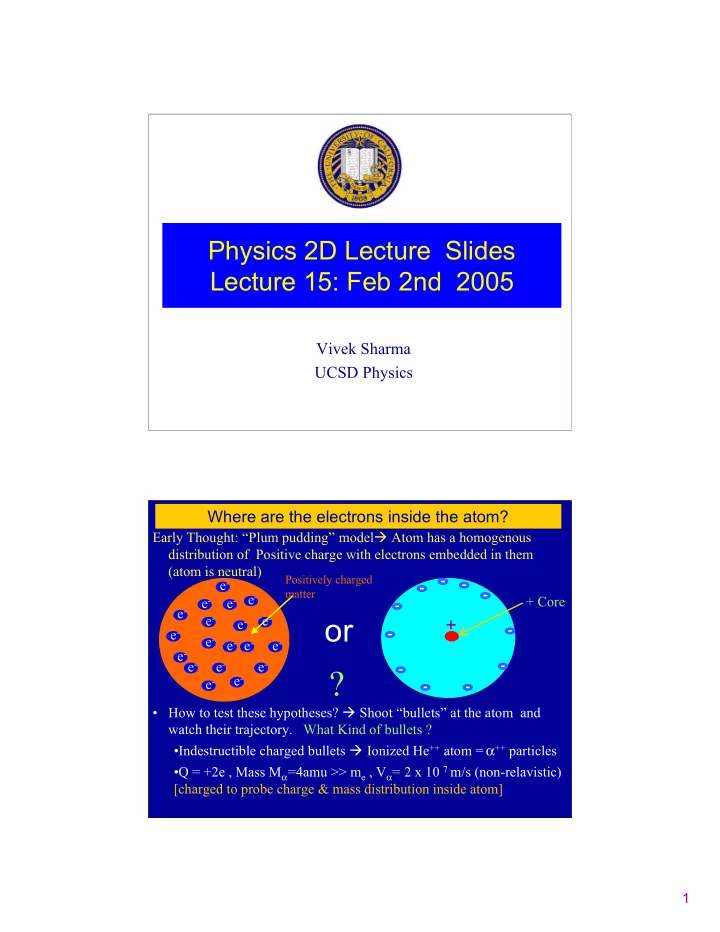
Early Thought: “Plum pudding” model Atom has a homogenous distribution of Positive charge with electrons embedded in them (atom is neutral)

  • How to test these hypotheses?  Shoot “bullets” at the atom and

watch their trajectory. What Kind of bullets ?

  • Indestructible charged bullets  Ionized He++ atom = α++ particles
  • Q = +2e , Mass Mα=4amu >> me , Vα= 2 x 10 7 m/s (non-relavistic)

[charged to probe charge & mass distribution inside atom] e- e- e- e- e- e- e- e- e- e- e- e- e- e- e- e- e- e- e-

Positively charged matter

?

+ Core

  • r

+

slide-2
SLIDE 2

2

Plum Pudding Model of Atom

  • Non-relativistic mechanics (Vα/c = 0.1)
  • In Plum-pudding model, α-rays hardly scatter because

– Positive charge distributed over size of atom (10-10m) – Mα >> Me (like moving truck hits a bicycle) –  predict α-rays will pass thru array of atoms with little scatter (~1o)

Need to test this hypothesis  Ernest Rutherford

Probing Within an Atom with α Particles

  • Most α particles pass thru gold foil with nary a deflection
  • SOME (≅10-4) scatter at LARGE angles Φ
  • Even fewer scatter almost backwards  Why
slide-3
SLIDE 3

3

Rutherford Discovers Nucleus (Nobel Prize)

“Rutherford Scattering” discovered by his PhD Student (Marsden)

slide-4
SLIDE 4

4

Force on α-particle due to heavy Nucleus

  • Outside radius r =R, F ∝ Q/r2
  • Inside radius r < R, F ∝ q/r2 = Qr/R2
  • Maximum force at radius r = R

2

particle trajectory is hyperbolic Scattering angle is related to impact par. Impact Parameter cot 2 kq Q b m v

  • =
  • Rutherford Scattering: Prediction and Experimental Result

2 2 4 2 2 2 4

1 4 ( / 2) 2 k Z e NnA n R m v Sin

  • =
  • # scattered Vs φ depends on :
  • n = # of incident alpha particles
  • N = # of nuclei/area of foil
  • Ze = Nuclear charge
  • Kα of incident alpha beam
  • A= detector area
slide-5
SLIDE 5

5

Rutherford Scattering & Size of Nucleus

2

distance of closest appoach r size of nucleus 1 Kinetic energy of = K = 2 particle will penetrate thru a radius r until all its kinetic energy is used up to do work AGAINST the Coulomb potent m v

  • (

)( )

  • Al

2 15 2 15

  • 10

2

For K =7.7.MeV, Z 13 2 ial of the Size of Nucleus = 10 Siz Nucleus: 2 1 K = 8 2 4.9 e of Ato m = 1 10 2 kZ Ze e m v MeV k e r m K kZe r K m m r

  • =
  • =

=

  • =

=

  • =

nucleus nucleus

Dimension Matters !

  • 15
  • 10

Size of Nucleus = 10 Size of Atom = 10 m m

  • how are the electrons located inside an atom
  • How are they held in a stable fashion
  • necessary condition for us to exist !
  • All these discoveries will require new experiments and observations
slide-6
SLIDE 6

6

Rutherford Atom & Classical Physics

?

Continuous & Discrete spectra of Elements

slide-7
SLIDE 7

7

Visible Spectrum of Sun Through a Prism

Emission & Absorption Line Spectra of Elements

slide-8
SLIDE 8

8

Kirchhoff’ Experiment : “D” Lines in Na

D lines darken noticeably when Sodium vapor introduced Between slit and prism

Emission & Absorption Line Spectrum of Elements

  • Emission line appear dark

because of photographic exposure

Absorption spectrum of Na While light passed thru Na vapor is absorbed at specific λ

slide-9
SLIDE 9

9

Spectral Observations : series of lines with a pattern

  • Empirical observation (by trial & error)
  • All these series can be summarized in a simple formula

2 7 1 2

1 1 1 , , 1,2,3,4.. Fitting to spectral line serie s R= data 1.09737 10

f i i f i

R n n n n n m

  • =
  • >

=

  • How does one explain this ?

The Rapidly Vanishing Atom: A Classical Disaster !

Not too hard to draw analogy with dynamics under another Central Force Think of the Gravitational Force between two objects and their circular orbits. Perhaps the electron rotates around the Nucleus and is bound by their electrical charge

2 2 2 1 2 1

M M F= G k r r Q Q

  • Laws of E&M destroy this equivalent picture : Why ?
slide-10
SLIDE 10

10

Bohr’s Bold Model of Atom: Semi Quantum/Classical

1. Electron in circular orbit around proton with vel=v 2. Only stationary orbits allowed . Electron does not radiate when in these stable (stationary) orbits 3. Orbits quantized:

– Mev r = n h/2π (n=1,2,3…)

4. Radiation emitted when electron “jumps” from a stable orbit of higher energy  stable orbit of lower energy Ef-Ei = hf =hc/λ 5. Energy change quantized

  • f = frequency of radiation

F V

me

+e

r

  • e

2 2

( ) 1 2

e

e U r k r KE m v = =

Reduced Mass of 2-body system

  • Both Nucleus & e- revolve around their common center of mass (CM)
  • Such a system is equivalent to single particle of “reduced mass” µ that

revolves around position of Nucleus at a distance of (e- -N) separation

– µ= (meM)/(me+M), when M>>m, µ=m (Hydrogen atom) – Νot so when calculating Muon (mµ= 207 me) or equal mass charges rotating around each other (similar to what you saw in gravitation)

me

F V

me

+e

r

  • e

General Two body Motion under a central force reduces to

slide-11
SLIDE 11

11

Allowed Energy Levels & Orbit Radii in Bohr Model

2 2 2 2 2 2 2

2

E=KE+U = Force Equality for Stable Orbit Coulomb attraction = CP Force Total En 1 2 2 2 Negative E Bound sy erg stem Thi y s

E = KE+U= - 2

e e e

m v m v e e k r m v e k r K r r E k

e k r

=

  • =
  • =
  • much energy must be added to

the system to break up the bound atom

2 2 2 2 2 10 2 2 2 2

, 1 ,2 Radius of Electron Orbit : , 1 substitute in KE= 2 2 1 B 1 0.529 10 Quantized orbits of rotat

  • hr Radius

In ge ,.... ; 1 ,2,... neral . io

n n e

n r mvr n a m mk n v mr r ke m v r n n n a n e e mk a

  • =
  • =

=

  • =

= =

  • =

= =

  • =
  • n

Energy Level Diagram and Atomic Transitions

2 2 2 2 2 2 2 2 2 2 2 2 2 2 i

2 since ,n =quantum number Interstate transition: 1 1 2 1 1 1 2 13.6 , 1,2,3.. 2 1 1 2 n

n n f i n f f f i i i f

ke E K U r ke f ha n n f ke c hca ke E eV n a n n ke n r a n a n E h n E n f E n

  • =

= =

  • =
  • =
  • =

=

  • =

+ = =

  • =

=

  • 2

2

1 1 = R

f i

n n

slide-12
SLIDE 12

12

Hydrogen Spectrum: as explained by Bohr

Bohr’s “R” same as the Rydberg Constant R derived emperically from photographs of the spectral series

2 2 2

2

n

ke Z E a n

  • =
  • Another Look at the Energy levels

2 2 2

2

n

ke Z E a n

  • =
  • Rydberg Constant
slide-13
SLIDE 13

13

Bohr’s Atom: Emission & Absorption Spectra

photon photon

Some Notes About Bohr Like Atoms

  • Ground state of Hydrogen atom (n=1) E0= -13.6 eV
  • Method for calculating energy levels etc applies to all Hydrogen-

like atoms  -1e around +Ze

– Examples : He+, Li++

  • Energy levels would be different if replace electron with Muons
  • Bohr’s method can be applied in general to all systems under a

central force (e.g. gravitational instead of Coulombic)

1 2 1 2

If change ( ) Changes every thing: E, r , f etc "Importance of constants in your life" Q Q M M U r k G r r =

slide-14
SLIDE 14

14

Bohr’s Correspondence Principle

  • It now appears that there are two different worlds with

different laws of physics governing them

– The macroscopic world – The microscopic world

  • How does one transcend from one world to the other ?

– Bohr’s correspondence Principle

  • predictions of quantum theory must correspond to

predictions of the classical physics in the regime of sizes where classical physics is known to hold. when n ∞ [Quantum Physics] = [Classical Physics]