SLIDE 1
Chapter 2: Atoms and the Periodic Table
CHEM 1115 & CHEM 1103
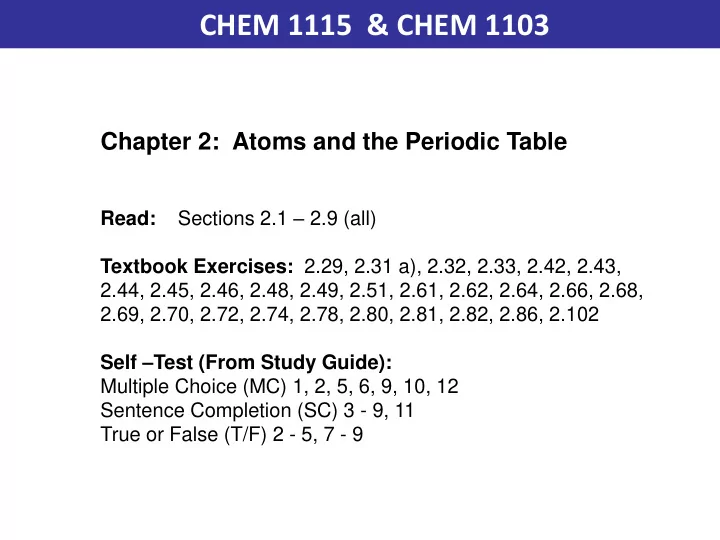
Read: Sections 2.1 – 2.9 (all) Textbook Exercises: 2.29, 2.31 a), 2.32, 2.33, 2.42, 2.43, 2.44, 2.45, 2.46, 2.48, 2.49, 2.51, 2.61, 2.62, 2.64, 2.66, 2.68, 2.69, 2.70, 2.72, 2.74, 2.78, 2.80, 2.81, 2.82, 2.86, 2.102 Self –Test (From Study Guide): Multiple Choice (MC) 1, 2, 5, 6, 9, 10, 12 Sentence Completion (SC) 3 - 9, 11 True or False (T/F) 2 - 5, 7 - 9
SLIDE 2
Atomic Structure: Modern model
SLIDE 3
Molecular Man
What do atoms look like?
(Image from a scanning tunneling microscope) Carbon monoxide molecules on platinum surface
SLIDE 4
The Japanese characters for “atom” written with atoms
SLIDE 5 Nucleus:
- Protons and neutrons (each about equal mass)
- Most of mass
- Very little volume
Outside Nucleus:
- Electrons
- Very little mass
- Most of atom’s volume
Atomic Structure: Modern model
SLIDE 6 Atomic Structure: An analogy
If this basketball were a hydrogen atom’s nucleus… Average distance to electron would be 2.5 km
SLIDE 7 Subatomic particle Mass Charge Proton 1.673 x 10⁻²⁴ g +1 Neutron 1.675 x 10⁻²⁴ g neutral Electron 9.109 x 10⁻²⁸ g
Atomic Structure: Composition
An electron is about 2000 times lighter than a proton or neutron
SLIDE 8
- The number of protons located in an atom’s nucleus determines
the element’s identity.
- The number of protons in the nucleus of an atom is called the
atomic number.
- Each element has a unique name and symbol.
Symbol has either one or two letters O (oxygen) or Fe (iron)
- The elements are arranged on the periodic table in order of their
atomic numbers
- Elements and names you should know:
https://learn.bcit.ca/d2l/le/content/198204/viewContent/1191199/View
Elements
SLIDE 9 Atom Notation
X = Atomic symbol Z = Atomic number (also = number of protons in nucleus) A = Mass number (total of protons + neutrons
𝐘
𝐚 𝐁
SLIDE 10 Isotopes
Isotopes – atoms of the same element with different numbers of neutrons
O
8 16
O
8 18
8 protons 10 neutrons 8 protons 8 neutrons
SLIDE 11
Problem: How many protons, electrons, and neutrons are in the following atoms: protons electrons neutrons
Isotopes and Symbols 𝐓
𝟐𝟕 𝟒𝟑
𝐃𝐯
𝟑𝟘 𝟕𝟔
𝐃
𝟐𝟓
SLIDE 12
16 16 16 29 29 36 6 6 8
Isotopes and Symbols 𝐓
𝟐𝟕 𝟒𝟑
𝐃𝐯
𝟑𝟘 𝟕𝟔
𝐃
𝟐𝟓
Problem: How many protons, electrons, and neutrons are in the following atoms: ANSWERS protons electrons neutrons
SLIDE 13
Atomic mass
Mass of an atom in amu (“atomic mass units”) Don’t confuse with mass number (a whole number) Atomic mass of an atom of carbon-12 = exactly 12 amu Each proton and neutron is approximately 1 amu, but not exactly Individual isotopes have different atomic masses; mass in periodic table is weighted average (sometimes called “atomic weight”)
SLIDE 14
Example: Magnesium has three naturally occurring isotopes with masses of 23.99 amu, 24.99 amu, and 25.98 amu and natural abundances of 78.99%, 10.00%, and 11.01%, respectively. Calculate the atomic weight (average atomic mass) of magnesium. Atomic weight = (% of isotope 1) x (mass of isotope 1) + (average (% of isotope 2) x (mass of isotope 2) + atomic mass) (% of isotope 3) x (mass of isotope 3) + . . .
SLIDE 15
Electronic structure
An atom of carbon: 6 protons, therefore 6 electrons How are the electrons arranged around the atom? Electrons are in constant motion, and maintain their space around the nucleus at specific energy levels Energy level = n n = 1, 2, 3, 4, …. etc
SLIDE 16 Electronic structure
Energy level (“Shell”), represented by circles n = 1 up to 2 electrons n = 2 up to 8 electrons Carbon: C
n = 1 n = 2
SLIDE 17 Shells and subshells (“orbitals”)
Shell Number of subshells Type of subshell 1 1 s 2 2 s, p 3 3 s, p, d 4 4 s, p, d, f
For example: In energy level 1 (shell 1), there is only one type of subshell (s) In energy level 2, there are two types of subshells (s and p), etc. Subshells are also called “orbitals”
SLIDE 18 Orbitals
Orbitals – regions in space around the nucleus of an atom where electrons are located
Orbital shapes:
s-orbital p-oribitals (px py, pz),
SLIDE 19
- Electrons arrange in atoms in electron
configurations
- Each orbital can hold up to two electrons
- As orbitals are filled, continue to fill into next
(higher energy) orbitals
- Order of filling orbitals: 1s, 2s, 2p, 3s, 3p, 4s, 3d,
5s, 4p, 6d…. (don’t worry, there is an easy way to remember this)
- “Orbital diagrams” schematically show how
electrons are arranged within each orbital
Electron configurations
SLIDE 20
1s 2s 2p 3s 3p 3d 4s 4p 4d 4f 5s 5p 5d 5f . . . . 6s 6p 6d 6f . . . .
Electron configurations and orbitals worksheet: https://learn.bcit.ca/d2l/le/content/198204/viewContent/1191005/View
SLIDE 21 Mg (atomic number 12): 1s2 2s2 2p6 3s2
2 electrons in shell 1 2 electrons in shell 3 8 electrons in shell 2
SLIDE 22
- The elements are arranged from left to right in increasing atomic number
(number of protons an element has).
- Rows in the periodic table are referred to as periods.
- Columns in the periodic table are sometimes referred to as groups or
families. – Elements within the column have similar physical and chemical properties (because of similar electron configurations)
Periodic Table: Organization
SLIDE 23
Today’s Periodic Table
SLIDE 24 = Metal = Metalloid = Nonmetal
Periodic Table: Areas
SLIDE 25
= Alkali Metals = Alkaline Earth Metals = Noble Gases = Halogens = Transition Metals = Lanthanides = Actinides
Periodic Table: Families