E-Discovery in Employment Litigation Cost-Saving Strategies for - - PowerPoint PPT Presentation

e discovery in employment litigation
SMART_READER_LITE
LIVE PREVIEW

E-Discovery in Employment Litigation Cost-Saving Strategies for - - PowerPoint PPT Presentation

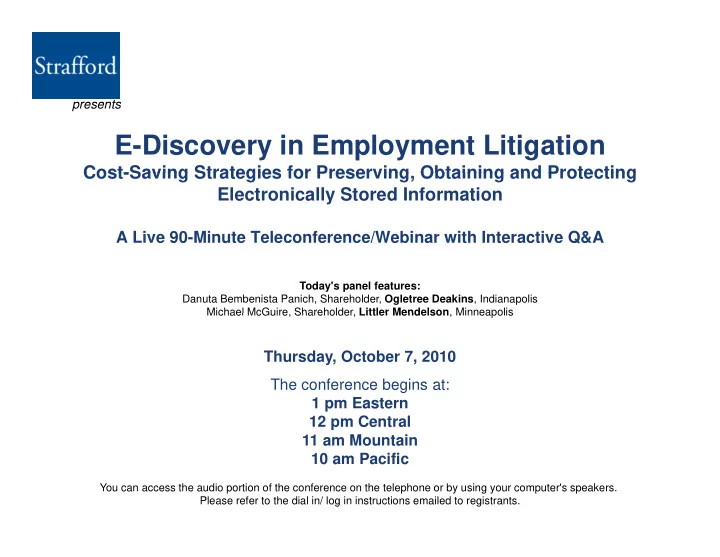
presents presents E-Discovery in Employment Litigation Cost-Saving Strategies for Preserving Obtaining and Protecting Cost-Saving Strategies for Preserving, Obtaining and Protecting Electronically Stored Information A Live 90-Minute


slide-1
SLIDE 1

presents

E-Discovery in Employment Litigation

Cost-Saving Strategies for Preserving Obtaining and Protecting

presents

Cost-Saving Strategies for Preserving, Obtaining and Protecting Electronically Stored Information

A Live 90-Minute Teleconference/Webinar with Interactive Q&A

Today's panel features: Danuta Bembenista Panich, Shareholder, Ogletree Deakins, Indianapolis Michael McGuire Shareholder Littler Mendelson Minneapolis

Q&

Michael McGuire, Shareholder, Littler Mendelson, Minneapolis

Thursday, October 7, 2010 The conference begins at: The conference begins at: 1 pm Eastern 12 pm Central 11 am Mountain 10 P ifi 10 am Pacific

You can access the audio portion of the conference on the telephone or by using your computer's speakers. Please refer to the dial in/ log in instructions emailed to registrants.

slide-2
SLIDE 2

For CLE purposes, please let us know how many people are listening at your location by y

  • closing the notification box
  • and typing in the chat box your
  • and typing in the chat box your

company name and the number of attendees attendees.

  • Then click the blue icon beside the box

to send to send.

For live event only For live event only.

slide-3
SLIDE 3
  • If you are listening via your computer

If you are listening via your computer speakers, please note that the quality of your sound will vary depending on the speed and lit f i t t ti quality of your internet connection.

  • If the sound quality is not satisfactory and you

li t i i t k are listening via your computer speakers, please dial 1-866-258-2056 and enter your PIN when prompted. Otherwise, please send e p o p ed O e se, p ease se d us a chat or e-mail sound@straffordpub.com immediately so we can address the problem.

  • If you dialed in and have any difficulties

during the call, press *0 for assistance.

slide-4
SLIDE 4

E-Discovery in Employment Liti ti Litigation

Program Sponsor: Strafford P bli ti Publications October 7, 2010 Presented By:

Donna Panich, Esq. q

Ogletree, Deakins, Nash, Smoak & Stewart, P.C.

slide-5
SLIDE 5

ER G TOGETHE

DISCOVERY IN EMPLOYMENT LITIGATION TENDS TO BE

WORKING

LITIGATION TENDS TO BE A ONE-WAY STREET

LAWYERS, LOYERS & L EMPL FIRST CLASS SERVICE, COAST TO COAST 5

slide-6
SLIDE 6

HAVE THE RULE AMENDMENTS HELPED?

ER

 American Trial Lawyers Task Force on

G TOGETHE

Discovery:

WORKING

“The discovery rules in particular are impractical in that they promote full discovery as a value above almost anything else”

LAWYERS,

above almost anything else

LOYERS & L EMPL FIRST CLASS SERVICE, COAST TO COAST 6

slide-7
SLIDE 7

HAVE THE RULE AMENDMENTS HELPED?

ER

 Cartel Asset Mgt. v. Ocwen Financial Corporation, 2009

G TOGETHE

WL 2242395 (D. Colo. 2009): “The discovery process necessarily imposes burdens on

WORKING

The discovery process necessarily imposes burdens on the responding party” A h i di “ ld ff

LAWYERS,

Argument that certain discovery “would affect our profitability and ability to serve our clients” was “the e- discovery equivalent of a claim that the ‘sky is falling’”

LOYERS & L EMPL FIRST CLASS SERVICE, COAST TO COAST 7

slide-8
SLIDE 8

HAVE THE RULE AMENDMENTS HELPED?

ER

 39 % of all recent ESI cases involve spoliation

G TOGETHE

claims

 Standards vary

WORKING

 Standards vary

 Proof of deliberate, bad faith conduct (Fla.)  Some evidence of intentional misconduct (Tex.)

LAWYERS,

 Negligence (NY)

 Victor Stanley Inc v Creative Pipe Inc (D Md

LOYERS & L

 Victor Stanley Inc. v. Creative Pipe Inc. (D. Md.

September 9, 2010)

EMPL FIRST CLASS SERVICE, COAST TO COAST 8

slide-9
SLIDE 9

E-DISCOVERY ACROSS THE STATES

ER G TOGETHE WORKING LAWYERS, LOYERS & L EMPL FIRST CLASS SERVICE, COAST TO COAST 9

slide-10
SLIDE 10

ER

WHAT DOES THIS MEAN?

G TOGETHE

A new industry

WORKING

A new paradigm

LAWYERS,

e pa ad g

LOYERS & L EMPL FIRST CLASS SERVICE, COAST TO COAST 10

slide-11
SLIDE 11

ER G TOGETHE WORKING LAWYERS, LOYERS & L EMPL FIRST CLASS SERVICE, COAST TO COAST 11

slide-12
SLIDE 12

KEY PHASES OF DISCOVERY

ER 

Triggering event Liti ti bl ti i ti th f

G TOGETHE  Litigation or reasonable anticipation thereof 

Search Id if h i i i

WORKING  Identify the preservation universe in gross 

Preserve

LAWYERS,  Suspend the ordinary disposition or alteration of

information Id tif

LOYERS & L 

Identify

 Locate responsive/potentially responsive information EMPL FIRST CLASS SERVICE, COAST TO COAST 12

slide-13
SLIDE 13

KEY PHASES OF DISCOVERY

ER

 Collect

G TOGETHE  Take physical custody of responsive/potentially responsive

information

WORKING

 Review

 Multi-pass process to reduce information to responsive &

non-privileged

LAWYERS,

 Produce

 Process to deliver responsive & non privileged information LOYERS & L  Process to deliver responsive & non-privileged information

to parties

EMPL FIRST CLASS SERVICE, COAST TO COAST 13

slide-14
SLIDE 14

NON-LINEAR PROCESS

ER G TOGETHE WORKING LAWYERS, LOYERS & L EMPL FIRST CLASS SERVICE, COAST TO COAST 14

slide-15
SLIDE 15

SO HOW DOES INFORMATION MANAGEMENT FIT IN?

ER

MANAGEMENT FIT IN?

 Significant feature in preparing for litigation

G TOGETHE

 Helps avert viable spoliation claims  Helps reduce ongoing litigation costs

Defensible mechanism for eliminating n sed

WORKING  Defensible mechanism for eliminating unused

information

 Less information = lower discovery costs LAWYERS,  Streamlines identification process LOYERS & L EMPL FIRST CLASS SERVICE, COAST TO COAST 15

slide-16
SLIDE 16

INFORMATION MANAGEMENT HAS ADDED BENEFITS

ER

ADDED BENEFITS

 Business needs

G TOGETHE

 Necessary information is available for use  Reduces costs of undisciplined storage

 Regulatory requirements

WORKING

 Regulatory requirements

 FLSA & State Wage/Hour  FMLA

LAWYERS,

 EEO  OSHA/MSHA  IRCA

LOYERS & L

 ERISA/COBRA/HIPAA

EMPL FIRST CLASS SERVICE, COAST TO COAST 16

slide-17
SLIDE 17

FEATURES NEEDED TO OPTIMIZE INFORMATION MANAGEMENT

ER

INFORMATION MANAGEMENT

 Data mapping

G TOGETHE

 Adequate infrastructure  Clear “use” policies

WORKING

 Communication methods  Equipment

Data export and storage

LAWYERS,

 Data export and storage

 Comprehensive records retention program  Record management procedures

LOYERS & L

 Record management procedures  Training, review and housecleaning

EMPL FIRST CLASS SERVICE, COAST TO COAST 17

slide-18
SLIDE 18

ADDED OPTIMIZATION

ER

 Consider litigation at each step

G TOGETHE

 Centralize storage  Build-in preservation solutions

A id d t lif ti

WORKING

 Avoid data proliferation  Maintain oversight of application development  Include liaison role in IT job description

LAWYERS,

j p

 Phillip M. Adams v. Dell, Inc., 2009 WL 910801 (D.

Utah 2009)

LOYERS & L EMPL FIRST CLASS SERVICE, COAST TO COAST 18

slide-19
SLIDE 19

IDENTIFICATION

ER

 Common information requests in employment

G TOGETHE

litigation

 Personnel data and “files”

P ll

WORKING

 Payroll  Policies and procedures  Decisional documentation

LAWYERS,

 Audits, surveys and training  Other claims and litigation

LOYERS & L

 Investigatory materials

EMPL FIRST CLASS SERVICE, COAST TO COAST 19

slide-20
SLIDE 20

IDENTIFICATION

ER

 Common information requests in employment

G TOGETHE

litigation (cont’d) that are more troublesome

 Communications

Person to person (e mail instant messaging tweeting)

WORKING  Person-to-person (e-mail, instant messaging, tweeting)  Mass (web-pages, articles, webinars)

 Systems and information infrastructure

LAWYERS,

 Hidden or alternative use data

LOYERS & L EMPL FIRST CLASS SERVICE, COAST TO COAST 20

slide-21
SLIDE 21

PRESERVATION

ER 

Triggering event: “litigation or reasonable anticipation thereof”

G TOGETHE 

What causes “reasonable anticipation”?

 Charge (Zubulake v. UBS Warburg LLC, 220 F.R.D. 212

(S.D.N.Y. 2003) (“Zubulake IV”))

WORKING

 Demand letter (Goodman v. Praxair Services, Inc., 632

F.Supp.2d 494 (D.Md. 2009); Major Tours, Inc. v. Colorel, 2009 WL 2413631 (D.N.J. 2009))

 Internal complaint (Broccoli v Echostar Communications

LAWYERS,

 Internal complaint (Broccoli v. Echostar Communications

Corporation, 229 F.R.D. 506 (D.Md. 2005))

 Consensus belief (Zubulake IV)

(

D ll I )

LOYERS & L

 Widespread litigation in industry (Phillip M. Adams v. Dell, Inc.)

EMPL FIRST CLASS SERVICE, COAST TO COAST 21

slide-22
SLIDE 22

PRESERVATION

ER

Pension Committee of the University of Montreal Pension Plan v Banc of America Securities*

G TOGETHE

Pension Plan v. Banc of America Securities*— key components of preservation

 Written litigation hold WORKING  Sent when litigation becomes reasonably foreseeable  Sent to everyone who may have relevant information LAWYERS,  Define relevant information broadly  Suspend “auto-delete” LOYERS & L

* 2010 WL 184312 (S.D.N.Y. Jan. 15, 2010)

EMPL FIRST CLASS SERVICE, COAST TO COAST 22

slide-23
SLIDE 23

PRESERVATION NOTICES

ER

 Written

G TOGETHE

 Identify “Key Players”

WORKING

 Include IT

LAWYERS, LOYERS & L EMPL FIRST CLASS SERVICE, COAST TO COAST 23

slide-24
SLIDE 24

PRESERVATION NOTICES

ER

 Content

G TOGETHE

 Nature of claim and summary of allegations  Relevant period and whether ongoing  Sources and locations of data

WORKING

 Sources and locations of data  Types of information sought and definition of

relevance

 What recipient should do: preserve; collect; notify

LAWYERS,

 What recipient should do: preserve; collect; notify

  • thers

 Methodology for required actions

Accountability

LOYERS & L

 Accountability  Certification

EMPL FIRST CLASS SERVICE, COAST TO COAST 24

slide-25
SLIDE 25

PRESERVATION NOTICES

ER

 Methodology

G TOGETHE

 Dealing with metadata  How to create .pst folders

H t h l d t

WORKING

 How to preserve ephemeral data  Using share drives or other shared resources  Remote collection

LAWYERS,

 Additional distribution of notices

LOYERS & L EMPL FIRST CLASS SERVICE, COAST TO COAST 25

slide-26
SLIDE 26

PRESERVATION NOTICES

ER

 Steps after issuance

G TOGETHE

 Track certifications  Track compliance

R l tt i ht

WORKING

 Regular attorney oversight  Issue reminders  Prioritize for collection

LAWYERS,

 Address replacement custodians

LOYERS & L EMPL FIRST CLASS SERVICE, COAST TO COAST 26

slide-27
SLIDE 27

PRESERVATION

ER

 Automated functions

G TOGETHE

 Auto-delete  Size limits

B k

WORKING

 Back-up

 Suspension of retention period expiration  System information

LAWYERS,

 System information

 Tangential business information  Logs and audit trails

LOYERS & L

g

EMPL FIRST CLASS SERVICE, COAST TO COAST 27

slide-28
SLIDE 28

COLLECTION – DETERMINING METHODOLOGY

ER

METHODOLOGY

 Overview of collection methods

G TOGETHE

Overview of collection methods

 Forensic Copy: A forensic copy is an exact copy of an

entire physical storage media including all active and

WORKING

entire physical storage media including all active and residual data and unallocated or slack space on the media. F i ll d A f th bl ibl

LAWYERS,  Forensically sound: A copy of the reasonably accessible

data contained in an information repository pursuant to documented and generally accepted collection methodologies and accomplished using appropriate tools

LOYERS & L

methodologies, and accomplished using appropriate tools.

EMPL FIRST CLASS SERVICE, COAST TO COAST 28

slide-29
SLIDE 29

COLLECTION

ER 

Overview of collection resources

 Third-party: relies on a specialty vendor to provide G TOGETHE  Third-party: relies on a specialty vendor to provide

collection services (either forensic or forensically sound)

 Company IT: relies on the party’s IT department to

execute on the collection plan; typically party’s IT

WORKING

p ; yp y p y department is “certified” to collect data

 Self/Custodial: relies upon an individual to locate and

transfer information from an information repository to the ti t

LAWYERS,

requesting party

All require involvement of counsel to ensure collection is forensically sound/documented/complete

LOYERS & L

forensically sound/documented/complete

EMPL FIRST CLASS SERVICE, COAST TO COAST 29

slide-30
SLIDE 30

FORENSIC COLLECTION

ER

 When is a forensic collection necessary or

d i bl ?

G TOGETHE

advisable?

 Criminal activity, fraud, or suspected fraud  Cases involving information “leakage” (e.g.,

WORKING

 Cases involving information leakage (e.g.,

trade secrets, proprietary information, intellectual property, etc.)

 Cases alleging a serious violation of a non

LAWYERS,

 Cases alleging a serious violation of a non-

compete agreement

 When authenticity/integrity of information is at

i

LOYERS & L

issue

 When required by agreement or court order  Central character/special circumstances

EMPL FIRST CLASS SERVICE, COAST TO COAST 30

Central character/special circumstances

slide-31
SLIDE 31

CUSTODIAL SELF-COLLECTION

ER

 Some judicial criticism/skepticism expressed

G TOGETHE

j p p

 Pension Committee (S.D.N.Y.)

 Roffe v. Eagle Rock Energy GP (Del. Ch.)

WORKING

 Qualcomm Inc. v. Broadcom Corp. (S.D. Cal.)

LAWYERS,

 Emphasis on counsel’s involvement and

  • versight

LOYERS & L EMPL FIRST CLASS SERVICE, COAST TO COAST 31

slide-32
SLIDE 32

COLLECTION - NOTES

ER

 The producing party determines the best and most

G TOGETHE

reasonable way to locate relevant information in discovery

 “Structured” data (e.g., from HR systems) is typically

WORKING

( g , y ) yp y provided through the client as an extract or report

 Consider Special Circumstances

 Proprietary data/database concerns LAWYERS,  Proprietary data/database concerns  Confidential information or trade secrets  Personally Identifiable Information LOYERS & L  Limitations on legacy systems

 Rule 26 “reasonably accessible” considerations

EMPL FIRST CLASS SERVICE, COAST TO COAST 32

slide-33
SLIDE 33

DOCUMENTING CHAIN OF CUSTODY

ER

 Why document Chain of Custody?

G TOGETHE

 Confirms that the evidence was not altered

(authenticity)

WORKING

(authenticity)

 Identifies who handled the evidence, why they

handled it, and what they did with it

LAWYERS,

 Must be retained by the producing party and

made available to other parties upon request

LOYERS & L EMPL FIRST CLASS SERVICE, COAST TO COAST 33

slide-34
SLIDE 34

DOCUMENTING CHAIN OF CUSTODY

ER

 What to include on Chain of Custody?

G TOGETHE

 All the “touch or potential alteration points”

WORKING

 Touch or alternation points include:

 Collection LAWYERS,  Transmission (e.g., Client to attorney, attorney to

processing vendor)

 When data is “processed” (e.g., scanned, extracted to

database etc )

LOYERS & L

database, etc.)

 When data returned in processed state for production EMPL FIRST CLASS SERVICE, COAST TO COAST 34

slide-35
SLIDE 35

MAINTAINING CHAIN OF CUSTODY

ER

 Use appropriate (forensically sound)

G TOGETHE

pp p ( y ) tools and procedures

 Maintain metadata

WORKING

 Preserve the information collected and

each subsequent winnowed set

LAWYERS,

 Document “search” and data mapping

information

LOYERS & L EMPL FIRST CLASS SERVICE, COAST TO COAST 35

slide-36
SLIDE 36

SAMPLE CHAIN OF CUSTODY

ER G TOGETHE WORKING LAWYERS, LOYERS & L EMPL FIRST CLASS SERVICE, COAST TO COAST 36

slide-37
SLIDE 37

FINAL COLLECTION NOTES

ER

 Sampling v. complete collection

G TOGETHE

p g p

 Early case assessment tools  Document your search and collection

WORKING

y approach, including locations accessed, data accessed, search results, errors, and

LAWYERS,

exceptions

 Consider using a collection tracking log

LOYERS & L EMPL FIRST CLASS SERVICE, COAST TO COAST 37

slide-38
SLIDE 38

THANK YOU!

ER

THANK YOU!

G TOGETHE WORKING

Danuta Bembenista Panich Ogletree Deakins Law Firm

LAWYERS,

donna.panich@odnss.com 317.916.2168

LOYERS & L EMPL FIRST CLASS SERVICE, COAST TO COAST 38

slide-39
SLIDE 39

E­Discovery in Employment Litigation in Employment Litigation

Cost‐Saving Strategies for Preserving, Obtaining and Protecting Electronically Stored Information g y Michael J. McGuire Michael J. McGuire Shareholder and eDiscovery Counsel

October 7, 2010

slide-40
SLIDE 40

Agenda g

  • Key cost drivers for eDiscovery
  • Key cost drivers for eDiscovery
  • Practical strategies for minimizing highest

t cost areas

– Process less – Review less – Review Smarter

40

slide-41
SLIDE 41

41

slide-42
SLIDE 42

Processing

Review

Preservation C ll ti

Identification Information Management

Production

Presentation

Collection Analysis

42

slide-43
SLIDE 43

To collect, process, store, review, and produce

What does it actually cost?

, p , , , p data from 1 PC

43

slide-44
SLIDE 44

44

slide-45
SLIDE 45

45

slide-46
SLIDE 46

“All In” Cost Per Document

Document Type Avg Pages/Doc Price Per Doc Word 9 $ 18 Excel 50 $ 100 Powerpoint 14 $ 28 Text Files 20 $ 40 Image Files 1.4 $ 3 Outlook/Exchange Email 1.5 $ 3

46

slide-47
SLIDE 47

The Role of Cost and

NEGOTIATING ESI PROTOCOLS

Proportionality

47

slide-48
SLIDE 48

Fed.R.Civ.P. 1

Rules should be construed and administered to Rules should be construed and administered to secure the “just, speedy, and inexpensive determination of every action and proceeding.” y p g

48

slide-49
SLIDE 49

Fed.R.Civ.P. 26(g) (g)

Rule 11 for discovery Rule 11 for discovery * * * neither unreasonable nor unduly burdensome i id i th d f th

  • r expensive, considering the needs of the case,

prior discovery in the case, the amount in controversy and the importance of the issues at controversy, and the importance of the issues at stake in the action.

49

slide-50
SLIDE 50

Mancia v. Mayflower y

  • Discovery budget in line with amount in controversy
  • Discovery budget in line with amount in controversy

and issues at stake

50

slide-51
SLIDE 51

Process Less

51

slide-52
SLIDE 52

Processing Options g p

  • Don’t process everything you collect
  • Don t process everything you collect
  • Exclude system files
  • Exclude irrelevant date ranges
  • Targeted extraction
  • Targeted extraction
  • Targeted file types

52

slide-53
SLIDE 53

53

slide-54
SLIDE 54

The NIST List

  • National Software Reference Library
  • National Software Reference Library
  • Over 17 million files in the database
  • Hash values
  • Used to identify known system files
  • Used to identify known system files

54

slide-55
SLIDE 55

Custom NIST lists

  • Remove standard files from corporate deployment
  • Remove standard files from corporate deployment

images

55

slide-56
SLIDE 56

PC USB PC ES USB

Custodian Global

We have seen 43%

FS

Custodian Deduplication 7 files become 1* Global Deduplication 14 files become 1*

to 64% global deduplication rates

PC USB ES

56

slide-57
SLIDE 57

Review Less

57

slide-58
SLIDE 58

Cull Before You Search

  • Narrow date ranges
  • Narrow date ranges
  • Email senders
  • Email domains

58

slide-59
SLIDE 59

Date Range Filters g

  • One of the most effective ways to reduce the volume
  • One of the most effective ways to reduce the volume
  • Key date range or ranges
  • Tie to events, sources, custodians
  • Different date ranges for different custodians and
  • Different date ranges for different custodians and

different sources

59

slide-60
SLIDE 60

Irrelevant Emails

Domains and Senders

  • Company distribution lists
  • Community involvement

Company distribution lists

  • Standard corporate

announcements Community involvement

  • Solicitations
  • Trade associations
  • Travel messages
  • Family members
  • Trade associations
  • DoNotReply
  • Workflow or approval emails
  • Banks, brokers, insurance

companies

  • Workflow or approval emails

(PTO, product releases, press releases)

  • Fantasy football or other

sports Internal vs external domains

  • Spam
  • eCommerce sites
  • Internal vs. external domains

60

slide-61
SLIDE 61

EVALUATE REVIEW BURDEN BEFORE AGREEING TO A SEARCH PROTOCOL

Review Smarter

61

slide-62
SLIDE 62

starvation starring starks startrange starpower startdate starburst starta starck starch starving starkey startled starnet startangle starttexfig starnetsystems stardust starla stara start_date startinga starlight starwars startmonth startpage starke starpoints start2 starnatgas starley starkovich starsupply startle starco startex starker starline starred startupjournal starship startegy starcoexp starlite staroffice starsupppetfee starboy starleaf starmedia stardom stargate startterm staralismy starghill starteda starve starcomglobal starcomm starcomms starlink starfish starine starkist start cost

286 Variations

*

starcomms starlink starfish starine starkist start_cost startrow starvpplp starchow6 starcom stares started_template startrust starent starling starpoint starrett startribune starz starband starhub starit starkly

87,807 Documents 7,111 for Star or Stars

Star*

starrett startribune starz starband starhub starit starkly starnberg staro starr_peaces starsa start_memory startac startec startfor startlingly startpos starwooda starcat starcraft starkeville starpow starsailor startc startecha

7,111 for Star or Stars

p startles starttint startxref starbranch starcher starchy stardust1118 starer stargazer starkest starkweather starletts starmark starowicz starsnbars starsteel start1 start2new start3 start_up startdd startloc startmenu startng startpath1 startpath10 startpath2 startpath3 startpath4 startpath5 startpath6 startpath7 startpath8 h9 h i l i 06 9

62

slide-63
SLIDE 63

Sample The Results p

  • Calculate hits for each search term
  • Calculate hits for each search term
  • Review a random sample of documents for terms with high hit

rate

  • Drop, add, or modify terms based upon joint review of sample

set – X – X not Y X not Y – X w/5 Z X d t (X /5 W) – X and not (X w/5 W)

63

slide-64
SLIDE 64

Review samples o f exc lude d do c uments do c uments

A

Generate random sample of

B

sample of documents (B – C) (yellow area) to d t i h th determine whether relevant documents will be excluded by

C

narrowing search to set C (red area).

64

slide-65
SLIDE 65

Evaluate Search Results

  • By date
  • By date
  • By location
  • By source
  • By custodian
  • By custodian

Look for patterns that may be clues to relevancy

65

slide-66
SLIDE 66

66

slide-67
SLIDE 67

“Raptor” by Month Raptor by Month

67

slide-68
SLIDE 68

“Raptor”

A P f All I As Percentage of All Items

68

slide-69
SLIDE 69

“Confidential” by Month y

69

slide-70
SLIDE 70

Confidential

P f All I as Percentage of All Items

70

slide-71
SLIDE 71

EMAIL THREADING, CONCEPTUAL SEARCH, CLUSTERING, AND

“New” Search

CATEGORIZATION

71

slide-72
SLIDE 72

New Features

  • Email chaining
  • Email chaining
  • Near duplicates
  • Concept searching
  • Clustering
  • Clustering
  • Categorization

72

slide-73
SLIDE 73

73

slide-74
SLIDE 74

74

slide-75
SLIDE 75

75

slide-76
SLIDE 76

Mi h l M G i Michael McGuire

Shareholder and eDiscovery Counsel Littler Mendelson P C Littler Mendelson, P.C. 612‐313‐7612 mmcguire@littler.com

76