Discovery Requests in Employment Litigation After Amended Rules - - PowerPoint PPT Presentation

discovery requests in employment litigation after amended
SMART_READER_LITE
LIVE PREVIEW

Discovery Requests in Employment Litigation After Amended Rules - - PowerPoint PPT Presentation

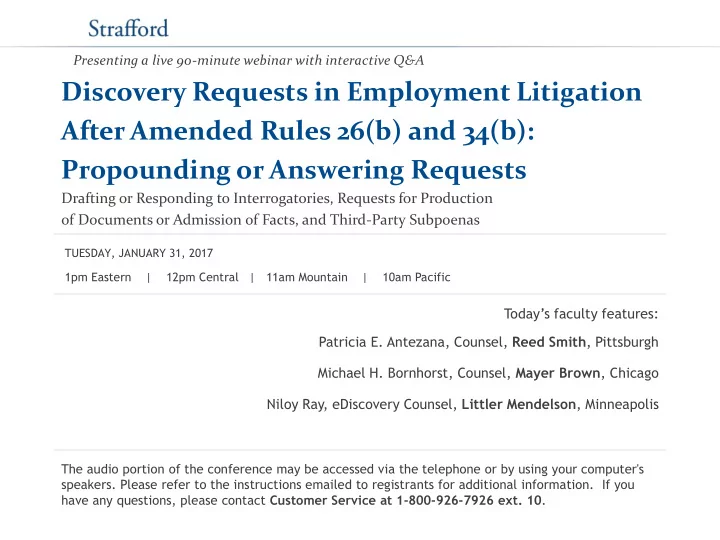
Presenting a live 90-minute webinar with interactive Q&A Discovery Requests in Employment Litigation After Amended Rules 26(b) and 34(b): Propounding or Answering Requests Drafting or Responding to Interrogatories, Requests for Production


slide-1
SLIDE 1

Discovery Requests in Employment Litigation After Amended Rules 26(b) and 34(b): Propounding or Answering Requests

Drafting or Responding to Interrogatories, Requests for Production

  • f Documents or Admission of Facts, and Third-Party Subpoenas

Today’s faculty features:

1pm Eastern | 12pm Central | 11am Mountain | 10am Pacific

The audio portion of the conference may be accessed via the telephone or by using your computer's

  • speakers. Please refer to the instructions emailed to registrants for additional information. If you

have any questions, please contact Customer Service at 1-800-926-7926 ext. 10.

TUESDAY, JANUARY 31, 2017

Presenting a live 90-minute webinar with interactive Q&A Patricia E. Antezana, Counsel, Reed Smith, Pittsburgh Michael H. Bornhorst, Counsel, Mayer Brown, Chicago Niloy Ray, eDiscovery Counsel, Littler Mendelson, Minneapolis

slide-2
SLIDE 2

Tips for Optimal Quality

Sound Quality If you are listening via your computer speakers, please note that the quality

  • f your sound will vary depending on the speed and quality of your internet

connection. If the sound quality is not satisfactory, you may listen via the phone: dial 1-866-370-2805 and enter your PIN when prompted. Otherwise, please send us a chat or e-mail sound@straffordpub.com immediately so we can address the problem. If you dialed in and have any difficulties during the call, press *0 for assistance. Viewing Quality To maximize your screen, press the F11 key on your keyboard. To exit full screen, press the F11 key again.

FOR LIVE EVENT ONLY

slide-3
SLIDE 3

Continuing Education Credits

In order for us to process your continuing education credit, you must confirm your participation in this webinar by completing and submitting the Attendance Affirmation/Evaluation after the webinar. A link to the Attendance Affirmation/Evaluation will be in the thank you email that you will receive immediately following the program. For additional information about continuing education, call us at 1-800-926-7926

  • ext. 35.

FOR LIVE EVENT ONLY

slide-4
SLIDE 4

DISCOVERY REQUESTS IN EMPLOYMENT LITIGATION AFTER AMENDED RULES 26(B) AND 34(B)

slide-5
SLIDE 5

Relevant Changes to the Federal Rules

December 2015 Amendments

  • Rules 1, 16, 26, 34, and 37.
  • Significant impact on discovery practice.
  • Rule changes affect nearly every step of discovery.

December 2016 Amendments

  • Rule 6.
  • Impact limited to timing of discovery response.

5

slide-6
SLIDE 6

2015 Amendments

I. DECEMBER 2015 AMENDMENTS A. Rule 1: Cooperation

  • FRCP are to be “construed, administered and employed by the court

and the parties to secure the just, speedy and inexpensive determination of every action and proceeding.”

  • Emphasizes cooperation among the parties to ensure that discovery

remains reasonable/proportional. B. Rules 16, 26, 34: Scheduling

  • Rule 16: Amendment generally shortened the time before the court

issues a scheduling order (now - 90 days after defendant has been served or 60 days after defendant has appeared).

  • Encourages parties to address ESI preservation in the initial

scheduling order.

6

slide-7
SLIDE 7

2015 Amendments

I. DECEMBER 2015 AMENDMENTS B. Rules 16, 26, 34: Scheduling

  • Rule 26: Amendment permits parties to “deliver” Rule 34 requests

for production 21 days after service of the complaint, even if the Rule 26(f) scheduling conference has not yet taken place.

  • But, time to respond to requests does not start until after the

Rule 26(f) conference.

  • Rule 34: Amendment
  • Encourages parties to address ESI preservation in the initial

scheduling order.

7

slide-8
SLIDE 8

2015 Amendments

I. DECEMBER 2015 AMENDMENTS C. Rule 26: Proportionality Standard

  • Addition of proportionality to the scope of discovery under Rule

26(b)(1): "Parties may obtain discovery regarding any non-privileged matter that is relevant to any party's claim or defense and proportional to the needs of the case.“ Emphasizes cooperation among the parties to ensure that discovery remains reasonable/proportional.

  • Eliminates the “reasonably calculated to lead to the discovery of

admissible evidence” standard.

8

slide-9
SLIDE 9

2015 Amendments

I. DECEMBER 2015 AMENDMENTS C. Rule 26: Proportionality Standard

  • Courts have focused on importance and burden in deciding

discovery disputes, and expect parties to address these factors.

  • In raising discovery issues with the court, parties should provide

specific, factual support tied closely to proportionality factors.

  • These factors also should be taken into account in crafting

discovery requests and responses/objections, as well as during the meet and confer process.

  • Courts appear willing to actively curtail otherwise relevant

discovery due to a lack of proportionality.

9

slide-10
SLIDE 10

2015 Amendments

I. DECEMBER 2015 AMENDMENTS D. Rule 34: Requests for Production

  • Requires greater detail in responding to document requests. Must

now state the grounds for objections "with specificity" and indicate whether any responsive materials are being withheld; must also indicate timing of production.

10

slide-11
SLIDE 11

2015 Amendments

I. DECEMBER 2015 AMENDMENTS D. Rule 34: Requests for Production

  • Courts have been quick to reprimand parties for not objecting with

specificity and instead serving general, boilerplate objections. Court may strike such objections/deem them waived, grant opposing party's motion to compel, and/or award costs.

  • Objections should be tailored to respond to the requests and identify what

documents will be withheld and produced.

  • Need to think carefully about how to apply this in practice, particularly in

cases involving large volumes of e-discovery where parties need to respond to written discovery before collecting/reviewing their documents.

  • Courts are also enforcing the requirement to indicate when documents will

be produced; failure to do so may result in court's imposition of its own timeline upon granting a motion to compel.

11

slide-12
SLIDE 12

2016 Amendments

II. DECEMBER 2016 AMENDMENT A. Rule 6: Timing

  • Amendment removes electronic service rule under Rule 5(d)(2)(E).
  • Bottom line: eliminates the three additional days for electronic

service.

12

slide-13
SLIDE 13

Age Discrimination – Single Plaintiff

Sue Jones alleges that she was fired by software company VR Kids, Inc., in April 2015, simply because of her age. Jones, who had been an engineer with VR Kids for 8 years, was 45 years old when she was fired. Jones claims that she endured an ageist work environment, that younger employees received preferential treatment and lesser discipline, that VR Kids consistently hired under-40 candidates, and that she was replaced by a 25-year-old recent grad. VR Kids answers that Jones was fired for poor performance, that she was over- paid and under-performing, that she behaved unprofessionally at work and towards her colleagues, and that lately she had not shown the performance growth and development expected of a senior engineer in her position. The company denies that Jones was replaced by a younger hire, and states that prior to the lawsuit, she did not raise any of her concerns with HR/management.

13

slide-14
SLIDE 14

Jones v. VR Kids – Round 1

Jones sues VR Kids on January 4th, 2016, in federal court. VR Kids is served on January 15th, and retains outside counsel shortly thereafter.

  • Counsel for VR Kids begins identifying paper and electronic content to

preserve, including e-mail, personnel files, performance reviews, engineer hiring/firing/payroll data, and HR material (including the employee handbook, the code of conduct, age-discrimination training records, and applicable policy and procedure documentation). Counsel have an introductory call on February 1st, and set a formal Rule 26(f) meet-and-confer for the 22nd, ahead of the March 15th scheduling conference. On February 18th, Jones e-mails Ptfs’ First Set of RFPs to VR Kids’ counsel. The RFPs demand production on or before March 21st.

14

slide-15
SLIDE 15
  • R. 16 Scheduling Conference - March 15th

Ahead of the conference, the parties file a R. 16(f) report stating that the parties:

  • met-and-conferred on March 1st;
  • are working on an ESI protocol;
  • will propose a stipulated confidentiality and claw-back order; and
  • have a disagreement regarding Jones’s RFPs.

At the conference, the parties present their dispute to the Court.

15

slide-16
SLIDE 16

Jones v. VR Kids – Round 2

Jones RFP 1: Produce all corporate e-mail sent to, received by, or regarding Plaintiff Sue Jones, including but not limited to all such e-mail related to her hiring, her job performance, her termination, and the hiring of her replacement. VR Kids Response: Defendant objects to this Request because it is overly broad, unduly burdensome, and not proportional to the needs of the case. This Request requires Defendant to search through its entire e-mail system and archives. This Request is argumentative in asserting that any “replacement” was hired. Defendant objects to this Request to the extent it calls for the production of any information that is protected by the attorney-client privilege or the work- product doctrine. Subject to and without waiver of these objections, Defendant will produce relevant, non-privileged e-mail from the following individuals, for the time period May 1, 2014-May 1, 2015: Barry Hardy [Jones’s supervisor], Kate Dixon [relevant HR manager], and Sarah Simon [head of HR].

16

slide-17
SLIDE 17

Jones v. VR Kids – Round 2

VR Kids RFP 1: Produce all personal e-mail, social-media content, and other electronic documentation depicting or capturing Plaintiff’s alleged age-related workplace concerns and her communication of these concerns to family, friends and colleagues. Jones Response: Plaintiff objects to RFP 1 on grounds of vagueness, ambiguity,

  • ver-breadth and undue burden of cost and effort. RFP 1 has no temporal
  • limitations. RFP 1 seeks information that is not relevant to the subject matter of

this lawsuit, and in fact is not reasonably calculated to lead to the discovery of relevant evidence. RFP 1 is plainly an attempt to harass Plaintiff, as neither party’s “personal e-mail” or “social-media content” is relevant to this lawsuit. Plaintiff notes that she has not sought such content from Defendants’ employees.

17

slide-18
SLIDE 18

Motion to Compel Hearing – June 1st

Parties meet-and-confer, but are unable to resolve their differences. Jones does not produce any content, and VR Kids produces the subset of e-mail described in their response. Parties then file duelling motions to compel proper RFP responses as well as comprehensive productions. The Court conducts oral arguments on issues such as:

  • failure to meet requirements of amended Rules
  • use of improper/inapplicable standards
  • proportionality of requests
  • relevance of social media

18

slide-19
SLIDE 19

Gilead Sciences, Inc. v. Merck & Co, Inc.,

Case No. 5:13-cv-04057-BLF (N.D. Ca. Jan. 13, 2016)

  • Court recognized that proportionality under the Federal Rules is nothing new
  • “No longer is it good enough to hope that the information sought might lead

to the discovery of admissible evidence. … Instead, a party seeking discovery

  • f relevant, non-privileged information must show, before anything else, that

the discovery sought is proportional to the needs of the case.”

19

slide-20
SLIDE 20

Gilead Sciences, Inc. v. Merck & Co, Inc.,

Case No. 5:13-cv-04057-BLF (N.D. Ca. Jan. 13, 2016)

  • Defendant filed a motion to compel information re compounds related to its patents
  • Court reasoned that the requests were disproportionate under Rule 26(b)(1)
  • If the requests were permissible, Plaintiff would have to produce “discovery on all

sorts of compounds that bear no indication of any nexus to the disputes in this case.”

  • Court analogized the situation to requiring GM to produce discovery on Buicks and

Chevys in a patent case about Cadillacs simply because all three happen to be cars

  • Court denied Defendant’s motion to compel given the relevant information already

produced, the lack of any reason to doubt the proof already offered by Plaintiff, and the cost and potential delay caused by the requested production

20

slide-21
SLIDE 21
  • Relevancy Analysis

a. Regulatory communications largely controlled within the United States – captured by ESI searches already b. No Plaintiffs in MDL are from foreign countries c. Discovery sought for a narrow purpose – to determine if foreign communications were inconsistent with communications with US regulators d. Court concluded that requested discovery was only marginally relevant

In re: Bard IVC Filters Prods. Liab. Litig., No.

MDL 15-02641-PHX DGC (D. Ariz. Sept. 16, 2016)

21

slide-22
SLIDE 22
  • Proportionality Analysis
  • a. Importance of the discovery in resolving the issues in the case – Court referenced

its marginal relevance discussion

  • b. Parties relative access to relevant information favored Plaintiffs, but Court noted

“only in Defendants’ possession of possibly relevant information”

  • c. Burden or expense outweighed likely benefit – Defendants would have to search ESI

from 18 foreign entities over a 13-year period which outweighed mere possibility

  • f finding an inconsistent communication

In re: Bard IVC Filters Prods. Liab. Litig., No.

MDL 15-02641-PHX DGC (D. Ariz. Sept. 16, 2016)

22

slide-23
SLIDE 23
  • Defendants need not search ESI of foreign Bard entities because proposed discovery

was not proportional to the needs of the case

  • Court’s relevancy analysis was key to conclusion:
  • a. Importance of discovery to resolve issues = “marginally relevant”
  • b. Parties access to information = slightly favored Plaintiffs only to find “possibly

relevant information”

  • c. Burden outweighed benefit = “mere possibility” of finding inconsistent

communications

In re: Bard IVC Filters Prods. Liab. Litig., No.

MDL 15-02641-PHX DGC (D. Ariz. Sept. 16, 2016)

23

slide-24
SLIDE 24

Jones v. VR Kids – Round 3

Jones gathers pay stubs, tax documents and other paper files, and prints off a few dozen e-mail files and attachments. Her counsel scans all the content and produces a single omnibus PDF to VR Kids. At the same time, VR Kids circulates a finalized ESI protocol that lays out technical specifications for productions: Bates stamping, unitization, TIFF images, metadata, load-files, etc. VR Kids also produces e-mail pursuant to these specs.

  • VR Kids’ RFP specifies a ‘TIFF+’ production format. Jones objects to

this instruction, and states that she will produce “in PDF .”

  • Jones’s RFP defines documents as including “ … e-mail (in native

format) …”; VR Kids’ response does not object to that definition or specify a counter form of production.

  • VR Kids rejects Jones’s demand that VR Kids “organize and label”

productions by RFP .

24

slide-25
SLIDE 25

Discovery Status Hearing – August 15th

At a routine status hearing, both parties raise concerns re each others’ deficient productions, including:

  • Jones’s failure to follow the ESI protocol
  • VR Kids’ failure to object to the definition of document
  • whether Jones’s PDF format is “reasonably usable”
  • whether VR Kids must “organize and label” its e-mail production
  • discoverability of metadata

25

slide-26
SLIDE 26

Kissing Camels Surg. Cen., LLC v. Centura Health Corp., No. 12-cv-03012-WJM-NYW (D. Colo., Jan. 22, 2016)

  • Court addressed the parties’ obligations under Rule 34(b) and Rule 1 on

Plaintiffs’ motion to strike requests

  • Court cited to Chief Justice John Roberts in his Year-End Report on the

Federal Judiciary to remind the parties that the rules amendments were intended to: ― Encourage greater cooperation among counsel ― Focus discovery on what is truly necessary to resolve the case ― Engage judges in early and active case management ― Address serious problems associated with vast amounts of ESI

26

slide-27
SLIDE 27

Kissing Camels Surg. Cen., LLC v. Centura Health Corp., No. 12-cv-03012-WJM-NYW (D. Colo., Jan. 22, 2016)

  • The Court took issue with Plaintiffs’ boilerplate objections, which it

instructed were improper under Rule 34(b)

  • “The responding party has the obligation to explain and support its
  • bjections.”
  • Plaintiffs failed “to provide any specificity to their objections, including their
  • bjection that they have already produced responsive documents”

27

slide-28
SLIDE 28

Kissing Camels Surg. Cen., LLC v. Centura Health Corp., No. 12-cv-03012-WJM-NYW (D. Colo., Jan. 22, 2016)

  • The Court also agreed that many of Defendants’ requests for production were

improper on their face as “omnibus requests”

  • Court permitted Defendant to identify categories of documents in its

requests to which Plaintiffs objected based on their objection that they were duplicative of documents already produced

  • Court ordered Plaintiffs to then identify Bates ranges of responsive

documents to those categories

  • Court advised parties to follow principles under Rule 34(b) and Rule 1

28

slide-29
SLIDE 29

Scranton Prods., Inc. v. Bobrick Washroom Equip., Inc., Case No. 3:14-CV-00853 (M.D. Pa. June 2, 2016)

  • Plaintiff brought claims under the Lanham Act for false and misleading

advertising

  • Parties had been engaged in highly contentious discovery disputes for two

years

  • Defendant claimed Plaintiff improperly redacted information from relevant

documents

  • Defendant sought, inter alia, an order requiring Plaintiff to disclose whether

it had silently withheld documents based on its objections under Rule 34(b)

29

slide-30
SLIDE 30

Scranton Prods., Inc. v. Bobrick Washroom Equip., Inc., Case No. 3:14-CV-00853 (M.D. Pa. June 2, 2016)

  • Court reminded the parties of their obligations under Rule 1 and that discovery

is not a “competition to see which party can manipulate legal doctrines to gain advantage”

  • Burden was on Plaintiff as the party refusing to provide discovery to

demonstrate how the redacted information was not relevant

  • Plaintiff failed to meet its burden on most categories
  • Court instructed that no party could redact information it deemed irrelevant

without first obtaining leave of Court

  • Based on amended Rule 34(b), Court required Plaintiff to amend its responses

and disclose whether it “silently withheld” documents based on its objections

30

slide-31
SLIDE 31

2015 Amendments - Sanctions

I. DECEMBER 2015 AMENDMENTS E. Rule 37: Preservation Obligations 1. Rule 37(e) was added to set forth a uniform standard for when courts can give an "adverse inference" instruction or impose other sanctions to remedy the loss of electronically stored information. Also authorizes less severe measures as needed to cure prejudice resulting from a loss of ESI. 2. Rule is based on existing duties and did not create a new duty to preserve. 3. Only applies if the lost information should have been preserved in anticipation or conduct of litigation and the party failed to take reasonable steps to preserve it. a. Was there spoliation (i.e., duty to preserve)? If so, what sanctions are appropriate, taking in to account whether the other party was prejudiced and if information is recoverable?

31

slide-32
SLIDE 32

2015 Amendments - Sanctions

I. DECEMBER 2015 AMENDMENTS E. Rule 37(e): Preservation Obligations 1. Rule calls for reasonable steps, not perfection. 2. Sophistication and resources of the parties may be considered. 3. A less costly information preservation system may be reasonable if it is substantially effective.

32

slide-33
SLIDE 33

2015 Amendments - Sanctions

I. DECEMBER 2015 AMENDMENTS E. Rule 37(e): Preservation

  • 37(e)(1) provides for curative measures where information is lost.

Some courts have construed this term broadly.

  • Severe sanctions under Rule 37(e)(2) (adverse inference, dismissal,

default judgment), require a finding of intent and thus far seem to be ordered less frequently than other forms of sanctions.

  • Where no wrongful intent is found, the court “may order measures

no greater than necessary”.

33

slide-34
SLIDE 34

Questions?

34

Patricia E. Antezana Reed Smith pantezana@reedsmith.com Michael H. Bornhorst Mayer Brown mbornhorst@mayerbrown.com Niloy Ray Littler Mendelson nray@littler.com