Discovery Issues in Federal Agency Litigation: Navigating - - PowerPoint PPT Presentation

discovery issues in federal agency litigation navigating
SMART_READER_LITE
LIVE PREVIEW

Discovery Issues in Federal Agency Litigation: Navigating - - PowerPoint PPT Presentation

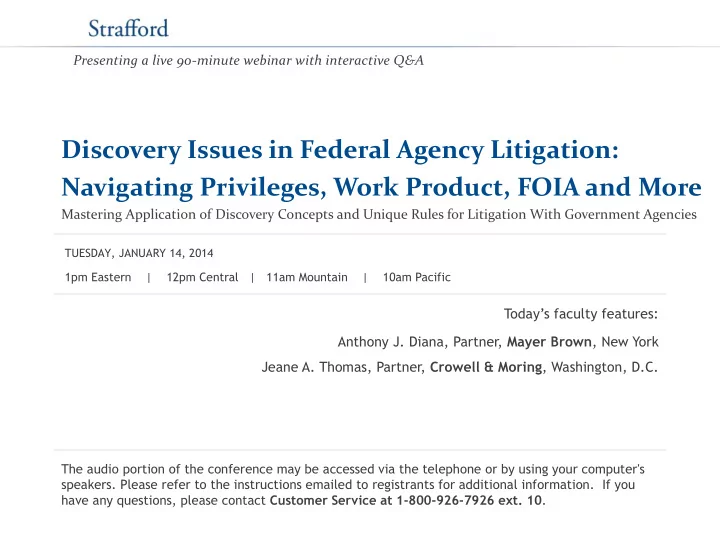
Presenting a live 90-minute webinar with interactive Q&A Discovery Issues in Federal Agency Litigation: Navigating Privileges, Work Product, FOIA and More Mastering Application of Discovery Concepts and Unique Rules for Litigation With


slide-1
SLIDE 1

Discovery Issues in Federal Agency Litigation: Navigating Privileges, Work Product, FOIA and More

Mastering Application of Discovery Concepts and Unique Rules for Litigation With Government Agencies Today’s faculty features:

1pm Eastern | 12pm Central | 11am Mountain | 10am Pacific

The audio portion of the conference may be accessed via the telephone or by using your computer's

  • speakers. Please refer to the instructions emailed to registrants for additional information. If you

have any questions, please contact Customer Service at 1-800-926-7926 ext. 10.

TUESDAY, JANUARY 14, 2014

Presenting a live 90-minute webinar with interactive Q&A Anthony J. Diana, Partner, Mayer Brown, New York Jeane A. Thomas, Partner, Crowell & Moring, Washington, D.C.

slide-2
SLIDE 2

Sound Quality If you are listening via your computer speakers, please note that the quality

  • f your sound will vary depending on the speed and quality of your internet

connection. If the sound quality is not satisfactory, you may listen via the phone: dial 1-866-869-6667 and enter your PIN when prompted. Otherwise, please send us a chat or e-mail sound@straffordpub.com immediately so we can address the problem. If you dialed in and have any difficulties during the call, press *0 for assistance. Viewing Quality To maximize your screen, press the F11 key on your keyboard. To exit full screen, press the F11 key again.

FOR LIVE EVENT ONLY 2

slide-3
SLIDE 3

For CLE purposes, please let us know how many people are listening at your location by completing each of the following steps:

  • In the chat box, type (1) your company name and (2) the number of

attendees at your location

  • Click the SEND button beside the box

If you have purchased Strafford CLE processing services, you must confirm your participation by completing and submitting an Official Record of Attendance (CLE Form). You may obtain your CLE form by going to the program page and selecting the appropriate form in the PROGRAM MATERIALS box at the top right corner. If you'd like to purchase CLE credit processing, it is available for a fee. For additional information about CLE credit processing, go to our website or call us at 1-800-926-7926 ext. 35.

FOR LIVE EVENT ONLY 3

slide-4
SLIDE 4

If you have not printed the conference materials for this program, please complete the following steps:

  • Click on the ^ symbol next to “Conference Materials” in the middle of the left-

hand column on your screen.

  • Click on the tab labeled “Handouts” that appears, and there you will see a

PDF of the slides for today's program.

  • Double click on the PDF and a separate page will open.
  • Print the slides by clicking on the printer icon.

FOR LIVE EVENT ONLY 4

slide-5
SLIDE 5

Discovery Issues in Federal Agency Litigation:

Navigating Privileges, Work Product, FOIA and More Anthony Diana, Mayer Brown Jeane Thomas, Crowell & Moring LLP

January 14, 2014 Strafford

slide-6
SLIDE 6

Outline

  • Overview of discovery challenges
  • FOIA Exemptions

– Deliberative process – Privacy – Law enforcement – Challenging exemptions under FOIA

  • Privileges

– Attorney-client – Work product – FRE 502 considerations

  • E-discovery Issues

6

slide-7
SLIDE 7

Overview of Discovery Challenges

  • The government may have a significant headstart
  • n discovery through investigation processes
  • The “government” is big
  • The government has unique grounds for

withholding otherwise discoverable material

  • There may be special circumstances regarding the

government’s and parties’ assertion of privilege claims

  • The government’s e-discovery capabilities and

incentives vary significantly

7

slide-8
SLIDE 8

FOIA Exemptions

8

slide-9
SLIDE 9

FOIA Exemptions/Privileges for Government

  • Exemptions (5 U.S.C. § 552(b))

– Classified documents/national security; – Related solely to the internal personnel rules and practices of an agency; – Specifically exempted from disclosure by statute; – Trade secrets and commercial or financial information obtained from a person and privileged or confidential; – Deliberative process and attorney client privilege (inter-agency or intra- agency memorandums or letters which would not be available by law to a party other than an agency in litigation with the agency); – Personal privacy; – Law enforcement purposes; – Bank examination privilege--Regulation or supervision of financial institutions; – Geological and geophysical information and data, including maps, concerning wells

9

slide-10
SLIDE 10

Deliberative Process

  • Deliberative Process (5 U.S.C. § 552(b)(5))

– Protects from disclosure documents reflecting advisory opinions, recommendations and deliberations comprising part of a process by which government decisions and policies are formulated

  • Intended to enhance the quality of agency decisions, by protecting open and frank

discussion among those who make them with the government

– To qualify for the deliberative process privilege, the document must be “pre- decisional” and deliberative”

  • “pre-decisional” means it was prepared in order to assist an agency decision-maker in

arriving at the decision – Document must be related to a specific decision facing the agency

10

slide-11
SLIDE 11

Deliberative Process

  • Deliberative Process (5 U.S.C. § 552(b)(5))

– “deliberative” means it is actually related to the process by which policies are formulated

  • Formed an essential link in a specified consultative process;
  • Reflects the personal opinions of the writer rather than the policy of the agency;

and

  • If released, would inaccurately reflect or prematurely disclose the views of the

agency

– Privilege does not extend to:

  • ”purely factual material”
  • Documents later adopted or incorporated into a final agency opinion

– Pre-decisonal document can lose its status if it is adopted, formally or informally, as the agency position on an issue or is used by the agency in its dealings with the public

11

slide-12
SLIDE 12

Privacy

  • Privacy ((5 U.S.C. § 552(b)(6))

– Protects from disclosure of “personnel and medical files and similar files the disclosure

  • f which would constitute a clearly unwarranted invasion of personal privacy”
  • Purpose is to protect individuals from the injury or embarrassment that can result from the

unnecessary disclosure of personal information – Interpreted broadly to include any detailed Government records on an individual which can be identified as applying to that individual

  • If “substantial privacy interests” would be compromised, no disclosure
  • If no substantial privacy interest compromised, balancing test

– Potential harm to privacy interests – Public interest in disclosure of the requested information

  • Requesting party bears the burden establishing public disclosure outweighs privacy interests
  • Law enforcement exemption 7(C) also contains privacy exemption for law enforcement matters
  • Government often asserts that names, addresses, phone numbers, and email addresses of

government employees (federal and state) fall within this exemption – Result is emails with all email addresses and signatory lines redacted – Third-parties’ information also withheld – Problem challenging deliberative process and attorney-client privileges if do not know who sent or received a document

12

slide-13
SLIDE 13

Law Enforcement

  • Law enforcement (5 U.S.C. § 552(b)(7))

– (A) could reasonably be expected to interfere with enforcement proceedings, – (B) would deprive a person of a right to a fair trial or an impartial adjudication, – (C) could reasonably be expected to constitute an unwarranted invasion of personal privacy, – (D) could reasonably be expected to disclose the identity of a confidential source, including a State, local, or foreign agency or authority or any private institution which furnished information on a confidential basis, and, in the case of a record or information compiled by a criminal law enforcement authority in the course of a criminal investigation or by an agency conducting a lawful national security intelligence investigation, information furnished by a confidential source, – (E) would disclose techniques and procedures for law enforcement investigations or prosecutions, or would disclose guidelines for law enforcement investigations or prosecutions if such disclosure could reasonably be expected to risk circumvention of the law, or – (F) could reasonably be expected to endanger the life or physical safety of any individual

13

slide-14
SLIDE 14

Challenging Exemptions under FOIA

  • Challenging Assertions of Exemptions

– Request Vaughn Index

  • Similar to privilege log, government agency must log and describe information

that it is withholding because of exemptions – Can challenge government’s lack of detail on descriptions » Must have sufficient detail so requesting party understands what is being withheld so requesting party has basis to challenge appropriateness of exemption

– Target/Prioritize documents for Vaughns to documents that are most important to requesting party

  • Limiting the number of documents subject to Vaughns expedites process and helps

argument that requesting party is reasonable – Similar prioritization when challenging adequacy of descriptions and/or appropriateness of exemptions

14

slide-15
SLIDE 15

Challenging Exemptions under FOIA

  • Challenging Assertions of Exemptions

– Summary Judgment Motions

  • Depositions unlikely—rely on affidavits
  • Affidavits submitted by government agency are accorded a presumption of good faith

– As long as affidavits supply facts indicating that the agency conducted a thorough search and give reasonably detailed explanations why any withheld documents fall within an exemption, the agency will sustain its burden – Government agency’s decision that the information is exempt from disclosure receives no deference (de novo review) – To overcome presumption, need to demonstrate by reference to specific documents and specific requests

  • Prioritization is key to overcoming presumption—court unlikely to believe that all

information withheld is not subject to exemption – Often need in-camera review to make determination, so less is more – Use samples if large number of documents – If court sees that government is over-reaching in its designations of exemptions, credibility undermined for other challenged exemptions

15

slide-16
SLIDE 16

Privileges

16

slide-17
SLIDE 17

Attorney Client Privilege

  • Government attorney must be acting in legal

capacity; if acting as regulator or administrator, communications are not privileged

– Texas Puerto Rico, Inc. v. Dep’t of Consumer Affairs, 60 F.3d 867 (1st Cir. 1995)

17

slide-18
SLIDE 18

Attorney Work Product

  • Protects information created “in anticipation of

litigation”

  • Existence of regulatory or administrative

proceeding, alone, typically does not meet requirement

  • Thus, possibility that regulatory decision would

be challenged in court does not qualify to shield documents relating to regulatory process

– E.g., Coastal States Gas Corp. v. Department of Energy, 617 F.2d 854, 864 (D.C. Cir. 1980)

18

slide-19
SLIDE 19

FRE 502 Considerations

  • 502(a) protects against subject matter waiver except

where disclosure is made in federal proceeding or to federal agency and:

– (1) is intentional; – (2) disclosed and undisclosed information concern the same subject matter; and – (3) they ought in fairness to be considered together

  • 502(d) extends non-waiver protections to other state

and federal proceedings – but only if entered as an

  • rder by a federal court

– Even if you have a pre-litigation non-waiver agreement with the government, make sure to get the agreement entered as a court order

19

slide-20
SLIDE 20

E-Discovery

20

slide-21
SLIDE 21

Government’s Duty to Preserve

  • Generally the same standard: “reasonable

anticipation of litigation”

  • Preservation trigger:

– Litigation was “reasonably forseeable” when government received letter from defense counsel rejecting settlement offer (U.S. v. Community Health Systems, Inc. et al., 2012 WL 5387069 (D.N.M. 2012))

21

slide-22
SLIDE 22

Spoliation by Government

  • Government can be sanctioned for spoliation:

– U.S. v. Community Health Systems, Inc. et al., (litigation hold “woefully inadequate” and defendants were prejudiced thereby)

  • But same standards apply:

– SEC v. Mercury Interactive LLC, 2012 WL 3277165 (N.D. Cal. Aug. 9 2012) (SEC not sanctioned for deleting over 5 million pages of ESI where defendants did not show sufficient prejudice)

22

slide-23
SLIDE 23

Government’s Duty to Cooperate

  • EEOC v. The Original Honeybaked Ham Co. of Georgia, Inc.,

2013 U.S. Dist. LEXIS 26887 (D. Colo. 2013)

– sanctions imposed where EEOC was “negligent in its discovery

  • bligation, dilatory in cooperating with defense counsel, and

somewhat cavalier in its responsibility to the” court

  • SEC v. Collins & Aikman Corp., 2009 WL 94311 (S.D.N.Y.

2009)

– dispute over search terms – “When a government agency initiates litigation, it must be prepared to follow the same discovery rules that govern private parties…”

  • Aguilar v. Immigration & Customs Enforcement Division,

255 F.R.D. 250 (S.D.N.Y. 2008)

– dispute over production of metadata

23

slide-24
SLIDE 24

Duty of Competence – A Cautionary Tale

  • In re Fannie Mae Sec. Litig., 552 F.3d 814 (D.C. Cir.

2009)

– OFHEO receives broad third party subpoena – Following dispute regarding search of backup tapes, parties enter into stipulated order agreeing that defendants have sole discretion to specify search terms – Defendants submitted over 400 search terms which hit 660,000 documents – OFHEO spend over $6 million (9% of its budget) and missed final production deadline – Court found that OFHEO abandoned any burden argument by agreeing to stipulated order; found OFHEO in contempt and ordered production of deliberative process privileged documents not logged by final production deadline

24

slide-25
SLIDE 25

E-Discovery Issues Under FOIA

  • Does FRCP and relevant case law regarding e-discovery apply to FOIA

requests?

– Government has taken position that FRCP does not apply even if litigation commences – Concept of meet and confer after administrative request is not fully recognized by government – E.g., Format of Production (5 U.S.C. § 552(a)(3)(B))

  • “In making any record available to a person under this paragraph, an agency shall

provide the record in any form or format requested by the person if the record is readily reproducible by the agency in that form or format. Each agency shall make reasonable efforts to maintain its records in forms or formats that are reproducible for purposes of this section.”

  • Key issue is clearly requesting format of production in initial request

– the records will be provided in a format that is searchable, – families maintained between email parents and attachments – De-lineation of records

  • Not clear if any recourse if not in initial request

– Agency may start search and processing prior to any “meet and confer”

25

slide-26
SLIDE 26

Speakers

  • Anthony J. Diana
  • Mayer Brown
  • adiana@mayerbrown.com
  • Phone: 1-212-506-2542
  • http://www.mayerbrown.com
  • Jeane A. Thomas
  • Crowell & Moring LLP
  • jthomas@crowell.com
  • Phone: 1.202.624.2877
  • http://www.ediscoverylawinsights.com/

26