
SLIDE 1
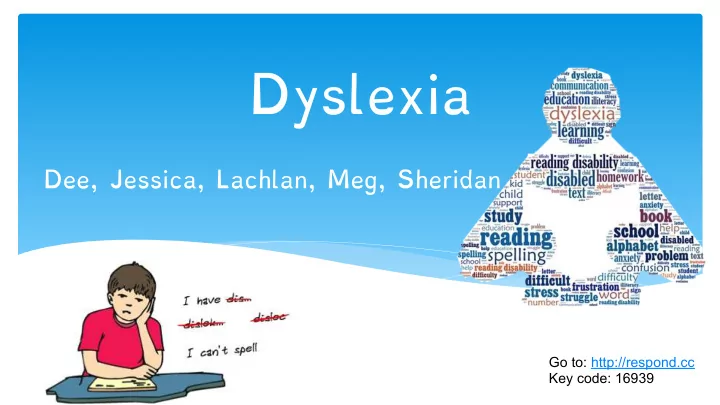
Dyslexia
Dee, Jessica, Lachlan, Meg, Sheridan
Go to: http://respond.cc Key code: 16939
Dyslexia Dee, Jessica, Lachlan, Meg, Sheridan Go to: - - PowerPoint PPT Presentation
Dyslexia Dee, Jessica, Lachlan, Meg, Sheridan Go to: http://respond.cc Key code: 16939 Introduction Lachlan: background, personal experience Meg: apps, books Dee: SPELD Jess: teaching resources Sheridan: diagnosing,
Dee, Jessica, Lachlan, Meg, Sheridan
Go to: http://respond.cc Key code: 16939
brain
higher level of intelligence
aren’t diagnosed by the 2nd grade remain so into adulthood
Tutoring a Year 8 student with dyslexia
sentences
seeing, hearing and touching
“Find something positive, something they have done well, and acknowledge it. They will remember that comment- and you.”
Dyslexia Help- http://dyslexiahelp.umich.edu/professionals/dyslexia-school/
strategies-for-teachers
There are a variety of apps that either parents, teachers or even the students with dyslexia that can aid in their education and enjoyment. There are many apps for educational purposes, take a quick moment to go onto either Playstore or iTunes (whichever phone you have) and type in the search option “dyslexia apps” and a variety of options come up. The few apps that I will go through that I believe can be very beneficial for students and parents are:
rd fo for r Dy Dysle lexics:
Dysle lexia Reading Assistant:
Dysle lexia Glo lossary ry (to identify dyslexia):
Dysle lexia – Find He Help lp (Information):
There are even apps for games that students with dyslexia can play which is not only beneficial but also fun. There are quite a few (I will give you a quick minute to search games for dyslexics, feel free to download and play while I talk). As you can there are a few, the two that I thought were good are:
Worm rm alp lphabet fo for r dysle lexia: Although it may be too simple for high school students it can be extremely helpful to primary school, preschool or even middle school students to use.
Word rd searc rch puzzle les: Although this game does not specify for dyslexics specifically, it can be useful for them to help understand words and the order the letters go in.
Not only are there great apps for students, but also there are books available for students, teachers and parents. As educators you would know first hand what I mean when I say there is a lot of material available on dyslexia. To name a few that I think are quite useful: Ho How to defe feat your r child ld’s dysle lexia: your r guide to
rcomi ming dysle lexia inclu luding tools ls you can use fo for r le learn rning emp mpowerme rment, , (this book is targeted at parents but can be easily adapted for the classroom). Dy Dysle lexia: surv rviving and succeeding at Co Colle llege Mult ltisensory ry teaching of f basic la language skills lls activity book book Wri Writing Better: r: effe ffective stra rategies fo for r teaching students with le learn rning diffi fficult lties
Specific Learning Difficulties Association of South Australia. What is a Specific Learning Difficulty?
variety of ways including how they take in, remember, understand or express information.
encounter in learning that affect achievement and daily life skills.
spelling, but they may also be found in other areas of functioning including spoken language and mathematics.
Recent work rkshops inclu lude:
can do to help people with specific learning difficulties
and high school students
Do know what you are re deali ling with
Do docume ment pattern rns of f le learn rning behaviour
Do set child ldre ren up fo for r success
Do pro rovide stru ructure re within your r teaching pro rogra ram
Do docume ment any goal- l-setting negotiations and stra rategies you are re tri rialli lling
Do teach expli licit skills lls
Do be fle flexible le Do Don't get so caught up with the get so caught up with the symp mptoms ms that you mi miss the cause Do Don't expect le less ... unders rstand and accept diffe ffere rent Do Don't single le the child ld out Do Don't try ry to go it alo lone
The Australian Disability Clearing House on Education and Training: http://www.adcet.edu.au Learning Difficulties Australia: https://www.ldaustralia.org The Australian Psychology Society: https://www.psychology.org.au/publications/tip_sheets/learning/ AUSPELD: http://auspeld.org.au International Dyslexia Association: http://eida.org
¡ ¡ ¡ http://www.education.vic.gov.au/school/teachers/teachingresources/discipline/english/reading/Pages/focusteach.aspx ¡
keywords, expectations. You may also come across students who exhibit symptoms of dyscalculia
Reid, , Gavin. Dy Dysle lexia: A Co Comp mple lete Guide fo for r Pare rents and Th Those Wh Who He Help lp Th
Chichester: r: Wi Wile ley- Bla lackwell ll (2011).
educational psychologist
explains jargon and breaks down clinical diagnosis
assessment without an official test
Stage 2 Task Sheet
http://www.htasa.org.au/LinkClick.aspx?fileticket=f3aXhHndhBk%3d&tabid=721
Stage 2 Example
https://www.youtube.com/watch?v=8RBH0y7FneY&feature=youtu.be
This can be built from a Year 8 level
http://www.htasa.org.au/LinkClick.aspx?fileticket=FbFvyyaNCMU%3d&tabid=721
Year 9 Example
https://www.youtube.com/watch?v=DS06GzuZUSE&feature=em-upload_owner
http://www.htasa.org.au/LinkClick.aspx?fileticket=JxP5%2fEx12iw%3d&tabid=721
Development of an essay-style argument orally, with visual aides
Garath’s explanation of how easy this is!