Dyno Test results of a Cat 3408 A Brief Overview in Association with - - PowerPoint PPT Presentation

dyno test results of a cat 3408
SMART_READER_LITE
LIVE PREVIEW

Dyno Test results of a Cat 3408 A Brief Overview in Association with - - PowerPoint PPT Presentation

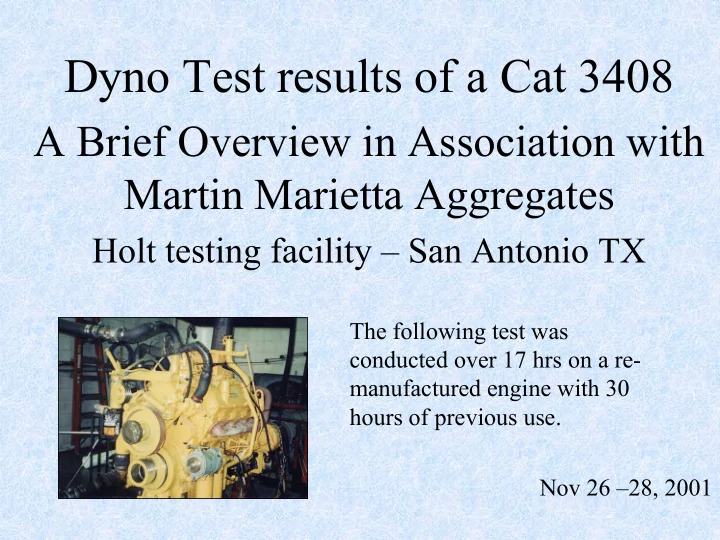
Dyno Test results of a Cat 3408 A Brief Overview in Association with Martin Marietta Aggregates Holt testing facility San Antonio TX The following test was conducted over 17 hrs on a re- manufactured engine with 30 hours of previous use.


slide-1
SLIDE 1

Dyno Test results of a Cat 3408

A Brief Overview in Association with Martin Marietta Aggregates

Holt testing facility – San Antonio TX

Nov 26 –28, 2001 The following test was conducted over 17 hrs on a re- manufactured engine with 30 hours of previous use.

slide-2
SLIDE 2

Inside the cylinder - before catalyst

Exhaust Valve Opens

Power Stroke Time = 13.6 milliseconds Exhaust Stroke Time = 13.6 milliseconds

Chained Hydrocarbons Ignite and Burn Un-Chained Hydrocarbons Smolder (Partial Combustion) Any Combustion After This Point Is Wasted Heat (Energy)!

After combustion, as the cylinder cools off, the un-used hydrocarbons smolder and energy is wasted in the exhaust.

slide-3
SLIDE 3

Power Stroke Time = 13.6 milliseconds Exhaust Stroke Time = 13.6 milliseconds

Exhaust Valve Opens

Chained Hydrocarbons Ignite and Burn Un-Chained Hydrocarbons Smolder (Partial Combustion)

Inside the cylinder - after catalyst

With the addition of the catalyst, the fuel can now use the oxygen more efficiently inside the engine, and is able to burn down to a lower temperature, this means the energy is used inside the engine rather than the exhaust. With less wasted energy, the exhaust temperature is

  • lower. This test showed:

45º F less @ 50% Load 119º F less @ 85% Load

slide-4
SLIDE 4

Fuel Reduction

This is verified during the Dyno test to show: 10.3% reduction @ 50% load 6.7% reduction @ 85% load

If the engine is exhausting less heat, then it must be using the heat (work) on the power stroke, therefore requiring less fuel to perform the same job.

slide-5
SLIDE 5

Increased Horsepower

This was shown by increasing the test engines maximum horsepower output from 447 Hp to 520 Hp, a 16.3% increase. If the engine is using more of the heat (energy) produced from combustion for the power stroke, this must translate to an increase in available static torque or horsepower.

slide-6
SLIDE 6

Cleaner Emissions

If the fuel is burning more completely, then the emissions must be reduced.

Opacity

  • 79%

(Static test – Load n/a) The black smoke is reduced Carbon Monoxide

  • 40% (50% load) -60% (85% load)

The conversion of CO is improved Hydrocarbons

  • 33% (50% load) -66% (85% load)

Less un-used hydrocarbons are present in the exhaust due to improved combustion Nox +16% (50% load) +29% (85% load) The Nox levels may increase during the initial ‘clean out’ period, while the soft and hard carbon deposits oxidize. 17 hours was not enough time for the Rhodium levels to build up.

Note: These values do not even include additional reductions in overall pollutants resulting from the un-used fuel. If the fuel wasn’t used in the first place, it never had a chance to turn into pollution. This translates into even greater overall pollution reductions.

slide-7
SLIDE 7

Smoother Running

Because the combustion is smoother and more even, the

  • verall vibration and torsional measurements from the

engine should go down, while the ultrasonic energy (produced from combustion) should go up. A spectral analyzer was used to measure the vibration produced during the operation of the engine. It is capable

  • f deciphering and filtering out lower frequency vibration,

such as the rotating mass in the bottom of the engine, as well as higher frequency vibration, such as the scraping of the rings against the cylinder liners. As changes in the engine occur (as in the addition of the catalyst), vibration analysis can be used to detect and quantify these changes.

slide-8
SLIDE 8

Torsion – Before Catalyst

HOLT - 3408 Cat 3408 Cat -ET Engine Torsional Vibration Label: 85% Load - Without ET Route Spectrum 27-Nov-01 00:54:26 OVERALL= .1099 G-DG RMS = .1093 LOAD = 100.0 RPM = 2055. RPS = 34.25 1 2 3 4 5 6 7 8 0.02 0.04 0.06 0.08 0.10 Frequency in Orders

RMS Amplitude in +/- Deg .50 1.00 1.50 2.00 2.50 3.00 3.50 4.00 4.50 5.00 5.50

slide-9
SLIDE 9

Torsion – After Catalyst

HOLT - 3408 Cat 3408 Cat -ET Engine Torsional Vibration Route Spectrum 28-Nov-01 08:54:01 OVERALL= .1022 G-DG RMS = .1018 LOAD = 100.0 RPM = 2115. RPS = 35.26 1 2 3 4 5 6 7 8 0.02 0.04 0.06 0.08 0.10 Frequency in Orders

RMS Amplitude in +/- Deg .50 1.00 1.50 2.00 2.50 3.00 3.50 4.00 4.50 5.00 5.50

slide-10
SLIDE 10

Summary of Torsional Data

Harmonics % Change 0.50

  • 27%

1.50

  • 21%

2.00

  • 23%

2.50

  • 5%

3.00

  • 27%

3.50

  • 24%

4.00

  • 24%

4.50

  • 6%

5.00

  • 5%

5.50 7%

*The number 1.00 harmonic revolution is removed due to excessive background interference

Reductions in the torsion or the “dynamic torque” of an engine means that the engine is running smoother and that there is less strain on the rod bearings and main bearings, resulting in longer engine life.

slide-11
SLIDE 11

Ultrasonic Data – Before Catalyst

HOLT - 3408 Cat 3408 Cat -SS1 SonicScan #1 Cylinder (43 kHz) Label: 85% Load - without ET Route Waveform 27-Nov-01 00:55:17 RMS = 6.64 LOAD = 100.0 RPM = 2073. RPS = 34.55 PK(+) = 21.42 PK(-) = 17.37 CRESTF= 3.23 0.5 1.0 1.5 2.0

  • 20
  • 10

10 20 30 Time in Seconds

Amplitude in STANDARD

Total = 38.79

slide-12
SLIDE 12

Ultrasonic Data – After Catalyst

HOLT - 3408 Cat 3408 Cat -SS1 SonicScan #1 Cylinder (43 kHz) Route Waveform 27-Nov-01 17:20:10 RMS = 7.10 LOAD = 100.0 RPM = 2116. RPS = 35.26 PK(+) = 26.33 PK(-) = 19.28 CRESTF= 3.71 0.5 1.0 1.5 2.0

  • 30
  • 20
  • 10

10 20 30 Time in Seconds

Amplitude in STANDARD

Total = 45.61 Increase of 6.82

  • r 17.6%
slide-13
SLIDE 13

Summary of Ultrasonic Data

Before Catalyst - 40.63 dB* After Catalyst - 43.93 dB* Net Change 3.3 dB or 8.13% This means that upon ignition the energy produced is 8.13% greater or longer, resulting from the more complete burn, this equates to more static torque or more horsepower. If the horsepower stays constant, less fuel will be needed to do the same work because the existing fuel will produce more.

* - Averaged over cylinders 1,3,5,7