Dynamic simulation models is R powerful enough? - - PowerPoint PPT Presentation

dynamic simulation models is r powerful enough
SMART_READER_LITE
LIVE PREVIEW

Dynamic simulation models is R powerful enough? - - PowerPoint PPT Presentation

Faculty Faculty of of Forest Forest- -, Geo , Geo- - and and Hydrosciences Hydrosciences, Institute of , Institute of Hydrobiology Hydrobiology Faculty Faculty of of Forest Forest - - , Geo , Geo - - and and Hydrosciences


slide-1
SLIDE 1

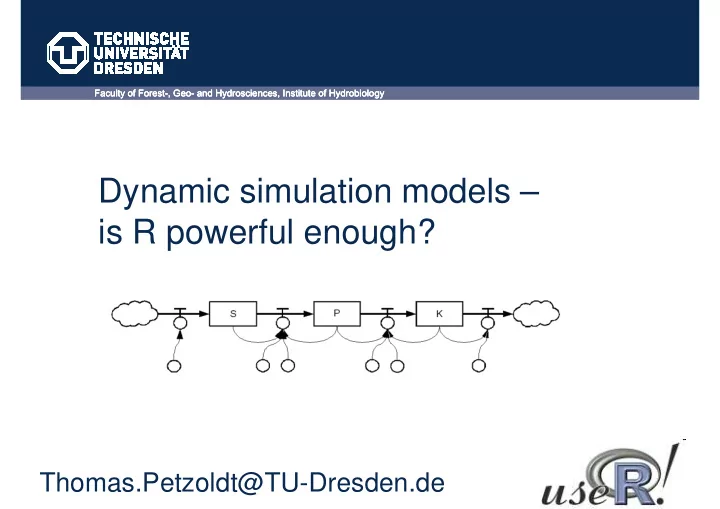
Dynamic simulation models – is R powerful enough?

Faculty Faculty Faculty Faculty of

  • f
  • f
  • f Forest

Forest Forest Forest-

  • , Geo

, Geo , Geo , Geo-

  • and

and and and Hydrosciences Hydrosciences Hydrosciences Hydrosciences, Institute of , Institute of , Institute of , Institute of Hydrobiology Hydrobiology Hydrobiology Hydrobiology

Thomas.Petzoldt@TU-Dresden.de

slide-2
SLIDE 2

Dynamic models …

  • … models that respect time explicitly.
  • used in many fields:

mathematics, physics, chemistry, biology, ecology, engineering, economics…

  • "What makes using system dynamics different from other

approaches to studying complex systems is the use of feedback loops and stocks and flows. These elements help describe how even seemingly simple systems display baffling nonlinearity. http://en.wikipedia.org/wiki/System_dynamics

      − ⋅ ⋅ = K N N r dt dN 1

slide-3
SLIDE 3

Example 1: A Lotka-Volterra-type model

K P d e b f S Import c

Substrate Producer Consumer

K f K P e dt dK K P d P S c dt dP P S b import dt dS ⋅ − ⋅ ⋅ = ⋅ ⋅ − ⋅ ⋅ = ⋅ ⋅ − =

Source Sink

slide-4
SLIDE 4

The LV-type model in R

  • !

! ! ! ! ! ! ! " " " "

  • #

# # # " " " "# # # #

  • $

$ $ $

  • $

$ $ $ $ $ $ $ $ $ $ $

  • $%

$% $% $%

  • $%

$% $% $%

  • &$

&$ &$ &$

  • package deSolve

(Soetaert, Petzoldt, Setzer)

slide-5
SLIDE 5

Benchmark

3 equations (ODEs) in R, 1000 (external) timesteps

  • case A: interpolated input (approxfun)
  • case B: import <- if (trunc(t) %% 2 == 0) 0 else 0.1

………… 1.4 s ………… 0.8 s Time is ok for this toy model, but is R suited for more complex simulations? 3 ODEs = 1 s

  • spatial system with 10.000 ODEs > 1 hour?

K f K P e dt dK K P d P S c dt dP P S b import dt dS ⋅ − ⋅ ⋅ = ⋅ ⋅ − ⋅ ⋅ = ⋅ ⋅ − =

CPU time

slide-6
SLIDE 6

Example 2: A stream model

Experimentally manipulated small stream of our limnological workgroup Elbe River Hamburg 500 km Dresden 20 km Rennes 1200 km Experimental Range 650m

slide-7
SLIDE 7

Downward drift of water insects in the stream (Mayflies)

Is buffer stretch sufficiently long?

1) Reference no fish 2) Buffer stretch with fish 3) Fish treatment

flow

v

up down

Water Sediment Fences Fences Fences Fences

fish nofish

drift drift >

slide-8
SLIDE 8

Can be described by a basic PDE model

flow

v

up down

Water Sediment

M down S up dt dS x M v M down S up t M ⋅ + ⋅ − = ∂ ∂ ⋅ − ⋅ − ⋅ = ∂ ∂

Mobile Organisms Sessile Organisms

dx

1

x

2

x

n

x

slide-9
SLIDE 9

The drift model in R: simple structure but 1300 eqs.

  • '()*+

'()*+ '()*+ '()*+" " " "

  • ,

, , ,

  • '*-().*+

'*-().*+ '*-().*+ '*-().*+ " " " " , , , ,

  • /

/ / /,0 ,0 ,0 ,0

  • ,-

,- ,- ,-

  • ,
  • ,
  • ,
  • ,
  • ,

, , ,

  • !

! ! !

  • (

( ( ( " " " "$ $ $ $ 1 1 1 1 '+ '+ '+ '+

  • (////

(//// (//// (//// " " " "2 2 2 2

  • 02

02 02 02

  • 30.45/

30.45/ 30.45/ 30.45/2 2 2 2 & & & &

  • "

" " "

  • 45/

45/ 45/ 45/ * * * *

  • $

$ $ $

  • 4(.//(6*

4(.//(6* 4(.//(6* 4(.//(6*

  • .//

.// .// .//"(0 "(0 "(0 "(0

  • 7///

7/// 7/// 7///" " " "

  • (0

(0 (0 (0

  • (

( ( (

  • .

. . . " " " "2 2 2 2 (0 (0 (0 (0 "" "" "" ""

  • 22

22 22 22

  • &5//*,&/*

&5//*,&/* &5//*,&/* &5//*,&/*

  • 3/4/$&(/(

3/4/$&(/( 3/4/$&(/( 3/4/$&(/(" " " "

  • (82&

(82& (82& (82&

  • &*9::

&*9:: &*9:: &*9::

  • &.

&. &. &.

slide-10
SLIDE 10

fish stretch buffer stretch fish free stretch Individuals 1/m2

  • 2 simulated months, 100 external time steps
  • model with 2 x 650 = 1300 equations; computation time of ode.1D: ………. 0.6s

AMD Athlon AM2 X2 6000+, 3000 MHz, 2MB RAM, Windows XP, R-2.10-devel

buffer stretch long enough R much faster than expected fence fence fence fence effect effect effect effect

slide-11
SLIDE 11

Chromatography model

Similar approach like insect drift fixed phase, mobile phase Example:

  • 5 chemical species,
  • 500...5000 grid cells
  • 100 external time steps

Location after 100 time units Peak intensity

Grid cells 500 Equations 500 * 2 * 5 = 5,000 model in C model in R 0.8 s 1.95 s 5000 5,000 * 2 * 5 = 50,000 59 s 66 s Computational Effort:

slide-12
SLIDE 12

Example 3: Population dynamics of Daphnia (water flea)

Agent-based simulation e.g. sample of 1000 ... 2000 individuals Population dynamics Bioenergetic model (ODE) growth and reproduction

slide-13
SLIDE 13

Effort needed per 100 simulation days: 100 ABM time steps 1000 ODE time steps 1000 …2000 individuals 4000 … 8000 equations Performance pure R: …..136 s ABM in R, ODEs in C: ……..65s

Agent-based Daphnia simulation (ABM) with bioenergetic growth model (ODE)

slide-14
SLIDE 14

Calling a small model many times

Remember: 3 equations (resource, producer, consumer) Rectangular external signal (import of resource) Now 10,000 time steps Model in: R signal with if … else in model function ………………… 8 s R with approxfun (10,000 rows in data table) ….………… 65 s C, bisectioning, similar to approxfun ………………..……… 0.16 s C, sequential search in ordered forcings ..………….……… 0.03 s The integrator (lsoda) and the model are able to communicate directly at the machine code level. Simulation without "friction"

K f K P e dt dK K P d P S c dt dP P S b import dt dS ⋅ − ⋅ ⋅ = ⋅ ⋅ − ⋅ ⋅ = ⋅ ⋅ − =

The Lotka-Volterra-type model revisited

slide-15
SLIDE 15

Efficiency is more than CPU time

Programming in R:

more convenient than C or Fortran ... more interactive, more compact code, …

High-level statistical algorithms and graphics

I can do almost everything in one system no need to export / import data to other software stats, … deSolve, FME, … Sweave

support data analysis and report writing

Open Source

Allows to work with talented people on a global scale Enables me to share my code with others (and use theirs)

model collection package simecolModels simecolModels simecolModels simecolModels

slide-16
SLIDE 16

Conclusion: R is powerful for system dynamics

Vectorization! Matrix algebra!

Large models with identical equations = fast in pure R ABMs are efficient with data frames and subset()

Avoid unnecessary copying of large objects.

Sometimes it helps to prefer matrices over data frames. Avoid interpolation (i.e. approx), If approx is unavoidable, minimize the tables.

Complex systems of equations or frequent calls to small models:

considerable performance gain if core functions in C or Fortran consider direct communication between deSolve and compiled code

R is a good investment even in that cases:

It handles my input and output data so I can concentrate on the equations.

A A A A few few few few rules rules rules rules: : : :

slide-17
SLIDE 17

Thanks to Karline Soetaert, Woodrow Setzer, Carola Winkelmann and Thank Thank Thank Thank You You You You! ! ! !

Thomas.Petzoldt@tu-dresden.de http://tu-dresden.de/Members/thomas.petzoldt package deSolve (Soetaert, Petzoldt, Setzer): http://cran.r-project.org/web/packages/deSolve/ packages simecol and simecolModels http://www.simecol.de http://r-forge.r-project.org/projects/simecol/