From Conceptual Models From Conceptual Models to Simulation Models - - PDF document

from conceptual models from conceptual models to
SMART_READER_LITE
LIVE PREVIEW

From Conceptual Models From Conceptual Models to Simulation Models - - PDF document

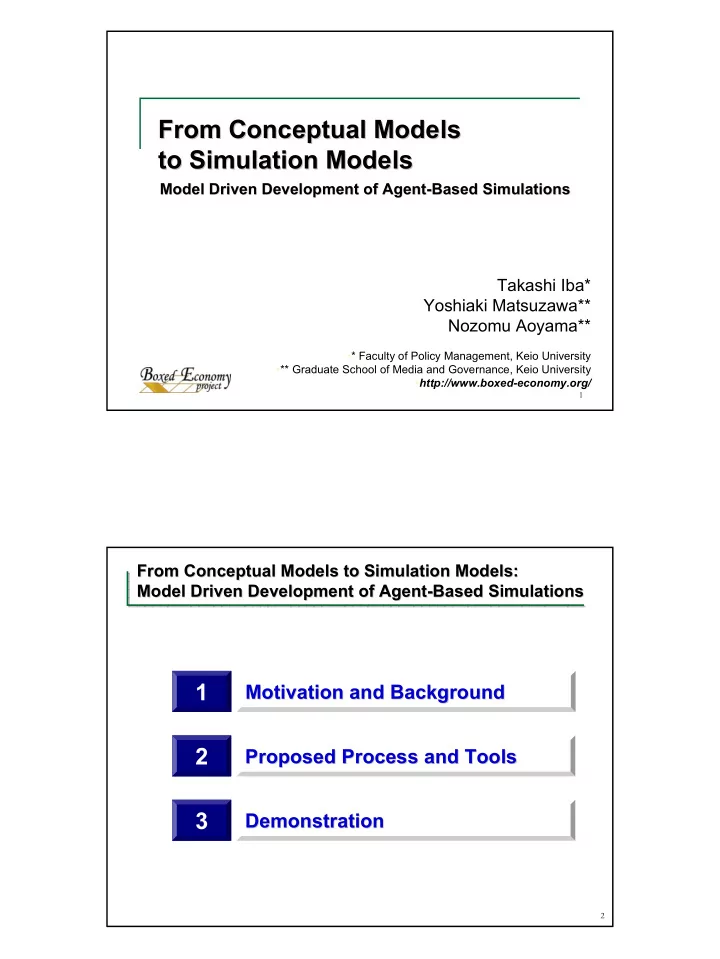
From Conceptual Models From Conceptual Models to Simulation Models to Simulation Models Model Driven Development of Agent- -Based Based Simulations Simulations Model Driven Development of Agent Takashi Iba* Yoshiaki Matsuzawa** Nozomu


slide-1
SLIDE 1

1

From Conceptual Models From Conceptual Models to Simulation Models to Simulation Models

Takashi Iba* Yoshiaki Matsuzawa** Nozomu Aoyama**

  • * Faculty of Policy Management, Keio University
  • ** Graduate School of Media and Governance, Keio University
  • http://www.boxed-economy.org/

Model Driven Development of Agent Model Driven Development of Agent-

  • Based

Based Simulations Simulations

2

From Conceptual Models to Simulation Models From Conceptual Models to Simulation Models: : Model Driven Development of Agent Model Driven Development of Agent-

  • Based

Based Simulations Simulations

1

Motivation and Background Motivation and Background

2

Proposed Process and Tools Proposed Process and Tools

3

Demonstration Demonstration

slide-2
SLIDE 2

3

From Conceptual Models to Simulation Models From Conceptual Models to Simulation Models: : Model Driven Development of Agent Model Driven Development of Agent-

  • Based

Based Simulations Simulations

1

Motivation and Background Motivation and Background

2

Proposed Process and Tools Proposed Process and Tools

3

Demonstration Demonstration

4

Position of Social Simulation Studies Position of Social Simulation Studies

computer science

computer simulation multi-agent system

a new approach

  • f modeling

and analysis a practical application

social sciences

society as interaction decision making and Learning

Social Simulation Studies

What

should we make?

How

should we make it?

slide-3
SLIDE 3

5

W h a t w e s h

  • u

l d i m p r

  • v

e i s t h e P r

  • c

e s s !

6

Traditional Development Process of Software Traditional Development Process of Software

The traditional development process of software is driven by implementation (program coding).

slide-4
SLIDE 4

7

A New Development Process of Software: A New Development Process of Software: Model Driven Development Model Driven Development

A new development process is driven by modeling.

8

Raising the level of Abstraction Raising the level of Abstraction

  • Cf. “MDA” (Model Driven Architecture) and “Executable UML”

The point is “using modeling languages as programming languages rather than merely as design languages.” (Frankel 2003)

slide-5
SLIDE 5

9

From Conceptual Models to Simulation Models From Conceptual Models to Simulation Models: : Model Driven Development of Agent Model Driven Development of Agent-

  • Based

Based Simulations Simulations

1

Motivation and Background Motivation and Background

2

Proposed Process and Tools Proposed Process and Tools

3

Demonstration Demonstration

10

Overview of Proposed Process Overview of Proposed Process

In the conceptual modeling phase, the modeler analyzes the target world and describes the conceptual model. In the simulation design phase, the modeler designs and implements the simulation model. In the verification phase, the modeler runs the simulation and inspects whether the simulation program is coded rightly.

The proposed process, which is based on Model Driven Development, consists of three major phases.

slide-6
SLIDE 6

11

Describing Agents’ Activities Describing Agents’ Interaction Extracting Types from Target World

Conceptual Modeling Phase Simulation Design Phase Verification Phase

Designing Statechart of Behavior Making the Initial Settings Run and Verify the Simulation Designing Types and Classes

12

Boxed Economy Foundation Model (BEFM) Boxed Economy Foundation Model (BEFM)

Model Frameworks Model Frameworks for Model Driven Development of Simulations for Model Driven Development of Simulations

[Iba et al., 2002]

slide-7
SLIDE 7

13

Describing Agents’ Activities Describing Agents’ Interaction Extracting Types from Target World

Conceptual Modeling Phase Simulation Design Phase Verification Phase

Designing Statechart of Behavior Making the Initial Settings Run and Verify the Simulation Designing Types and Classes

14

Describing Agents’ Activities Describing Agents’ Interaction Extracting Types from Target World

Conceptual Modeling Phase Simulation Design Phase Verification Phase

Designing Statechart of Behavior Making the Initial Settings

Behavior Designer World Composer Activity Designer Communication Designer Model Designer Model Designer Boxed Economy Simulation Platform

Run and Verify the Simulation Designing Types and Classes

slide-8
SLIDE 8

15

Component Builder (CB) Component Builder (CB)

Tools for Model Driven Development of Simulations Tools for Model Driven Development of Simulations

Component Builder is developed as the plug-in for the currently standard development environment “Eclipse.” Component Builder consists of four designers and one composer.

Behavior Designer World Composer Model Designer Activity Designer Communication Designer

Plugins for

16

Boxed Economy Simulation Platform (BESP) Boxed Economy Simulation Platform (BESP)

Tools for Model Driven Development of Simulations Tools for Model Driven Development of Simulations

An integrated environment to execute and analyze the agent-based social simulations. Implemented in Java language. The source code and detail specification are opened to the public.

[Iba et al., 2002]

slide-9
SLIDE 9

17

From Conceptual Models to Simulation Models From Conceptual Models to Simulation Models

Conceptual Model Simulation Model Source Code of Simulation

CB

Compiler

Executable Program of Simulation Now we still need to write source code a little bit.

18

From Conceptual Models to Simulation Models From Conceptual Models to Simulation Models: : Model Driven Development of Agent Model Driven Development of Agent-

  • Based

Based Simulations Simulations

1

Motivation and Background Motivation and Background

2

Proposed Process and Tools Proposed Process and Tools

3

Demonstration Demonstration

slide-10
SLIDE 10

19

Describing Agents’ Activities Describing Agents’ Interaction Extracting Types from Target World

Conceptual Modeling Phase Simulation Design Phase Verification Phase

Making the Initial Settings

Behavior Designer World Composer Activity Designer Communication Designer Model Designer Model Designer Boxed Economy Simulation Platform

Run and Verify the Simulation Designing Types and Classes Designing Statechart of Behavior

20

We have already applied to We have already applied to … …

Format Competition (VHS vs. Beta) Evolving Network (Scale-Free Network) Evolutionary Market Competition Emergence and Collapse of Money Artificial Financial Market Strategic Evolution in Iterated Prisoners Dilemma Airport Queuing Model Influence Analysis of Social Interaction to Voting Electric Power Market

slide-11
SLIDE 11

21

From Conceptual Models From Conceptual Models to Simulation Models to Simulation Models

Takashi Iba* Yoshiaki Matsuzawa** Nozomu Aoyama**

  • * Faculty of Policy Management, Keio University
  • ** Graduate School of Media and Governance, Keio University
  • http://www.boxed-economy.org/

Model Driven Development of Agent Model Driven Development of Agent-

  • Based

Based Simulations Simulations

Contact us by sending E-mail to iba@sfc.keio.ac.jp

  • r talk to me later,

if you are interested in our tools.