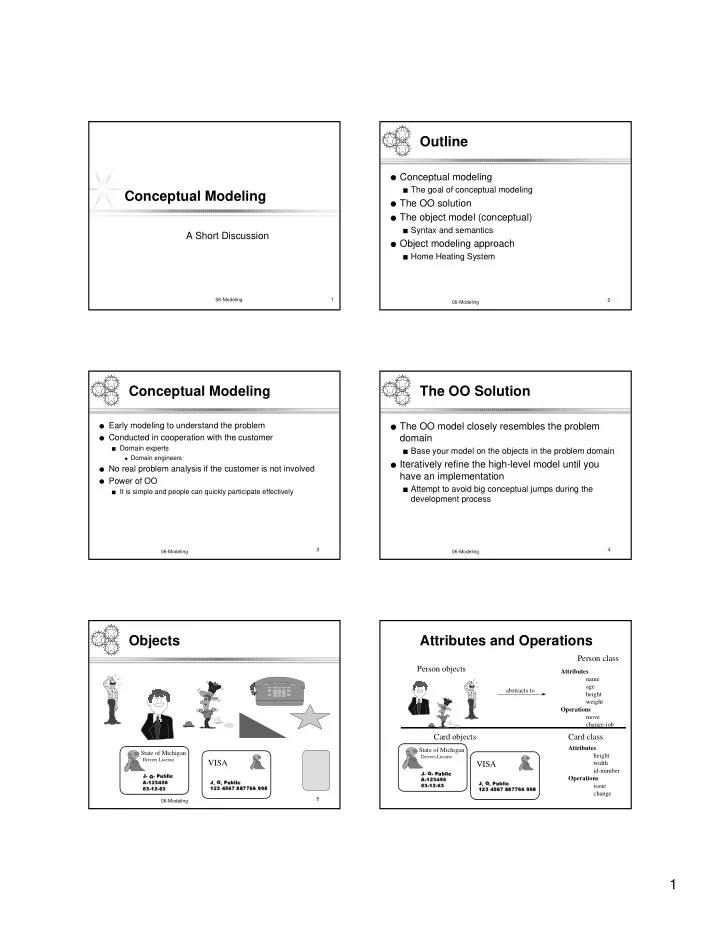
1 Characteristics of Objects Identity The Class Diagrams Discrete - - PDF document

1
SMART_READER_LITE
LIVE PREVIEW

1 Characteristics of Objects Identity The Class Diagrams Discrete - - PDF document

Outline Conceptual modeling Conceptual Modeling The goal of conceptual modeling The OO solution The object model (conceptual) Syntax and semantics A Short Discussion Object modeling


slide-1
SLIDE 1

1

06-Modeling 1

Conceptual Modeling

A Short Discussion

2 06-Modeling

Outline

  • Conceptual modeling

■ The goal of conceptual modeling

  • The OO solution
  • The object model (conceptual)

■ Syntax and semantics

  • Object modeling approach

■ Home Heating System

3 06-Modeling

Conceptual Modeling

  • Early modeling to understand the problem
  • Conducted in cooperation with the customer

■ Domain experts

◆ Domain engineers

  • No real problem analysis if the customer is not involved
  • Power of OO

■ It is simple and people can quickly participate effectively 4 06-Modeling

The OO Solution

  • The OO model closely resembles the problem

domain

■ Base your model on the objects in the problem domain

  • Iteratively refine the high-level model until you

have an implementation

■ Attempt to avoid big conceptual jumps during the

development process

5 06-Modeling

✂✁☎✄✆✁✂✝✂✞☎✟✂✠ ✡ ☛

VISA

☞☎✌✎✍✑✏✓✒✎✔☎✕✗✖✎✖☎✕✂✕✎✔☎✔✗✘✎✘✂✖ ✙✎✚✎✛✆✚✎✜✂✢✎✣✂✤ ✥ ✦

Drivers License

State of Michigan

✧✩★ ✪✎✫✎✬✮✭✓✯✎✰ ✱☎✲✎✳ ✴☎✵✎✳ ✶☎✲

Objects

Person class

✷✂✸✎✹✺✸✂✻✂✼✎✽✎✾ ✿ ❀

VISA

✴☎✵✂✲✑❁✂❂✎✶✎❃✗❄☎❄✎❃✂❃☎✶✎✶✗❅☎❅✂❄ ✷✎✸✎✹✆✸✎✻✂✼✎✽✂✾ ✿ ❀

Drivers License

State of Michigan

❆✩✳ ✴✎✵✎✲✮❁✓❂✎✶ ✱☎✲✎✳ ✴☎✵✎✳ ✶✎✲

Attributes name age height weight Operations move change-job Attributes height width id-number Operations issue change

Person objects Card objects Card class

abstracts to

Attributes and Operations

slide-2
SLIDE 2

2

7 06-Modeling

Characteristics of Objects

  • Identity

■ Discrete and distinguishable entities

  • Classification

■ Abstract entities with the same structure (attributes) and behavior

(operations) into classes

  • Polymorphism

■ The same operation may behave differently on different classes

  • Inheritance

■ Sharing of attributes and operations based on a hierarchical

relationship

06-Modeling 8

The Class Diagrams

9 06-Modeling

Objects

  • Something that makes sense in the application context

(application domain)

■ J.Q. Public ■ Joe’s Homework Assignment 1 ■ J. Q. Public’s drivers license

  • All objects have identity and are distinguishable
  • NOT objects

■ Person

■ Drivers license

10 06-Modeling

Classes

  • Describes a group of objects with similar properties (attributes),

common behavior (operations), common relationships to other classes, and common semantics

  • Person

◆ J. Q. Public ◆ Joe Smith ◆ D. Q. Public

  • Card

◆ Credit card ◆ Drivers license ◆ Teller card

11 06-Modeling

  • D. Q. Public

32 Person

  • J. Q. Public

35 Person

Class with attributes Objects with values

person ID: integer name: String age: integer Person

Objects have an identity Do not explicitly list

  • bject identifiers

SSN OK!

Class diagram Instance diagram

name: String age: integer Person

Class Diagrams

12 06-Modeling

Examples

name: String age: integer height: integer weight: integer SSN: integer Person height: integer width: integer thickness: integer id-number: integer Card

slide-3
SLIDE 3

3

13 06-Modeling

issue() revoke() height: integer width: integer thickness: integer id-number: integer Card rotate(angle: integer) move(x: integer, y: integer) height: integer width: integer Shape

Operations and Methods

  • Transformation that can be

applied to or performed by an

  • bject
  • May have arguments

14 06-Modeling

Object Notation - Summary

  • peration-1(argument-list-1) : result-type-1
  • peration-2(argument-list-2) : result-type-2
  • peration-3(argument-list-3) : result-type-3

attribute-1 : data-type-1 = default-value-1 attribute-2 : data-type-2 = default-value-2 attribute-3 : data-type-3 = default-value-3 Class name

15 06-Modeling

Associations

  • Conceptual connection between classes

■ A credit card is issued-by a bank ■ A person works-for a company

J.Q. Public

35 Person

Michigan State Univ

Company

Works-for

Class diagrams Instance diagram

Credit Card Bank Issued-by

Person Company Works-for

16 06-Modeling

Associations are Bi-directional

  • There is no direction implied in an association

Country name Drivers-license lic.-number: integer Person name City name

Has-capital Is-issued

17 06-Modeling

Associations Have Direction

  • Unified adds a direction indicator

■ Inconsistently used

Country name Drivers-license lic.-number: integer Person name City name

Has-capital Is-issued

18 06-Modeling

Multiplicity

  • One object can be related to many objects

through the same association One person holds one credit card One person can hold zero

  • r more credit cards

(* stands for many)

name: String Person card-number: integer Credit-card Holds

name: String Person card-number: integer Credit-card Holds

0..*

slide-4
SLIDE 4

4

19 06-Modeling

One person can hold zero or more credit cards (0..*) Each card has zero or one holder (0..1)

  • J. Q. Public

35 Person 123 456 789 Credit-Card 111 222 333 Credit-Card

Holds

Holds

name: String Person card-number: integer Credit-card Holds

  • 0..*

0..1

111 222 333 Credit-Card

D.Q. Public

32 Person

Multiplicity (Cont.)

20 06-Modeling

  • D. Q. Public

32 Person

  • J. Q. Public

35 Person 123 456 789 Credit-Card 111 222 333 Credit-Card 111 222 333 Credit-Card Holds

Holds

❍ ■ Authorized

Holds

❏ ■ Authorized ■ Authorized ■ Authorized

Multiplicity (Cont.)

  • One person can hold zero or more credit cards (0..*)
  • Each card has one holder (no indication or 1)
  • Each card has one or more authorized users (1..*)
  • One person can be authorized to use zero or more cards
  • Driver’s License is optional (0..1)

Explicit enumeration is also possible (2, 3, 2..5, etc.)

name: String Person card-number: integer Credit-card Holds

0..*

▲ Authorized

1 1..* 0..* Driver’s License License-number: integer 0..1

*

Holds

21 06-Modeling

Language Person Project 1..* 1..* 1..*

  • J. Q. Public

35 Person Compiler Project C++ Language TicTacToe Project LISP Language

Higher order associations

  • Ternary association

Project, language, person

  • Seldom needed (and should be avoided)

22 06-Modeling

How to represent salary and job title? Use a link attribute!

name: String age: integer SSN: integer address: String Person name: String address: String Company Works-for

0..* name: String age: integer SSN: integer address: String Person name: String address: String Company Works-for

0..* salary: integer job-title: String

Link Attributes

  • Associations can have properties the same way objects have properties

23 06-Modeling

Folding Link Attributes

Why not this?

Salary and job title are properties of the job not the person

In this case, a link attribute is the only solution

name: String age: integer SSN: integer address: String salary: integer job-title: String Person name: String address: String Company Works-for

P

0..* name: String age: integer SSN: integer address: String Person name: String address: String Company Works-for

0..* salary: integer job-title: String 0..*

24 06-Modeling

Another Approach

name: String age: integer SSN: integer address: String Person name: String address: String Company Position Salary:integer Grade:integer Title:string *

slide-5
SLIDE 5

5

25 06-Modeling name: String age: integer SSN: integer address: String Person name: String address: String Company Works-for

0..* 0..* salary: integer job-title: String employer employee boss worker Manages

0..* 0..1

Role Names

  • Attach names to the ends of an association to

clarify its meaning

26 06-Modeling

Aggregation symbol Document Paragraph Sentence 1..* 1..*

Aggregation

  • A special association, the is-part-of association

■ A sentence is part of a paragraph (a paragraph consists

  • f sentences)

■ A paragraph is part of a document (a document

consists of paragraphs)

* 27 06-Modeling Car Wheel Body Gearbox Engine Door Hood Trunk Piston Valve Crankshaft 1..* 1..* 1..* 4

Aggregation (Cont.)

  • Often used in parts explosion

28 06-Modeling

Generalization and Inheritance

  • The is-a association

■ Cards have many

properties in common

■ Generalize the common

properties to a separate class, the base-card

■ Let all cards inherit from

this class, all cards is-a base-card (plus possibly something more)

issue() revoke() height: integer width: integer thickness: integer id-number: integer Card expire() class: vehicle issued: date expires: date Drivers License expire() issued: date expires: date ID Card validate() credit-limit: integer issued: date Credit Card name City name Airline name license Pilot name Passenger heat() clean() name Airport cancel() delay() date flight # Flight heat() refuel() clean() model serial # hours flown Plane reserve() location Seat Based-In 0..* Departs Works-for Arrives Used-For Certified-On Owns Located-In 0..* Offers Pilots Confirmed-for 0..* 0..* 0..* 1..* 0..* 0..* 0..* 0..* 30..*

Example

30 06-Modeling Company Department Division Person 0..*

Works-for 0..* 0..*

Aggregation Versus Association

  • Can you use the phrase is-part-of or is-made-of
  • Are operations automatically applied to the parts (for

example, move) - aggregation

  • Not clear what it should be……
slide-6
SLIDE 6

6

31 06-Modeling Car Wheel Body Gearbox Engine 4 Minivan Compact

Jeep

Roll Bar

Aggregation Versus Inheritance

  • Do not confuse the is-a

relation (inheritance) with the is-part-of relation (aggregation)

  • Use inheritance for special

cases of a general concept

  • Use aggregation for parts

explosion

32 06-Modeling

Program Simple Statement Compound Statement Block 0..*

Recursive Aggregates

  • A recursive aggregate contains (directly or indirectly) an instance of

the same kind of aggregate

33 06-Modeling

Object Modeling Summary

  • Classes

■ Name ■ Attributes ■ Operations

  • Associations

■ Roles ■ Link attributes

  • Aggregation
  • Inheritance

06-Modeling 34

Object Modeling Approach

35 06-Modeling

Object Modeling Approach

  • Start with a problem statement

■ High-level requirements

  • Define object model

■ Identify objects and classes ■ Prepare data dictionary ■ Identify associations and aggregations ■ Identify attributes of objects and links ■ Organize and simplify using inheritance ■ Iterate and refine the model ■ Group classes into modules

90 80 70 60 50

On Off

Controller Fuel Valve Burner Water Pump Hot Water Fuel Temp Sensor Water Valve Control Panel Home

The Home Heating System

slide-7
SLIDE 7

7

37 06-Modeling

Home Heating Requirements

  • The software shall control the heat in each room
  • The room shall be heated when the temperature is 2F

below desired temp

  • The room shall no longer be heated when the

temperature is 2F above desired temp

  • The flow of heat to each room shall be individually

controlled by opening and closing its water valve

  • The valve shall be open when the room needs heat

and closed otherwise

  • The user shall set the desired temperature on the

thermostat

  • The operator shall be able to turn the heating system
  • n and off
  • The furnace must not run when the system is off
  • When the furnace is not running and a room needs

heat, the software shall turn the furnace on

  • To turn the furnace on the software shall follow

these steps

  • pen the fuel valve

turn the burner on

  • The software shall turn the furnace off when heat is

no longer needed in any room

  • To turn the furnace off the software shall follow

these steps

close fuel valve

turn burner off

The purpose of the software for the Home Heating System is to control the heating system that heats the rooms of a house. The software shall maintain the temperature of each room within a specified range by controlling the heat flow to individual rooms. 38 06-Modeling

Requirements Statements Extract Nouns Tentative Object Classes Eliminate Spurious Classes Object Classes

Candidate Classes

Controller Fuel Valve Burner Water Pump Hot Water Fuel Temp Sensor Water Valve software Home Heating System heating system room house temperature heat desired temp

  • perator

thermostat furnace

  • n-off switch

Control Panel Home range

Identify Object Classes

39 06-Modeling

Eliminate Bad Classes

  • Redundant classes

Classes that represent the same thing with different words

  • Irrelevant classes

Classes we simply do not care about

  • Vague classes

Classes with ill defined boundaries

  • Attributes

Things that describe individual

  • bjects
  • Operations

Sequences of actions are often mistaken for classes

  • Roles

The name of a class should reflect what it is, not the role it plays

  • Implementation details

Save that for implementation

40 06-Modeling

Controller Fuel Valve Burner Water Pump Hot Water Fuel Temp Sensor Water Valve software Home Heating System heating system room house temperature heat desired temp

  • perator

thermostat furnace

Redundant Irrelevant Vague Attributes Operations Implementation Roles

None None None

heat flow

  • n-off switch

Control Panel home user range

Eliminate Classes

41 06-Modeling

Controller Fuel Valve Burner Water Pump Temp Sensor Water Valve Home Heating System Room Operator Thermostat Furnace

  • n-off switch

Control Panel

Classes After Elimination

42 06-Modeling

Prepare Data Dictionary

  • Water Tank

■ The storage tank containing the water that circulates in

the system.

  • Pump-1

■ The pump pumping water from the Water Tank to the

radiators in the rooms

slide-8
SLIDE 8

8

43 06-Modeling

Possible Associations

  • Not much information from the

prose requirements

  • A lot of information from the

system design

  • A room consists of a thermometer and a radiator
  • A radiator consists of a valve and a radiator element
  • The home heating system consists of a furnace, rooms, a

water pump, a control panel, and a controller

  • The furnace consists of a fuel pump and a burner
  • The control panel consists of an on-off switch and a

thermostat

  • The controller controls the fuel pump
  • The controller controls the burner
  • The controller controls the water pump
  • The controller monitors the temperature in each room
  • The controller opens and closes the valves in the rooms
  • The operator sets the desired temperature
  • The operator turns the system on and off
  • The controller gets notified of the new desired temperature

Home Heating System Control Panel On-Off Switch Thermostat Room Operator Water Valve Temp Sensor Furnace Burner Water Pump Fuel Valve Controller

Pushes Adjusts

Notifies

❱ ❲

Monitor

Actuates

Ignites

Opens/Closes

Runs 1..*

Object Model

Home Heating System Control Panel On-Off Switch Thermostat Room Operator Water Valve Temp Sensor Furnace Burner Water Pump Fuel Valve Controller Pushes Adjusts Notifies Monitor Heats Ignites Opens/Closes Runs 1..* 1..* 1..*

Object Model - Modified

46 06-Modeling

Temp Sensor temperature Thermostat desired-temp On-Off switch setting

Attributes

Home Heating System Control Panel On-Off Switch Thermostat Room Operator Water Valve temperature Temp Sensor Furnace Burner Water Pump Fuel Valve Controller

❨ Pushes

Adjusts

Notifies

❬ ❭

Monitor

Heats

❪ Ignites ❪ Opens/Closes ❪ Runs

1..* 1..* 1..*

Final OO Model

Home Heating System Control Panel On-Off Switch Thermostat Room Operator Water Valve Temp Sensor Furnace Burner Water Pump Fuel Valve Controller Pushes Adjusts Notifies Monitor Heats Ignites Opens/Closes Runs 1..* 1..* 1..*

Final Object Model

setting desired-temp temperature

slide-9
SLIDE 9

9

49 06-Modeling

Iterate Iterate the Model

  • Keep on doing this until

you, your customer, and your engineers are happy with the model

50 06-Modeling

Operation vs Method

  • Operation: specifies object behavior
  • Operations of class are public services offered by class.
  • Service: represented by set of operations.
  • Message: object requests execution of an operation from

another object by sending it message.

  • Method: message is matched up with method defined by

the class to which the receiving object belongs (or any of its superclasses)

  • Methods of its classes are the implementations of these
  • perations.