DXA Best Practices 50 80 70 40 60 Ten Year 30 Fracture 50 - - PDF document

dxa best practices
SMART_READER_LITE
LIVE PREVIEW

DXA Best Practices 50 80 70 40 60 Ten Year 30 Fracture 50 - - PDF document

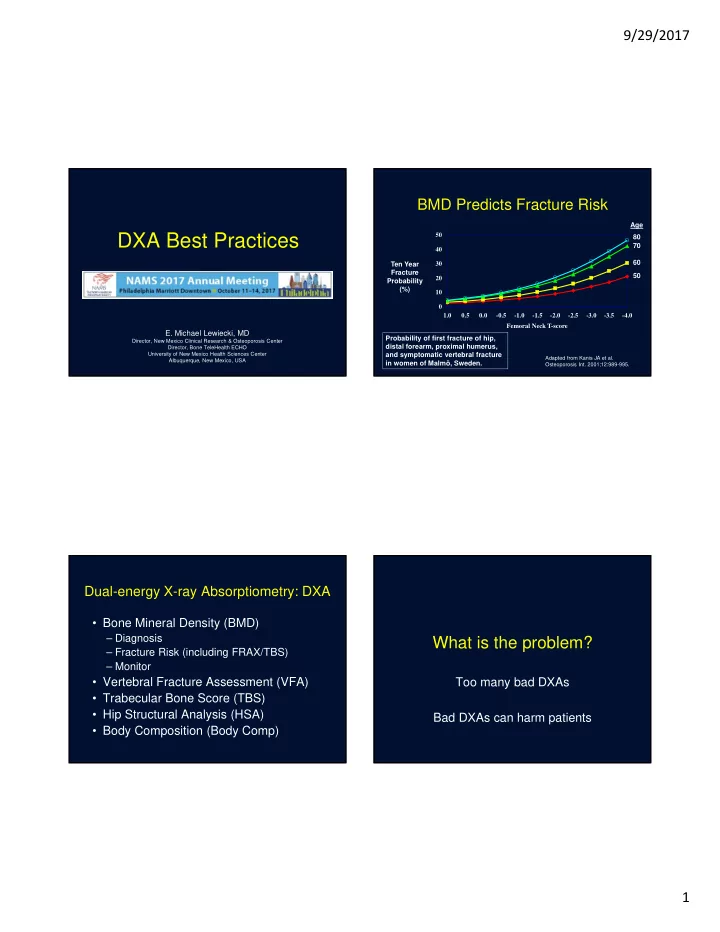
9/29/2017 BMD Predicts Fracture Risk Age DXA Best Practices 50 80 70 40 60 Ten Year 30 Fracture 50 20 Probability (%) 10 0 1.0 0.5 0.0 -0.5 -1.0 -1.5 -2.0 -2.5 -3.0 -3.5 -4.0 Femoral Neck T-score E. Michael Lewiecki, MD


slide-1
SLIDE 1

9/29/2017 1

  • E. Michael Lewiecki, MD

Director, New Mexico Clinical Research & Osteoporosis Center Director, Bone TeleHealth ECHO University of New Mexico Health Sciences Center Albuquerque, New Mexico, USA

DXA Best Practices

Dual-energy X-ray Absorptiometry: DXA

  • Bone Mineral Density (BMD)

– Diagnosis – Fracture Risk (including FRAX/TBS) – Monitor

  • Vertebral Fracture Assessment (VFA)
  • Trabecular Bone Score (TBS)
  • Hip Structural Analysis (HSA)
  • Body Composition (Body Comp)

BMD Predicts Fracture Risk

Adapted from Kanis JA et al. Osteoporosis Int. 2001;12:989-995.

10 20 30 40 50 1.0 0.5 0.0

  • 0.5
  • 1.0
  • 1.5
  • 2.0
  • 2.5
  • 3.0
  • 3.5
  • 4.0

Femoral Neck T-score Ten Year Fracture Probability (%) Age 80 70 60 50 Probability of first fracture of hip, distal forearm, proximal humerus, and symptomatic vertebral fracture in women of Malmö, Sweden.

What is the problem?

Too many bad DXAs Bad DXAs can harm patients

slide-2
SLIDE 2

9/29/2017 2

DXA Quality Gap Leads to Adverse Clinical Outcomes

  • Watts NB. 2004. Fundamentals and pitfalls of bone densitometry using

dual-energy X-ray absorptiometry (DXA). Osteoporos Int. 15:847–854.

  • Lewiecki EM, Binkley N, Petak SM. 2006. DXA quality matters. J Clin
  • Densitom. 9:388–392.
  • Lewiecki EM, Lane NE. 2008. Common mistakes in the clinical use of

bone mineral density testing. Nat Clin Pract Rheumatol. 4:667–674.

  • Messina C, Bandirali M, Sconfienza LM et al. 2015. Prevalence and

type of errors in dual-energy X-ray absorptiometry. Eur Radiol. 25:1504–1511.

  • Binkley N et al. 2016. Error prevalence in DXA performance and

reporting: Improving DXA quality is essential. ISCD Annual Meeting. Galway, Ireland. Poster presentation.

  • Borges JLC, Haddad LP, Lewiecki EM. 2016. Bone Loss or a Case of

Mistaken Gender? J Clin Exp Orthop. 2:20.

Low DXA Reimbursement Leads to Poor DXA Quality

Losing money with DXA Losing money with DXA No investment in education and training No investment in education and training Suboptimal DXA studies Suboptimal DXA studies Inappropriate clinical decisions Inappropriate clinical decisions

Potential harm to patients: higher medical expenses, unnecessary lab tests, wrong treatment, fractures that might have been prevented

17.9% 14.8% 13.2% 11.3% 693 884 738 500 550 600 650 700 750 800 850 900 10% 12% 14% 16% 18% 20% 22% 24% 26% Fractures per 100,000 Women Age 65+ Age-adjusted to the 2014 Age Distribution Percent of Women Age 65+ Lewiecki EM et al. ASBMR Oral Presentation #1077. 2016.

14,391 additional hip fractures $576 million additional expenses 2,878 additional deaths

DXA Medicare Payments DXA Testing $82 Osteoporosis Diagnosis $139 Hip Fracture Rates $42

US Hip Fracture Trends 2002-2015

DXA Best Practices. Lewiecki EM et al. J Clin Densitom. 2016;19(2):127-140.

Open access: download FREE at www.iscd.org

slide-3
SLIDE 3

9/29/2017 3

DXA Quality

“the degree to which DXA measurements and interpretation are consistent with current professional standards to facilitate desired health outcomes”

DXA Best Practices. Lewiecki EM et al. J Clin Densitom. 2016;19(2):127-140.

DXA Best Practices is . . .

  • A guide and expectation for DXA supervisors,

technologists, interpreters, and clinicians

  • A set of essential markers that are consistent

with high quality DXA

  • Intended to aid patients, referring providers, and

payers in recognizing high quality DXA services

  • Applicable worldwide for adult and pediatric DXA

(according to local circumstances and country- specific standards)

  • Expected to evolve over time as new data

emerge and new standards are developed

DXA Best Practices. Lewiecki EM et al. J Clin Densitom. 2016;19(2):127-140.

DXA Best Practices is NOT . . .

  • A comprehensive list of all features that

characterize a high quality DXA facility

  • A substitute for appropriate education,

certification, and accreditation

  • The only means of addressing the many

unmet needs in the care of patients with

  • steoporosis

DXA Best Practices. Lewiecki EM et al. J Clin Densitom. 2016;19(2):127-140.

Methodology

  • ISCD Position Development Conferences held

regularly since 2001, with rigorous reviews of best medical evidence evaluated by international panels

  • f experts
  • ISCD Official Positions, developed with modified

RAND Corporation and UCLA method (RAM) for recent PDCs

  • Written, reviewed, and vetted by numerous experts

in adult and pediatric DXA worldwide, including the ISCD Scientific Advisory Committee, and approved by the ISCD

DXA Best Practices. Lewiecki EM et al. J Clin Densitom. 2016;19(2):127-140.

slide-4
SLIDE 4

9/29/2017 4

DXA Best Practices. Lewiecki EM et al. J Clin Densitom. 2016;19(2):127-140.

How to use DXA Best Practices if you are a bone densitometrist

  • Download DXA Best Practices
  • Be familiar with it
  • Follow the recommendations
  • Be trained and stay updated
  • Get certified (if not already)
  • Facility accreditation is the best way to

demonstrate that high quality DXA is being performed

How to use DXA Best Practices if you are NOT a bone densitometrist

  • Ask about the following

– Certification for DXA tech and interpreter – Facility accreditation – Precision assessment has been done and least significant change is known

  • Look at the report

– Make and model of DXA instrument are identified – One diagnosis per patient, not different diagnosis for each skeletal site – One fracture risk assessment per patient, not different one for each skeletal site

  • Look at the images

– Spine positioning and vertebral body labeling – Hip positioning – Comparing “apples with apples”

1.1. At least one practicing DXA technologist, and preferably all, has a valid certification in bone densitometry.

DXA Best Practices

Scan Acquisition and Analysis

DXA Best Practices. Lewiecki EM et al. J Clin Densitom. 2016;19(2):127-140.

slide-5
SLIDE 5

9/29/2017 5

1.2. Each DXA technologist has access to the manufacturer’s manual of technical standards and applies these standards for BMD measurement.

DXA Best Practices

Scan Acquisition and Analysis

DXA Best Practices. Lewiecki EM et al. J Clin Densitom. 2016;19(2):127-140.

1.3. Each DXA facility has detailed standard operating procedures for DXA performance that are updated when appropriate and available for review by all key personnel.

DXA Best Practices

Scan Acquisition and Analysis

DXA Best Practices. Lewiecki EM et al. J Clin Densitom. 2016;19(2):127-140.

1.4. The DXA facility must comply with all applicable radiation safety requirements.

DXA Best Practices

Scan Acquisition and Analysis

DXA Best Practices. Lewiecki EM et al. J Clin Densitom. 2016;19(2):127-140.

1.5. Spine phantom BMD measurement is performed at least once weekly to document stability of DXA performance

  • ver time. BMD values must be

maintained within a tolerance of ±1.5%, with a defined ongoing monitoring plan that defines a correction approach when the tolerance has been exceeded.

DXA Best Practices

Scan Acquisition and Analysis

DXA Best Practices. Lewiecki EM et al. J Clin Densitom. 2016;19(2):127-140.

slide-6
SLIDE 6

9/29/2017 6

1.6. Each DXA technologist has performed in vivo precision assessment according to standard methods and the facility LSC has been calculated.

DXA Best Practices

Scan Acquisition and Analysis

DXA Best Practices. Lewiecki EM et al. J Clin Densitom. 2016;19(2):127-140.

1.7. The LSC for each DXA technologist should not exceed 5.3% for the lumbar spine, 5.0% for the total proximal femur, and 6.9% for the femoral neck.

DXA Best Practices

Scan Acquisition and Analysis

DXA Best Practices. Lewiecki EM et al. J Clin Densitom. 2016;19(2):127-140.

2.1. At least 1 practicing DXA interpreter, and preferably all, has a valid certification in bone densitometry.

DXA Best Practices

Interpretation and Reporting

DXA Best Practices. Lewiecki EM et al. J Clin Densitom. 2016;19(2):127-140.

2.2. The DXA manufacturer and model are noted on the report.

DXA Best Practices

Interpretation and Reporting

DXA Best Practices. Lewiecki EM et al. J Clin Densitom. 2016;19(2):127-140.

slide-7
SLIDE 7

9/29/2017 7

2.3. The DXA report includes a statement regarding scan factors that may adversely affect acquisition/analysis quality and artifacts/confounders, if present.

DXA Best Practices

Interpretation and Reporting

DXA Best Practices. Lewiecki EM et al. J Clin Densitom. 2016;19(2):127-140.

2.4. The DXA report identifies the skeletal site, region of interest, and body side for each technically valid BMD measurement.

DXA Best Practices

Interpretation and Reporting

DXA Best Practices. Lewiecki EM et al. J Clin Densitom. 2016;19(2):127-140.

2.5. There is a single diagnosis reported for each patient, not a different diagnosis for each skeletal site measured.

DXA Best Practices

Interpretation and Reporting

DXA Best Practices. Lewiecki EM et al. J Clin Densitom. 2016;19(2):127-140.

2.6. A fracture risk assessment tool is used appropriately.

DXA Best Practices

Interpretation and Reporting

DXA Best Practices. Lewiecki EM et al. J Clin Densitom. 2016;19(2):127-140.

slide-8
SLIDE 8

9/29/2017 8

2.7. When reporting differences in BMD with serial measurements, only those changes that meet or exceed the LSC are reported as a change.

DXA Best Practices

Interpretation and Reporting

DXA Best Practices. Lewiecki EM et al. J Clin Densitom. 2016;19(2):127-140.

Summary

  • High quality DXA is essential for correct

diagnostic classification, optimal fracture risk assessment, and BMD monitoring

  • DXA Best Practices provide a framework for

DXA supervisors, technologists, interpreters, and clinicians to achieve and assess DXA quality

  • DXA Best Practices are expected to evolve with

advances in medical evidence and changes in standards