Dump in the Framework of the LHC Injectors Upgrade Project Summary - - PowerPoint PPT Presentation

dump in the framework of the lhc injectors upgrade project
SMART_READER_LITE
LIVE PREVIEW

Dump in the Framework of the LHC Injectors Upgrade Project Summary - - PowerPoint PPT Presentation

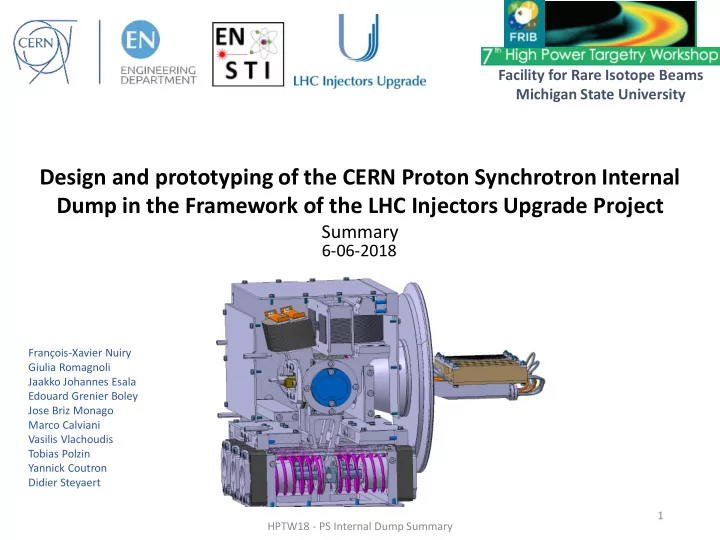
Facility for Rare Isotope Beams Michigan State University Design and prototyping of the CERN Proton Synchrotron Internal Dump in the Framework of the LHC Injectors Upgrade Project Summary 6-06-2018 Franois-Xavier Nuiry Giulia Romagnoli


slide-1
SLIDE 1

Design and prototyping of the CERN Proton Synchrotron Internal Dump in the Framework of the LHC Injectors Upgrade Project

Summary

François-Xavier Nuiry Giulia Romagnoli Jaakko Johannes Esala Edouard Grenier Boley Jose Briz Monago Marco Calviani Vasilis Vlachoudis Tobias Polzin Yannick Coutron Didier Steyaert

6-06-2018

HPTW18 - PS Internal Dump Summary 1

Facility for Rare Isotope Beams Michigan State University

slide-2
SLIDE 2

HPTW18 - PS Internal Dump Summary 2

PS Internal Dumps – Outlines

  • Introduction

Operation and PS dump description Requirements

  • New Dump Core

Description Energy deposition studies Thermo-mechanical simulations Prototyping Analysis

slide-3
SLIDE 3

HPTW18 - PS Internal Dump Summary 3

The PS Machine and LIU PS Upgrade

The LHC Injectors Upgrade should plan for delivering reliably to the LHC the beams required for reaching the goals of the HL-LHC. Timeline: Mai 2020 (PS closing) PS Machine: 628 m circumference 100 Main dipoles Max proton momentum: 26 GeV/c

SS48

slide-4
SLIDE 4

HPTW18 - PS Internal Dump Summary 4

New Dumps: Operation Modes

Machine Development

Cycle in the supercycle not requested for extraction

26GeV DUMP DUMP DUMP

Reference: PS Ring Internal Dump Functional Specifications, EDMS 1582110 v.2.0.

Time Magnetic field

1.2 s

2GeV

BEAM LHC 25 ns 2015 LHC25ns HL Particles Protons, for LHC Pulse Intensity: 8.7 × 10¹² 2.4 × 10¹³ Continuous pulses to study Minimum 4 pulses Minimum 4 pulses Beam revolution time: 2.1 µs 2.1 µs Pulse Period (Basic Period): 3.6 s 3.6 s Beam rms size (σh x σv) odd section [mm × mm] 1.85 x 0.98 1.74 x 0.87 Max momentum 26 GeV/c 26 GeV/c Intensity density* 76 252 Total shaving time

  • approx. 4 ms
  • approx. 4 ms

Total beam energy 35 kJ 96.3 kJ Total energy on the dump 3.2 kJ 8.3 kJ Tmax on dump 415°C 1154°C

*Intensity density

slide-5
SLIDE 5

HPTW18 - PS Internal Dump Summary 5

New PS Dump Description

Dimensions Mass: 175 kg 650 mm

slide-6
SLIDE 6

HPTW18 - PS Internal Dump Summary 6

PS Internal Dumps – Actuation System

Power supply SPRING MOTOR

MAGNET

OUT Move Return

ARM IN ARM OUT

SPRING

Vacuum Chamber

IN Power supply SPRING MOTOR

MAGNET

OUT Move Return

ARM IN ARM OUT

SPRING

Vacuum Chamber

IN

  • Magnetic field keeps the dump arm close to the magnet
  • Magnet current cut  springs pushes the dump in the beam position
  • Back springs push back the dump in the initial position
  • If problem (magnet current)  safety motor pushes away the dump from the chamber
slide-7
SLIDE 7

HPTW18 - PS Internal Dump Summary 7

PS Dump Kinematics

  • Cycle time: <300 ms
  • Angular movement: +/-6°

dump tangential velocity ~0.8 m/s

Beam

Courtesy: Yannick Coutron (CERN) PS ring

Beam turn after beam turn, the dump intercepts a small fraction

  • f the beam protons
slide-8
SLIDE 8

HPTW18 - PS Internal Dump Summary 8

PS Dump Shaving Impact

Nonlinear beam intensity drop over time*: Dump movement Gaussian beam intensity distribution Beam dynamics

PS ring

Beam intensity Time

~3-7 ms

*PS Wall Current Monitor measurement

slide-9
SLIDE 9

HPTW18 - PS Internal Dump Summary 9

PS Dump Shaving Impact

Nonlinear beam intensity drop over time:

On a very thin layer of the dump core surface (few tens of microns thick); A 1 degree angle is set in order to control the position of the primary impact location.

Beam intensity Time

1 degree

Beam Dump Movement

slide-10
SLIDE 10

HPTW18 - PS Internal Dump Summary 10

Project Main Requirements

 PS Ring Internal Dump Functional Specifications, EDMS 1582110 v.2.0.

Main Requirements

  • Dumping time shall be 300 ms
  • Beam impact every 1.2 s or 2.4 s for several

minutes

  • 200 000 cycles / year / dump
  • High vacuum (2 x 10⁻⁸ mbar after 24 h of pumping)
  • Geometrical constraints (max 955mm space in Z)
  • Short and punctual maintenance (1 per year)
  • Lifetime until 2035

Engineering challenges

  • Minimized dump core mass, considering

also proton leakage

  • Thermal management
  • Stress evaluation
  • Cooling system inside the vacuum chamber
  • Reliable mechanism
  • Fatigue (mechanism, bellow…)
  • Highly radioactive environment
  • Precise mechanical dimensioning
  • Efficient modular shielding
  • Material ageing (Gas production and DPA)
slide-11
SLIDE 11

HPTW18 - PS Internal Dump Summary 11

Concept: Isostatic graphite followed by CuCrZr Seamless cooling tubes Two designs studied: Clamped tubes (mechanical contact) Diffusion bonding (Hot Isostatic Pressing)

Dump Core Design

slide-12
SLIDE 12

HPTW18 - PS Internal Dump Summary 12

Materials

Some low density materials:

  • Graphite R7550
  • Silicon Carbide
  • Glassy Carbon

Low thermal conductivity ~7 W/(m K) High elastic modulus (~400 GPa)  high stresses. R7550 better known.

slide-13
SLIDE 13

HPTW18 - PS Internal Dump Summary 13

Energy Density Distribution (Fluka)

BEAM

HL-LHC beam

Values shown are accumulated per pulse

Graphite 1800 J/cm3/150 µs At the surface only 40 µm

Courtesy: Jose Briz Monago

slide-14
SLIDE 14

HPTW18 - PS Internal Dump Summary 14

Thermal Simulation

26°C 48 °C Graphite – CuCrZr TCC: 1000 W/(m2 K) Cooling Pipe - Water HTC: 1000 W/(m2 K)

For boundary condition calculations see: Upgrade of the PS Internal Dump in the Framework of the LHC Injectors Upgrade Project. EDMS No. 1845424 Rev. 0.1

Graphite: 170 °C CuCrZr: 207 °C

Steady-state 4 pulses – HL-LHC

Graphite: 1378 °C CuCrZr: 258 °C 2400×1010 protons/3.6 s  667×1010 protons/s 8323 joules/3.6 s  2.3 kW

Beam LHC 25ns HL-LHC Intensity 2.4 × 10¹³ Momentum 26 GeV/c Size 1.74 × 0.87 mm×mm Pulse Steady-state + 4. pulse

Logarithmic! Initial beam impact point,

  • Max. temp. in Graphite
  • Max. temp. in CuCrZr

~180 °C Water boiling temperature 170 °C at 8 bar

V= 0.7 m/s

slide-15
SLIDE 15

HPTW18 - PS Internal Dump Summary 15

CuCrZr Structural Results, HIP design

CuCrZr at peak time

Yield strength (300 °C) 230 MPa Representative stress 58 MPa Safety Factor 3.96

Global maximum: 84 MPa

Beam LHC 25ns HL-LHC Intensity 2.4 × 10¹³ Momentum 26 GeV/c Size 1.74 × 0.87 mm×mm Pulse Steady-state + 4. pulse

slide-16
SLIDE 16

HPTW18 - PS Internal Dump Summary 16

Graphite Structural Results, HIP design

Stress evolution in Graphite in time Tensile strength 40 MPa

  • Comp. strength

130 MPa Mohr-Coulomb SF 1.17

Z

150 µm 1 mm 150 µm 1 mm

X

Graphite at peak time

ANSYS Help, Mohr-Coulomb Stress Safety Tool

σ1 is maximum principal stress (tensile) σ3 is minimum principal stress (compressive) Mohr-Coulomb Safety Factor:

slide-17
SLIDE 17

HPTW18 - PS Internal Dump Summary 17

Expected activation after 1 month of cool down

Courtesy: J. Vollaire, Cern

After 10 years of operation: close to 10 mSv/h on the dump, after 1 month of cool down BEAM

  • FLUKA Monte-Carlo code  three dimensions dose rate

maps

  • Inermet and Concrete as part of the shielding
  • For 2.4×10¹⁷ protons / year to the dump

60 kGy / year on mechanism

slide-18
SLIDE 18

HPTW18 - PS Internal Dump Summary 18

Core Prototyping

CuCrZr blocks + 316L tubes

Alumina coating of all blocks made of CuCrZr to prevent diffusion bonding to the steel tubes and steel casing during HIP

HIP process Thermal treatment Final precision machining

slide-19
SLIDE 19

HPTW18 - PS Internal Dump Summary 19

Core Prototyping: HIP Process, Thermal Treatment and Ageing

  • Heating and cooling rate of 5 K/min;
  • High temperature plateau for 3 h;
  • High Argon pressure.

BEFORE HIP AFTER HIP

  • Solutionizing (high temperature for 30 min in air);
  • Water quenching at RT for 10 min (~90⁰

/s);

  • Ageing at 500°C for 6h in air.

Steel tubes inner surfaces under vacuum and sealed to limit oxidation during heat treatment

AFTER thermal treatment, ageing and machining

slide-20
SLIDE 20

HPTW18 - PS Internal Dump Summary 20

Core Prototyping, Analysis

Diffusion bonding semi-success  Issue analysis

  • The CuCr1Zr groove was too large (Ø7 mm, tube  ~Ø6.3 mm)
  • At the beginning of the HIP  Pressure increase inside the tube (110 MPa)  tube swelling
  • CuCr1Zr housing too large  Tube crack

Before HIP After HIP + Heat treatment

slide-21
SLIDE 21

HPTW18 - PS Internal Dump Summary 21

Core Prototyping, Analysis

Optical inspections

Courtesy: Josep Busom Descarrega

2 mm

Interface CuCr1Zr-Steel:

  • Clearly visible
  • Defects confirmed as

voids in the interface (gaps up to 15 µm thick)

slide-22
SLIDE 22

HPTW18 - PS Internal Dump Summary 22

Core Prototyping, Analysis

CuCr1Zr 316L tube CuCr1Zr 316L tube

SEM observations and Energy Dispersive X-ray analysis

At the continuous bonding:

  • 10 µm thick interface
  • Cr and Zr diffusion at the interface
  • Sub-micrometric pores in the

CuCr1Zr due to Kinkerdall effect Fe, Cr, Ni. Fe, Cr. Cu Zr inclusions Gap, 2 µm thick

Courtesy: Josep Busom Descarrega

Diffusion bonding accomplished in a part of the interface

Sub-micron pore

slide-23
SLIDE 23

HPTW18 - PS Internal Dump Summary 23

PS Internal Dumps – Summary

  • Beam Intercepting Device with challenging requirements;
  • The multi-turn shaving / damping process is a key parameter for the core design;

PS Machine beam circulation simulations output lead to same intensity drop 4 ms energy deposition time (HL-LHC beam) >1000⁰C temperature gradient over few tens of µm of graphite

  • Water cooling is needed as 2.3 kW can be applied for several minutes
  • HIP design is challenging but would enhance PS operation from 2020 onwards
  • Radiation ageing is not expected to be an issue
  • Actuation system is a key sub-system for the equipment reliability
slide-24
SLIDE 24

HPTW18 - PS Internal Dump Summary 24

Thanks for your attention