DSKs WatSan Experience : Reaching to the Poor Dushtha Shasthya - - PowerPoint PPT Presentation

dsk s watsan experience reaching to
SMART_READER_LITE
LIVE PREVIEW

DSKs WatSan Experience : Reaching to the Poor Dushtha Shasthya - - PowerPoint PPT Presentation

DSKs WatSan Experience : Reaching to the Poor Dushtha Shasthya Kendra- DSK Bangladesh Context 160 million people live in Bangladesh 40% live below poverty 25% extreme poor 40 million live in urban urban population rising


slide-1
SLIDE 1

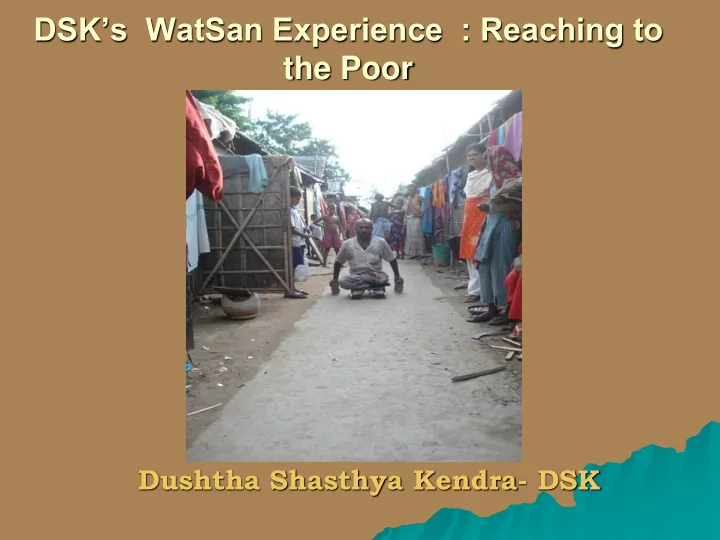
DSK’s WatSan Experience : Reaching to the Poor

Dushtha Shasthya Kendra- DSK

slide-2
SLIDE 2

Bangladesh Context

 160 million people live in Bangladesh  40% live below poverty  25% extreme poor  40 million live in urban  urban population rising 6% annually  6 million pop live in urban slum  Density of slum pop. 200 time higher than the

normal city area ( 531,000/ sqm)

 Slum pop. Become double from 1996 to 2005  Number of slum increase 70% ( 3007 to 4966)  Average daily income Tk 150- 200 ( USD 2-2.5)

slide-3
SLIDE 3

Water scenario

 Access to drinking water : 74%  Potential risk to As. : 40-60 m.

people [mostly rural area]

 Access to water in Urban areas

: 30-80%

 10-15% urban slum people

have access to legal water supply

slide-4
SLIDE 4

Sanitation scenario

 54 % cover by improve latrine

(JMP 2010) mostly in rural areas

 94% fix place defecation , only

6% open defecation

 Urban sanitation coverage : 76%  Sanitation coverage in Urban

slum 14% ( 2003, No up date data)

 National target 100% sanitation

by 2013

slide-5
SLIDE 5

DSK activity

DSK established in 1989

Start with health activity in urban slums

Major programme and project

  • Health Care
  • Water and Sanitation
  • Non formal education
  • Micro credit
  • Disaster management
  • Economic empowerment of urban

extreme poor

slide-6
SLIDE 6

DSK WatSan Components

 Water supply  Environmental Sanitation  Hygiene promotion ( including menstrual

hygiene)

 Community empowerment ( CBO + Training)  School WASH  Public toilets and Mobile toilets  Solid waste management ( collection, treat,

convert in to compost , sale in market )

 LGI engagement  Research and Innovation  Advocacy

slide-7
SLIDE 7

DSK’s approaches

Community based

  • CBO formation and empowerment
  • Community participation in problem identification

planning , implementation, supervision and monitoring

  • Promote Women leadership
  • Participation of Poor and extreme
  • O & M by community
  • 100% coverage
  • 100% cost recovery

LIG engagement

  • Activate sanitation taskforce ( Ward and Zone)
  • Participation local Ward Councilor
slide-8
SLIDE 8

DSK’s approaches

Advocacy

  • community voice ( rotted advocacy)
  • Dialogue with service provider ( local and

Central)

  • Meeting / workshop / Seminar
  • Cross visit- project intervention and community
  • Civil society network
  • Community organization : federation

Research and innovation

  • Action research
  • Piloting
slide-9
SLIDE 9

Water Supply in urban slums

 DSK stated it WatSan project in 1992  First install 2 community based

water point for slum dwellers in 1992

 Now popularly known as ‘DSK WP

Model’

 Replication the model by GOB &

NGOs

slide-10
SLIDE 10

Water options

Water point

 Stand post  DTW  Submergible pump  Mini pipe water supply  Mobile water Van  Water safety ( awareness +

Treatment)

slide-11
SLIDE 11

Environmental Sanitation Options

 Household latrine  Community Latrine  Sanitation Block  Biogas Plant  EcoSan Toilet  Public toilet  Mobile toilet

slide-12
SLIDE 12

Environmental Sanitation Options

Drainage Footpath Vacutug Solid waste management

slide-13
SLIDE 13

Vacutug

 Vacutug is a suction

machine that has the capacity to suck out pit contents or septic tank contents within the short period of time, with low cost and in a hygienic manner.

  • Environmentally safe
  • Low cost
  • Easy to clean
  • Less time required
slide-14
SLIDE 14

Participatory Hygiene Promotion

 Courtyard session for Hygiene

Group (Adult, child, Adolescents

 School HP  Menstrual Hygiene

Management

 Follow-up at HH level  Participatory monitoring of HP

slide-15
SLIDE 15

Community Empowerment

 CBO formation : Women headed

committee

 Community participation in

project cycle

 Training to CBO  Exposure visit  Learning sharing  Engagement with LGI  Linkage with service provider

slide-16
SLIDE 16

Slum dwellers obtained permission in the name of CBO Slum dwellers are entitled as DWASA legal customer (DWASA incorporated the issue in the by-laws) DWASA transferred ownership

  • f water point from DSK to community

MoU between DWASA & NGOs Dhaka WASA reduced the security money from Tk. 10,000 to Tk. 1000 Initial permission for 2 water points for slum dwellers in the name of DSK

A Successful Advocacy Outcome

slide-17
SLIDE 17

WP ownership

slide-18
SLIDE 18

DSK experiences

 Community participation in project

cycle is important

 Women are very active in water and

sanitation activities

 Hygiene promotion is important to create

demand and maintain the infrastructure

 COB take lead role in the project  Community empowerment is must to

sustain the project

slide-19
SLIDE 19

DSK experiences

 O & M done by users  Strong community mobilization prevent

mastan

 Integrate water , sanitation and HP  Community voice raise for service  Evident based advocacy gives more result

to motivate the policy group

 Action research is needed for innovation

  • f Technology, community particpation,

hygiene promotion etc.

slide-20
SLIDE 20

Challenges

 Slum eviction  Very poor housing  No pro poor urban development policy  Slum power structure  Internal migration  Seasonal variation of income  No land tenure ship  Very limited space for living  Unhealthy environment  Negative mind set towards slum dwellers

slide-21
SLIDE 21

Hands together for their better future