Drying of complex fluids: Deformations and fractures L. Pauchard - - PowerPoint PPT Presentation

drying of complex fluids deformations and fractures
SMART_READER_LITE
LIVE PREVIEW

Drying of complex fluids: Deformations and fractures L. Pauchard - - PowerPoint PPT Presentation

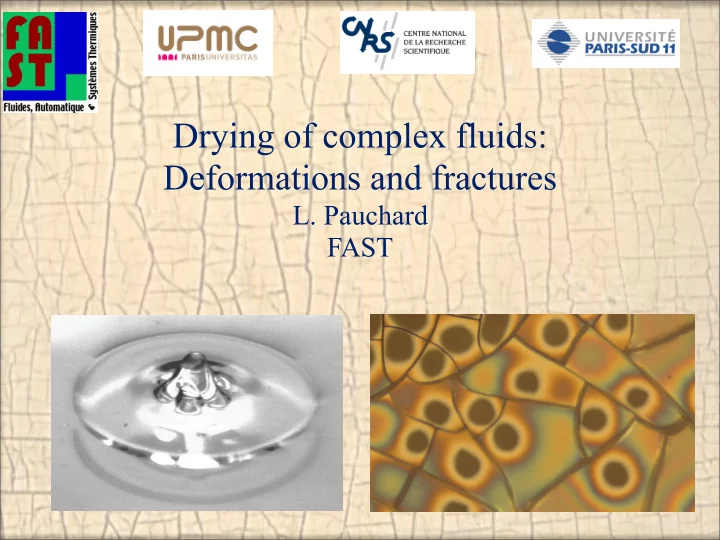
Drying of complex fluids: Deformations and fractures L. Pauchard FAST Singularities inversion of curvature in shells crack patterns JC Gminard 10 1 m A. Davaille directional cracks propagation sea-urchin embryo Carlson (1967)


slide-1
SLIDE 1

Drying of complex fluids: Deformations and fractures

  • L. Pauchard

FAST

slide-2
SLIDE 2

directional cracks propagation

  • A. Davaille

1m

100µm Carlson (1967)

sea-urchin embryo

1mm

coating

Singularities

crack patterns inversion of curvature in shells

  • A. Davaille

JC Géminard 10−1m

slide-3
SLIDE 3

I

Drying of drops of complex fluids

slide-4
SLIDE 4

Deegan, thesis (1998)

side view top view

Drying a sessile drop of complex liquids dilute solutions

  • I. deformation

3-phase line

deposition patterns left by a drop of a dilute colloidal suspension evaporation-induced flow → deposition of layers (Berteloot et al., Eur. Phys. Lett. (2008))

slide-5
SLIDE 5
  • pinning of the three-phase line
  • large concentration gradients
  • hydrodynamic (Rayleigh-Bénard or or mechanical instabilities

polymer solutions colloidal suspensions

Drying a sessile drop of complex liquids concentrated solutions

  • I. deformation

complex drop shapes due to different process

Rayleigh-Bénard or Bénard-Marangoni effects

slide-6
SLIDE 6

Drying a sessile drop of complex liquids concentrated solutions

  • I. deformation

importance of :

  • drying conditions,
  • geometry,
  • physico-chemical properties of the system.
slide-7
SLIDE 7

polymer = dextran (hydrosoluble polysaccharide) concentration in mass : from 20 to 40% ( ) Tg~220°C (glass transition temperature) solvent loss ⇒ polymer concentration increases ⇒ medium becomes glassy

0,001 0,01 0,1 1

Viscosity (mPa.s)

ωp (g/g) 1 10 100 0.1

viscosity (mPa.s)

semi-dilute regime

ωp

Drying a drop of polymer solution: glass transition during desiccation

  • I. deformation

polymer drop

slide-8
SLIDE 8

?

ωp ,RH,T : constants

Θ =40°

0.2 0.4 0.6 0.8 1 1.2 0.2 0.4 0.6 0.8 1 1.2 1.4

H/H 0 t/t D

Θ =40° Θ =20° Θ =20°

time H

2mm

Θ

complete duration: 2min

  • I. deformation

polymer drop

slide-9
SLIDE 9

?

ωp ,RH,T : constants

Θ =40°

0.2 0.4 0.6 0.8 1 1.2 0.2 0.4 0.6 0.8 1 1.2 1.4

H/H 0 t/t D

Θ =40° Θ =20° Θ =20°

time H

2mm

Θ

complete duration: 2min

  • I. deformation

polymer drop

slide-10
SLIDE 10

0,5 1

  • 1
  • 0,5

0,5 1 600s 900s 1200s

H/H0 R/R0

0.2 0.4 0.6 0.8 200 400 600 800 1000 1200 3.0 3.4 3.8 4.2 4.6 5.0 0 200 400 600 800 1000 1200

Time (s) (b) (c)

t B t B

Time (s)

formation of a glassy skin at the evaporation surface deformation: buckling process

600s 900s 1200s

R/R0

H/H0

t(s)

volume (mm3) surface area (mm2)

tB tB

  • I. deformation

polymer drop

slide-11
SLIDE 11

⇒ tD = R0 ˙ VE . V0 R0S0

⇒ tB = f(θ0, RH) R2 Dm

˙ VE = Dm.∇φp

Solvent flux conservation at interface Deformation criterion

φp|surface = φg (glassy state)

10 20 30 40 50 60 70 80 90 0,2 0,4 0,6 0,8 1

1-RH θ (°)

tB>tD : no buckling tB<tD : buckling

θ0(◦)

1 − RH

Pauchard, Allain Europhys. Lett. (2003) Pauchard, Allain Phys. Rev. E (2003)

˙ VE = A(θ0)Da nws(1 − RH) R0

Drop shape characterization

Evaporation rate: Transfer of solvent in air limited by diffusion

  • I. deformation

polymer drop

slide-12
SLIDE 12

Different patterns

  • I. deformation

polymer drop

Gorand et al. Langmuir (2004)

Asymmetry Axisymmetry

slide-13
SLIDE 13

ρ α

U = Eh

  • [

h2 24(1 − ν2)H2 + 1/8(∆−1K)2]ds

Inversion of curvature

in-plane deformation

  • ut-of-plane deformation

fold

elastic energy

Föppl (1907)

slide-14
SLIDE 14

Different patterns

  • I. deformation

polymer drop

Gorand et al. Langmuir (2004)

Asymmetry Axisymmetry

slide-15
SLIDE 15

Drying a drop of colloidal suspension

  • I. deformation

colloids drop

2 coupled effects in the sol-gel transformation (case of a silica dispersion) Drying kinetics evaporation of solvent

tD = R0 ˙ VE . V0 R0S0

drying time Gelation kinetics influence of the ionic strength I: screening charges borne by particles suspension viscosity increases as aggregates form

tG

tG gelation time ⇒ colloidal gel = solid porous matrix saturated by solvent

10 nm solvent

slide-16
SLIDE 16
  • I. deformation

colloids drop

tG/tD < 10−2

10−1 < tG/tD < 10 tG/tD > 102

skin formation buckling process drying gelation drying + gelation

Pauchard, Parisse, Allain Phys. Rev. E (1999)

slide-17
SLIDE 17

2mm Morrill (1985) air suspension gel

Invagination during the collapse of an inhomogeneous spheroidal shell

Pauchard, Couder Europhys. Lett. (2004) Goriely, Ben Amar Phys. Rev. Lett. (2005)

  • I. deformation

colloids drop

invagination in sea-urchin embryo super-hydrophobic substrate saturation in vapor

slide-18
SLIDE 18
  • I. deformation

colloids drop

Crack patterns induced by desiccation

slide-19
SLIDE 19

Conclusion

exemples of problems coupling physico-chemical properties and mechanical properties

large domain of elasticity brittle domain successsive generations of cracks induced by residual stresses stress relaxation ⇒ modifications internal structures ⇒ deformations (wrinkles, fractures)

slide-20
SLIDE 20
  • C. Allain
  • G. Gauthier
  • V. Lazarus
  • L. Pauchard
  • F. Parisse
  • M. Adda-Bedia
  • Y. Couder
  • B. Abou

JC Bacri

  • F. Elias
  • K. Sekimoto
  • G. Aitken
  • C. Lahanier