DRP and SSC Modelling in Ruamahanga Technical Overview James - - PowerPoint PPT Presentation

drp and ssc modelling in ruamahanga
SMART_READER_LITE
LIVE PREVIEW

DRP and SSC Modelling in Ruamahanga Technical Overview James - - PowerPoint PPT Presentation

DRP and SSC Modelling in Ruamahanga Technical Overview James Blyth- Senior Water Resource Scientist www.jacobs.com | worldwide What should you consider from the modelling results? These are a guide to help inform your decisions The

slide-1
SLIDE 1

www.jacobs.com | worldwide

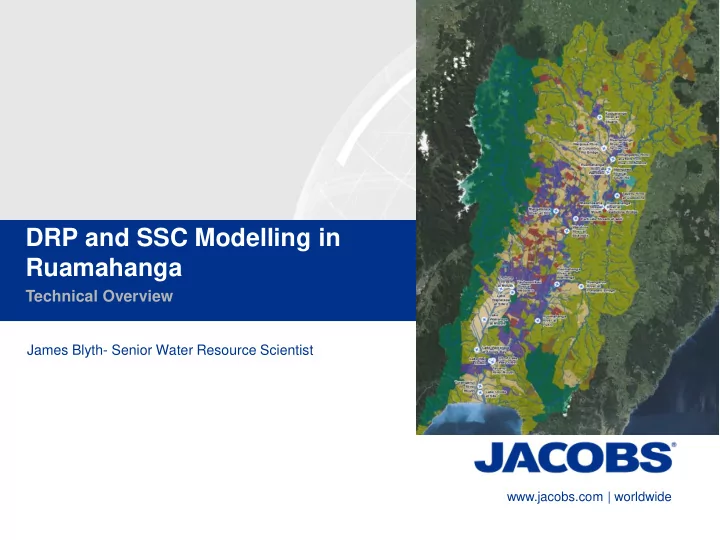
DRP and SSC Modelling in Ruamahanga

Technical Overview

James Blyth- Senior Water Resource Scientist

slide-2
SLIDE 2

What should you consider from the modelling results?

2

  • These are a guide to help inform your decisions
  • The results will not always be a perfect match to the
  • bserved data
  • The model is calibrated as close as possible to
  • bserved data, with the aim of representing the

natural system

  • The relative changes (i.e. percentage reductions and

swimming categories) provide the most useful information about how a catchments concentrations may change, depending on its landuse and the mitigations applied

slide-3
SLIDE 3

Background to catchment modelling-DRP

  • Landuse/soil classes defined in the catchment
  • Apply input data (DRP nutrient generation rates)

to these landuses using an EMC/DWC approach

– EMC - Event Mean Concentrations.

  • Applied to the quickflow/runoff during storm events

– DWC – Dry Weather Concentrations

  • Applied to the baseflow that occurs as regular inputs

to a stream

3

slide-4
SLIDE 4

Background to catchment modelling

  • Flows generated off each landuse are

partitioned into baseflow and quickflow.

  • The partitioned flow has either EMC’s or DWC’s

applied to generate load

  • Point source inputs (i.e. WWTP) added as a

daily DRP and SSC concentration

  • Model is calibrated at various river sites to
  • bserved data, by incorporating ‘attenuation

factors’

4

slide-5
SLIDE 5

Background to catchment modelling-SSC

  • Different methodology for modelling suspended

sediment concentration (SSC) compared to all

  • ther nutrients
  • Utilises a GIS method adapted for New Zealand

by Landcare Research called SedNetNZ, linked to the Revised Universal Soil Loss Equation (RUSLE) and NZLRI LUC maps

  • This GIS model maps sediment annual average yields

(tn/ha/yr)

  • Calibrated to observed SSC data NZ wide, where

available

  • May not reflect current landcover

5

slide-6
SLIDE 6

Background to catchment modelling-SSC

  • Source model utilises an SSC power curve for

every catchment, which predicts daily sediment concentration (mg/L) based off simulated flows.

  • Each catchments power curve has been

‘calibrated’ to ensure SSC simulated concentrations match SedNetNZ annual average loads

6

slide-7
SLIDE 7

Background to catchment modelling-SSC

  • The modelled power curve inputs are manually

tweaked to ensure the simulated concentrations are similar to observed SSC monitoring data

  • Leads to results in average annual loads

consistent with SedNetNZ, and concentrations ‘realistic’ to observed data.

7

slide-8
SLIDE 8

SSC and Clarity

8

  • NIWA added SSC sampling

in 2012 to National Rivers Water Quality Network (NRWQN) which covers 77 sites across New Zealand.

  • Can compare to clarity.
  • A reduction in SSC leads to

an increase in clarity, all sites show a strong correlation (r2 of 0.89 on the log scale). Beneficial for light penetration, aquatic ecosystems, aggradation, macrophytes etc.

https://www.niwa.co.nz/environmental-information/update/environmental-information-update-3-august-2012/monitoring-suspended-sediment-to-better

slide-9
SLIDE 9

Assumptions/Limitations to modelling

  • Most DRP input concentrations are taken from

literature data not always from the study area, and instream concentrations

  • Flows (from external models) have a significant

impact on concentrations. Poor flow calibrations mean nutrient calibrations may be poor, although buffered out by ‘attenuation’ factors.

  • Water quality data to calibrate was from 2000-

2014 (same as flow data). SSC data was limited, and turbidity was converted to SSC where possible

9

slide-10
SLIDE 10

Mitigations applied- DRP

  • All mitigations were modelled and reported by

agresearch/MPI for 16 representative farms in the catchment

  • The nutrient reductions were converted to

weighted average % reductions to apply to appropriate landuse types within the catchment

10

slide-11
SLIDE 11

Mitigations applied- DRP

  • Tier 1 BAU/Silver/Gold- Stock exclusion and dairy

effluent management

  • Tier 2 Silver/Gold- Optimal fertiliser use, constructed

wetlands

  • Tier 3 Silver/Gold- Riparian planting/buffer strips
  • WWTP land treatment- decrease DRP

concentrations by 98%

  • Land Retirement- changes input concentrations to

‘Native Bush’ values

  • Pole Planting- reduces DRP load by 70% when

trees are mature (>15 years old)

11

Mitigations applied to input concentrations Percentage (%) reduction from baseline concentrations Species Scenario Dairy Sheep and Beef Arable Farm Dairy Support Cumulative Weighted Average TP, DRP reductions (applied to EMC’s) Baseline

  • Tier 1

16.8 1.5 5.9 Tier 2 26.6 13.3 11.9 Tier 3 5m buffer 27.5 80.1 20 23.8 Tier 3 10m buffer 29.8 80.1 20 23.8

slide-12
SLIDE 12

Mitigations applied- SSC

  • Tier 1 and 3 BAU/Silver/Gold- Stock exclusion and

riparian planting reduce streambank erosion loads (from SedNetNZ streambank layer). Applied from BAU onwards.

  • Tier 2 Silver/Gold- Constructed wetlands reduce

erosion from hillslope layers in SedNetNZ

  • WWTP land treatment- decrease SSC

concentrations by 100%

  • Land Retirement- changes SedNetNZ hillslope load

to Native Bush values (from exotic pasture etc)

  • Pole Planting- reduces SedNetNZ hillslope load

when trees are mature (>15 years old)

12

Mitigations applied to input concentrations Percentage (%) reduction from baseline concentrations Species Scenario Dairy Sheep and Beef Arable Farm Dairy Support Individual SSC reductions (applied to streambank or hillslope erosion layers in SedNetNZ) Baseline

  • Tier 1 (stream

bank erosion layer)

80 80 80 80

Tier 2 (hillslope erosion layer)

6.40 20.70 0.00 5.80

Tier 3 5 and 10 m buffers

slide-13
SLIDE 13

Scenario Results- Example Western Sites

13

Tauherenikau at Websters Waingawa at South Road Scenario DRP % reduction (median) SSC % reduction (median) BAU 2080 0.9

  • 12.7

Silver 2080

  • 3.3
  • 13.6

Scenario DRP % reduction (median) SSC % reduction (median) BAU 2080

  • 3.8
  • 10.5

Silver 2080

  • 26.3
  • 14.6
slide-14
SLIDE 14

Scenario Results- Example Eastern Sites

14

Taueru River at Gladstone Huangarua at Ponatahi Bridge Scenario DRP % reduction (median) SSC % reduction (median) BAU 2080

  • 3.0
  • 36.7

Silver 2080

  • 52.0
  • 67.4

Scenario DRP % reduction (median) SSC % reduction (median) BAU 2080

  • 0.1
  • 18.0

Silver 2080

  • 34.9
  • 64.0
slide-15
SLIDE 15

Scenario Results- Ruamahanga River

15

Ruamahanga River at Wardells Ruamahanga River at Waihenga Scenario DRP % reduction (median) SSC % reduction (median) BAU 2080

  • 57.5
  • 13.5

Silver 2080

  • 71.2
  • 37.8

Scenario DRP % reduction (median) SSC % reduction (median) BAU 2080

  • 46.5
  • 20.4

Silver 2080

  • 60.6
  • 41.4
slide-16
SLIDE 16

Scenario Results- Ruamahanga River

16

Ruamahanga River Upstream of Lake Wairarapa Outlet (most downstream reporting site) Scenario DRP % reduction (median) SSC % reduction (median) BAU 2080

  • 47.1
  • 19.1

Silver 2080

  • 61.4
  • 41.6
slide-17
SLIDE 17

Summary

17

  • Significant reductions in DRP are attributed to:
  • Land treatment of WWTP
  • Pole planting and land retirement
  • Optimal fertiliser use, stock exclusion and riparian planting/buffer

strips

  • Significant reductions in SSC are attributed to:
  • Stock exclusion/riparian planting reducing net bank erosion

(significant load reduction especially in lowland catchments)

  • Pole planting and land retirement in the upland/steeper

catchments

  • Constructed wetlands (tier 2)
slide-18
SLIDE 18

18

Important note about your presentation

This presentation has been prepared by Jacobs for Greater Wellington Regional Council (the Client) for the purposes

  • f the Ruamahanga Catchment Modelling Scenarios project. Jacobs accepts no liability or responsibility whatsoever

for, or in respect of, any use of, or reliance upon, this presentation (or any part of it) for any other purpose. In preparing this presentation, Jacobs has relied upon, and presumed accurate, any information (or confirmation of the absence thereof) provided by the Client and/or others sources of external model inputs such as from Geological Nuclear Science (GNS) or National Institute of Water and Atmospheric Research (NIWA). If the information is subsequently determined to be false, inaccurate or incomplete then it is possible that our observations and conclusions as expressed in this presentation may change. Jacobs derived the data in this presentation from information sourced from the Client (if any) and/or available in the public domain at the time or times outlined in this

  • presentation. The passage of time, manifestation of latent conditions or impacts of future events may require further

examination of the project and subsequent data analysis, and re-evaluation of the data, findings, observations and conclusions expressed in this presentation. Jacobs has prepared this presentation in accordance with the usual care and thoroughness of the consulting profession, for the sole purpose described above and by reference to applicable standards, guidelines, procedures and practices at the date of issue of this presentation. For the reasons outlined above, however, no other warranty or guarantee, whether expressed or implied, is made as to the data, observations and findings expressed in this presentation, to the extent permitted by law. This presentation may also describe specific limitations and/or uncertainties which qualify its findings. Accordingly, this presentation should be read in full and no excerpts are to be taken as representative of the findings unless any such excerpt and the context in which it is intended to be used have been approved by Jacobs in writing.