Drones in agriculture at UC Davis Travis Parker Plant Biology - - PowerPoint PPT Presentation

drones in agriculture at uc davis
SMART_READER_LITE
LIVE PREVIEW

Drones in agriculture at UC Davis Travis Parker Plant Biology - - PowerPoint PPT Presentation

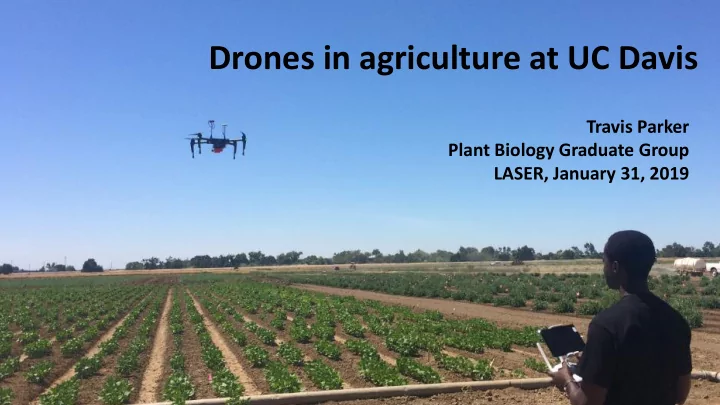
Drones in agriculture at UC Davis Travis Parker Plant Biology Graduate Group LASER, January 31, 2019 Why dr hy drone ones in s in ag? g? -need for increased agricultural production -consumer demand for responsible farm management -farm

slide-1
SLIDE 1

Drones in agriculture at UC Davis

Travis Parker Plant Biology Graduate Group LASER, January 31, 2019

slide-2
SLIDE 2

Why dr hy drone

  • nes in

s in ag? g?

  • need for increased agricultural production
  • consumer demand for responsible farm management
  • farm labor concerns
  • agriculture will need to rapidly evolve… and

drones are a powerful, rapidly evolving tool

slide-3
SLIDE 3

What can drones do in agriculture?

  • Research
  • Plant breeding
  • Improving agronomic practices
  • Precision agriculture
  • Eye in the sky for farmers
  • Application of sprays
  • Fewer recent advances than
  • ther sectors?

Which of these would you want to grow?

slide-4
SLIDE 4

Typical UAS workflow for agricultural science:

  • 1. Develop flight plan
slide-5
SLIDE 5

Typical UAS workflow for agricultural science (cont’d):

  • 2. Collect data
  • 3. Transfer imagery
slide-6
SLIDE 6

Typical UAS workflow for agricultural science (cont’d):

  • 4. Construct

models

slide-7
SLIDE 7

What questions can they solve?

slide-8
SLIDE 8
slide-9
SLIDE 9

Typical UAS workflow for agricultural science (cont’d):

  • 5. Export to other

programs (e.g. QGIS)

slide-10
SLIDE 10
  • Old method: Hand-

cut, dry, bag, weigh each plot individually

  • New method: Fly

drone, extract data from all plots simultaneously

Example: Alfalfa

slide-11
SLIDE 11

Takeaway: A few years ago, these results would have been impossible

slide-12
SLIDE 12

True-color Health predicted by true-color Thermal (IR) Health predicted by infrared and true color

+shapefiles for data extraction (different camera)

Sensors and vegetation indices

slide-13
SLIDE 13

y = 1.0915x - 0.111 R² = 0.9708 (drought) y = 1.0984x - 0.1507 R² = 0.9649 (control) 0.1 0.2 0.3 0.4 0.5 0.6 0.7 0.8 0.9 0.1 0.2 0.3 0.4 0.5 0.6 0.7 0.8 0.9 1 Mean NDVI (Parrot Sequoia) Mean NDVI (RedEdge-M)

Tak akea eaway: Highl ay: Highly y pr prec ecise, ise, rep eprod

  • duc

ucible, ible, an and d high high- th throu

  • ugh

ghpu put t resu esults lts

slide-14
SLIDE 14

Drones as an educational tool

Felicie elicien Zi Zida da tr trainin aining Lundber Lundberg g Famil amily y Far arms t ms training aining Picnic day booth Picnic day booth

slide-15
SLIDE 15

Drones as an educational tool

Field day demonstration flights with farmers

slide-16
SLIDE 16

PLS 198 student training

slide-17
SLIDE 17

PLS 198 students flying

slide-18
SLIDE 18

M 11am-12pm, W 1pm-4pm Instructor: Travis Parker trparker@ucdavis.edu Instructor of record: Paul Gepts

Unmanned Aerial Vehicles (UAVs) in Agriculture

PLS 198-32, Spring 2019, 2 units CRN: 87027

slide-19
SLIDE 19

Educa Education and outr tion and outreac each

PLS 198 student groups

slide-20
SLIDE 20

Heirloom (at left) and new variety (right)

KPBS: “A Growing Passion”

slide-21
SLIDE 21

The future of farming…

slide-22
SLIDE 22

Summary ry

  • Agriculture will need major advances in

coming decades

  • Drones are useful for many different

agricultural applications

  • Drones collect highly precise, high-

throughput data, which was out of reach just a few years ago

  • Drones are an excellent tool for engaging

the next generation of innovators

slide-23
SLIDE 23

Thanks!

This material is also supported by the National Institute of Food and Agriculture, U.S. Department of Agriculture, under award number 2016-38640-25383 through the Western Sustainable Agriculture Research and Education program under subaward number 200592-448 [project number GW18-062]. USDA is an equal opportunity employer and service provider. Any opinions, findings, conclusions, or recommendations expressed in this publication are those of the author(s) and do not necessarily reflect the view of the U.S. Department of Agriculture."