SLIDE 1 IT2EC 2020 IT2EC Extended Abstract Template Simulation for Better Operational Decisions: Game of Drones / War of the Drones
War of the Drones
Bruzzone Agostino, Full Professor University of Genoa, Italy1, Di Bella Paolo, Colonel ITA Army, Simulationist 2 Massei, Marina, University of Genoa, Italy
Abstract — UAV, UAS, UGV and the broad category of devices on multiple domains, often just named Drones, are now in their infancy, but we are going to see a lot of them in the future. The present paper wants to draw a sketch of a (future) military doctrine for the employment of drones paired with regular (i.e. human) army units and related needs for Exercise, Education & Training based on Modelling and Simulation. Since the employment of AI guided drones rises concerns because of the capability of killing without any human in the loop, conversely their massive employment toward other drones or other non-living entities, such as critical infrastructures, pose a different perspective. However, with the development of a mass production of drones, both the armies – the attacker and the defender – should develop a doctrine for their employment. It is evident the necessity to develop proper multi domain synthetic environments to study the new corresponding doctrines and technological solutions for deployment and employment as well as to train the Commanders and their staff.
1 Introduction
1.1 Rise of the Drones The broad categories of devices called “Drones”, which by large comprehends unmanned vehicles, robotics and autonomous systems, represent indeed the case of disruptive technologies that “radically alters the symmetry
- f military power between competitors, immediately
- utdating the policies, doctrines and organizations of all
actors” (Bower & Christensen, 1997). Those devices called “Drone”, in particular flying drones, ranges from Unmanned Air Vehicles (gross weight of hundreds of Kgs) to Smart Dusts (gross weight of grams); in particular, as shown in Fig. 1 below, there is a spread spectrum of drones from UAV class with maximum wing span of 61 mt and weight of 15,000 kg to smart dust (SD) with minimum size
- f 1 mm and weight of 0.005 g. Between UAV and SD at
both ends of the defined spectrum, there are various types
- f drones, which are called micro drones, such as micro
unmanned air vehicle (μUAV), micro air vehicle (MAV), nano air vehicle (NAV), and pico air vehicle (PAV) (Hassanalian & Abdelkefi, 2017).
Fig.1 Spectrum of Drones from UAVs to SDs (Hassanalian & Abdelkefi, 2017).
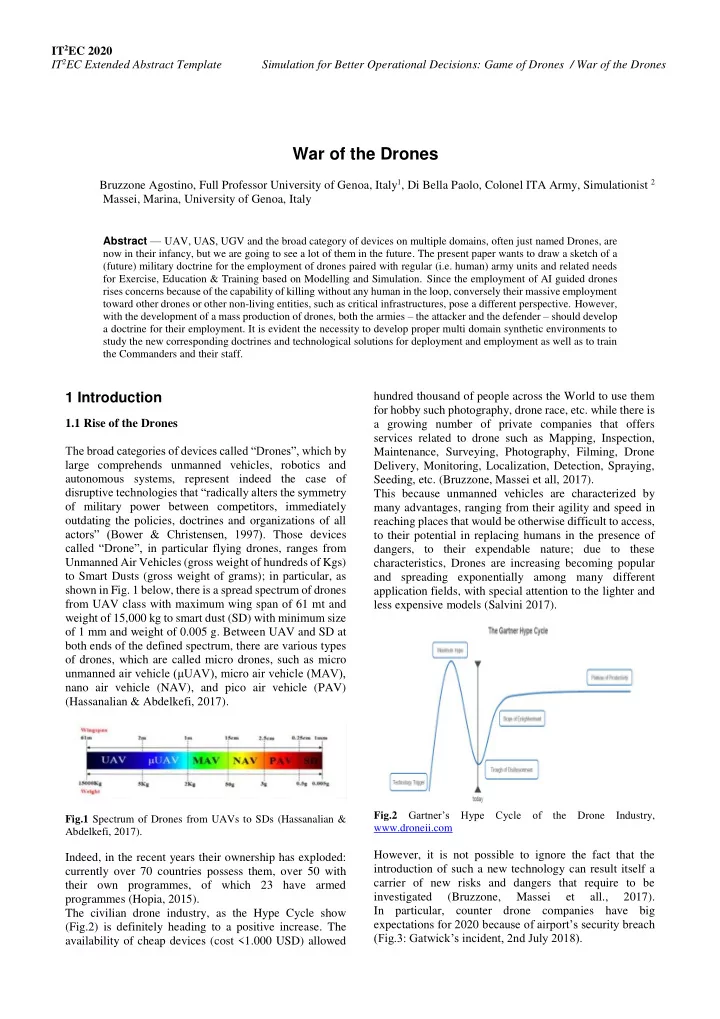
Indeed, in the recent years their ownership has exploded: currently over 70 countries possess them, over 50 with their own programmes, of which 23 have armed programmes (Hopia, 2015). The civilian drone industry, as the Hype Cycle show (Fig.2) is definitely heading to a positive increase. The availability of cheap devices (cost <1.000 USD) allowed hundred thousand of people across the World to use them for hobby such photography, drone race, etc. while there is a growing number of private companies that offers services related to drone such as Mapping, Inspection, Maintenance, Surveying, Photography, Filming, Drone Delivery, Monitoring, Localization, Detection, Spraying, Seeding, etc. (Bruzzone, Massei et all, 2017). This because unmanned vehicles are characterized by many advantages, ranging from their agility and speed in reaching places that would be otherwise difficult to access, to their potential in replacing humans in the presence of dangers, to their expendable nature; due to these characteristics, Drones are increasing becoming popular and spreading exponentially among many different application fields, with special attention to the lighter and less expensive models (Salvini 2017).
Fig.2 Gartner’s Hype Cycle of the Drone Industry, www.droneii.com
However, it is not possible to ignore the fact that the introduction of such a new technology can result itself a carrier of new risks and dangers that require to be investigated (Bruzzone, Massei et all., 2017). In particular, counter drone companies have big expectations for 2020 because of airport’s security breach (Fig.3: Gatwick’s incident, 2nd July 2018).
SLIDE 2 IT2EC 2020 IT2EC Extended Abstract Template Simulation for Better Operational Decision /War of the Drones However, in this paper we are not going to discuss about “weaponization” of “piratization” of commercial drones (photo 1 and fig.3). However, given the fact that even a single device or a few can disrupt/damage critical infrastructure, as in the case of 14 September 2019 attack in the Abqaiq–Khurais Oil facility in Saudi Arabia, the threat posed by a massive employment of drone employed according to a military doctrine, certainly escalates the problem from a tactical perspective into a strategic one.
Fig.3 Gatwick’s drone incident, July 2nd, 2018. (Source: Vimeo)
For such reason Drones are definitely a Force Multiplier, because of their inherent features and capabilities, even though not immune by limitations. In fact, Drones have been appreciated because they are quick deployable, ubiquitous and cheap to operate, however, vulnerable to extreme weather conditions, jamming and shooting down.
Photo 1. Makeshift drone captured by Russian Forces in Syria, 2017 (Source NYT)
1.2 Drones: to be banned as the land mines? Drones typically perform surveillance and information gathering missions (ISR) and ground fire support, this one which has been the most legally and morally challenged so
- far. A Drone (Hopia, 2015) does not differ from manned
aircraft, and accordingly there is not an ethical difference between launching a missile or firing an armed UAV ; this because there is and always will be a “human” chain of command, accountable for full responsibility. The perspective indeed change when there is no human in the loop, arriving at the extreme of “Robots killing humans” (https://autonomousweapons.org/). However, it possible to argue that even the choice to deploy Drones solely guided by AI can be clearly tracked back to a human decision; well, if it is possible to reconnect the use of any type of autonomous killing robot to a human decision, however this introduce the risk of manipulation into justify even the positioning of land mines (banned and prohibited by Law of the Armed Conflicts long ago) because of argument of the mere existence of a human chain of
- command. On the other extreme however, we could oddly
end up venturing into science fiction, imagining an AI that gains control of Full Autonomous Systems and employ those to kill humans. However, until now, the final decision to engage and (most probably) kill, involve a human in the loop decision. What it is necessary to underline here is that the analysis takes in consideration the mere existence of such devices and the full spectrum of capabilities they could serve the military, while the debate around the legal limitations of Full Autonomous Systems as weapons lies within the provision and interpretations of Law of Armed Conflicts. In particular, in the area of the interaction between the human and robots, it is necessary to take as well into consideration the role of the military Command and Control (C2) Operational Function. A M&S prototype for CD&E activity on UAV employed in urban operational scenario allows experimentation on robotic platforms, their tactical procedures, their sensor payload, behaviours, missions and tasks according to their level of autonomy within the operational vignettes (Biagini, Corona, 2018).
- Fig. 4 The 5 levels of Commercial Drone Autonomy
(www.droneii.com)
2 DRONES FOR THE MILITARY
2.1 Drone: From Tactic to Strategic Advantage Having understood the tactical advantages given by the employment of the drones for ISR missions and as flying IED/ED (Adams, 2017) and the capability to substitute fixed and rotary wing assets in dull, dirty or dangerous (DDD) missions (Austin, 2010), it is necessary now to comprehend how such tactical advantage brought by drones can be enhanced into a strategic one. Of course drones could operate not only individually, but also in a swarm which allows to install different kinds of sensors on the platforms and it could enhance drastically data acquisition capabilities of the whole system; this swarm collaborative use represents one of most promising directions of research in this field (Burkle et al. 2011). Several research from different organizations have been conducted in order to make drones fly as a group and act
SLIDE 3 IT2EC 2020 IT2EC Extended Abstract Template Simulation for Better Operational Decision /War of the Drones autonomously without the interference of humans (Hassanalian & Abdelkefi, 2017). China, on top of many, is nowadays the foremost producer and exporter of armed Unmanned Aerial Systems, possibly “copies” of the US Predator and Reaper UAVs, but much cheaper (Frew, 2019). This suggest that China has the capability of mass production of drones, able to overcome the US in term of numbers, with the possibility that Chinese People's Liberation Army (PLA) could any time soon be able to deploy massive “Armies” of swarming
- drones. At the moment however, the only known project
to deploy an Army of Swarming Drones reside into the US Perdix Program; Perdix are expendable micro-drones that can be launched from military aircraft (Source: Wikipedia), in order to perform ISR missions.
Photo 2: Perdix drone (Wikipedia)
However, a huge drone can be separated into many micro drones to make a formation flight based on a defined
- mission. In other words, drones will have the ability to
carry and release micro drones that can be designed to conduct swarm flights (Hassanalian, & Abdelkefi, 2019). The table 1 below introduce a categorization of this broad class of device named “Drones”, linking those to the respective platforms.
Tab. 1 US DoD Categorization
Drones (Source: NCAR / EOL Workshop - Unmanned Aircraft Systems for Atmospheric Research – February 2017)
For the purpose of the current research, which focus on innovative employment of drones on the battlefield, the focus is on the tactical drones (W<600 kg), which are smaller, lighter and more flexible than Medium Altitude Long Endurance (MALE) or High Altitude Long Endurance (HALE) drones (W>600 kg), (Brooke, 2012). In table 2 below there are reported some examples of tactical drones, two of them belonging to countries who are not at the cutting edge of research or drone production. This means that nowadays no regular army could afford the luxury of ignoring the existence of this disruptive technology. Model /Country Speed/Alt Combat Radius Payload CH-3/3A CHINA 250 km/h 3.000 mt. 200 km 2x 50/90 kg Precision Guided bombs Burraq PAKISTAN 215 km/h 7.500 mt. 500 km 1-laser guided missile Gorlytsa UKRAINE 230 km/h 5.000 mt. 80 km 50 kg
bombs/missi les
Table 2: Features of tactical drones. Source: Drone Wars UK, 2018.
When looking at the figures above, payloads and combat radius/endurance are the main features to be taken into account for military exploitation. For what concern payload, this comes in two basic types (Austin, 2010): a) Non Dispensable (which remains with the aircraft): sensors, cameras, etc.; b) Dispensable: loads such as bombs, rockets.
- Fig. 5 View of payload vs gross weights (source: NCAR / EOL
Workshop - Unmanned Aircraft Systems for Atmospheric Research – February 2017)
We can however identify a third category: the fully disposable drone. This could be the case of Drone swarm
- r Drone Dust, meaning that the full device can be
dispensable when used as Flying Explosive Device. For this latter use, MAVs (Micro or Miniature Air Vehicles), NAVs (Nano Air Vehicles), have the distinct advantage of their small dimensions, and the consequent ability to fly in confined spaces; this is very much true for the rotary wing MAVs, which have high manoeuvrability because they can hover (Hassanalian et all, 2017). For what concerns endurance, the small drones are powered by Li-PO batteries, while micro drones utilize lithium batteries. One of the problems that can face MAVs is that they can fly no more than 30 min when powered by battery (Hassalian et all, 2014).
SLIDE 4 IT2EC 2020 IT2EC Extended Abstract Template Simulation for Better Operational Decision /War of the Drones
Fig. 6 Energy sources for Commercial Drones (www.droeni.com)
2.2 Innovative Employment of Drones for the Army In their current capacity, Drones perform for the Army:
- Electronic Intelligence, Surveillance of enemy
activity, Reconnaissance (ISR)
- Target Engagement;
- Monitoring of nuclear, biological or chemical
(NBC) contamination. Let’s now figure out instead innovative employments: 1) attach Tactical Drones in the role of fire support, to a company, battalion, regiment/brigade size unit, respectively as section, battery, artillery group in a deployed army on the ground. Their role as fire support because their bombs payload could replace the traditional ground artillery fire, increasing accuracy but decreasing the number of rounds compared to a regular cannon/mortar. 2) MAVs/NAVs in the form of Drone Swarm or Dust can be used instead by Spec Ops Team to infiltrate hostile areas and gather ISR or suppress targets. 3) Saturation of the battlefield with Drone Swarm/Dust, employed as flying Explosive Device; however, in order to make this option feasible, the cost of mass production of such devices has to achieve economic sustainability. There in both cases advantages and issues to be addressed. Among the Advantages:
- Fire support ubiquitous, precision guided, not
subjected to counter battery fire;
- Cheaper than Airstrikes / Helicopter strikes;
- Intelligence, Surveillance, Reconnaissance (ISR)
and Targeting fully integrated into the battlespace management;
- In case of deployment of Drone Swarms Dust,
with the defender not in possess of the same technology and /or adequate Counter Drone technology, the attacker will gain the edge. The Issues to be addressed when employing drone by the military are:
- Doctrine: it is mandatory to develop a doctrine for
the massive use of drone/dust swarms, totally integrated in the management of the battlespace;
- Doctrine for the employment of a so called
“Drone Artillery”, embedded into a regular army, integrated in the C2 chain of Command; this Drone artillery have to be built for maximizing payload and bombing radius;
- A Drone Swarm/Smart Dust mass production,
capable of damaging critical infrastructure on the battlefield (antennas, fuel tanks, command posts) as well as aircraft, vehicles and humans.
- A Countering Drone Technology and Doctrine:
while effective anti-drone products are already available off the shelves (Adams, 2017), they are studied to cope against a single or some, not against hundreds or thousands flying devices. It is also necessary to adopt, test and train own troops in TTP against drone ISR and Targeting;
Fig. 7. Counter Drone Market Solutions (www.droneii.com)
On this regard, NATO Modelling and Simulation Group (NMSG) 154 was tasked to develop models for commercially available Low, Slow and Small (LSS) aerial vehicles and make these models available for analysis and design of Counter-LSS systems, both for detection and neutralization (Proietti et all, 2017).
- IFF: equip with IFF transponder friendly drones.
Counter drones are then able to drift around installations checking for any “drone” not emitting a friend IFF signal and eliminate it.
- Weather: extreme cold/heat, strong wind, heavy
rain, can limit by large the usage of drone in
- perations (especially MAV, Swarm and Dust);
- Drones Physics limitation: flying endurance
(minutes); High Explosive (HE) Payload (Kgs, grams, or hundreds of);
- Logistic concept of the drones (hypothesis: +
supply, -maintenance);
- Necessity of the Availability / Dominance of the
Electromagnetic Spectrum / Electronic Warfare.
SLIDE 5 IT2EC 2020 IT2EC Extended Abstract Template Simulation for Better Operational Decision /War of the Drones
- Fig. 8 A view of the cost for design and
production of drone source: NCAR / EOL Workshop - Unmanned Aircraft Systems for Atmospheric Research – February 2017)
3 DronEX: a HLA framework to exercise the War of the Drones
Both the employment of tactical drone as fire support and swarming drones as flying ED are hypothesis that can be tested safely into a synthetic, simulated environment. Due to the complexity of these context, the use of Modelling and Simulation is considered often the most promise methodology for investigating modern UAV problems (Bruzzone et al. 2016). To complete test and experiment and to evaluate related risks it is necessary to recreate a realistic mission environments. The adoption of MS2G paradigm (Modelling, interoperable Simulation and Serious Games) represents a very strategic advantage allowing to combining different models, simulators and also real equipment within a common synthetic
- environment. These simulation environments should be
intuitive and interactive by using most advanced Mixed Reality solutions such as the SPIDER (Simulation Practical Immersive Dynamic Environment for Reengineering), developed by Simulation Team, in order to support the Subject Matter Experts (Bruzzone et al. 2016).
- Fig. 9 Trex: Drone swarm approaching Critical Infrastructure
When we step up from the level from tactical to Joint
- perational level exercises, Core (Brigade and Above)
Staff members are called to swiftly identify and proper address issues, and among many, drones as well. The proposed simulation architecture is able to provide the simulated means for the training audience to deal with the threat of drones in a context where it is expected to defend against an adversary which is employing the drones regardless any ethical or legal bound. In DroneEX (Drone EXercise), the military training audience will be guided through a complex and realistic scenario, where drone threats will be dynamically generated by the drone simulator, federated with the main simulation exercise
- tool. In such contest, the advantage of the use of simulation
allows to obtain results that are not deterministic but stochastic in their evolution and outcome, giving a value added in terms of training, with the additional advantage to explore successful and unsuccessful outcomes in a safe, synthetic but realistic environment provided by the simulation.
- Fig. 10 War of the Drones: Enemy drones engaged by Sentinel
Counter Drones, as proposed in T-REX simulator.
The proposed architecture for this exercise foreseen the possibility to integrate simulators already employed for training events (Joint Theatre Level Simulation – JTLS, Joint Conflict and Tactical Simulation – JCATS, Virtual Battlespace- VBS) federated with other simulators able to replicate the threat of drones. The interoperability requirements have to be in accordance with the IEEE 1516 “evolved” that is the updated version of HLA standard (High Level Architecture). From this point of view, the simulator “T-REX” developed by Simulation Team offers the possibility to recreate the conditions for executing exercise rehearsals in countering drones. Indeed, the use of UAV could be useful to reinforce the protection of critical infrastructures, considering that could be a robust solution supported by multiplatform, multisensory data fusion and that could allow to conduct further investigations directly approaching to the alerts in order to discriminate real threats from false alarms. Obviously these elements suggest specific requirements in terms of collaboration capabilities, redundancy and responsiveness of the multi UAV system. In particular, TREX simulator is able to create a wing of small MAV quadcopters with IED capabilities, guided by the enemy to attack sensitive civil (gas, oil refinery, etc.) or military installations (Command Post, radio relay, etc. in coordination with a cyber-attack based on introducing viruses acting on data integrity to disable the defensive capabilities of the critical infrastructure compound. T-REX simulator is also capable
- f creating wing of UAV tasked to monitor and to protect
the same facilities described above (Bruzzone, Massei et all, 2017).
SLIDE 6 IT2EC 2020 IT2EC Extended Abstract Template Simulation for Better Operational Decision /War of the Drones
Fig.11 TREX: Quadcopters on their way to engage a critical infrastructure.
Indeed, the use of UAV could be useful to reinforce the protection of critical infrastructures, considering that could be a robust solution supported by multiplatform, multisensory data fusion and that could allow to conduct further investigations directly approaching to the alerts in
- rder to discriminate real threats from false alarms.
Obviously these elements suggest specific requirements in terms of collaboration capabilities, redundancy and responsiveness of the multi UAV system (Bruzzone, Massei et all, 2017).
4 Conclusions and Way Ahead
Drone technology, in particular miniaturization of devices and of energy sources, coupled with the availability of mass production of cheap drone, raise questions that the Defence professionals are called to answer. In a contest of steady or slowly diminishing resources for the budget of Defence in many European Countries, the issue of policy and military doctrine for employing drones and how to stage their mass production with sustainable cost has become as much necessary as urgent. The M&S approach is the ideal ground where to develop hypothesis and to test those inside a safe, synthetic environment. Furthermore, recognizing the necessity of training troops in countering the drone threat with the support of simulation from tactical to Core level, it is proposed, in the contest of a Joint operational military exercise (DroneEX), a simulation exercise architecture where staff elements and functions can get trained at addressing and countering drone threats in a safe, synthetic environment. The Lessons Learned from the Exercise will drive the M&S Concept Development & Experimentation, addressing a Doctrine for their employment as Swarm or Dust, and the development of Counter Swarm Drones Technology and Doctrine.
Acknowledgements
Special thanks to the Director and the crew of the NATO Modelling & Simulation Centre of Excellence for their support and comradeship, and to Simulation Team and Liophant for their staunch support.
References
[1] Bower J.L. and Christensen C.M., ‘Disruptive Technologies: Catching the Wave’, Harvard Business Review (January/February 1995), 43- 53; and C.M. Christensen, The Innovator’s Dilemma (Cambridge, MA: Harvard Business School Press, 1997). [2] Hassanalian, Mostafa & Abdelkefi, Abdessattar. (2017). Classifications, applications, and design challenges of drones: A review. Progress in Aerospace,Sciences.10.1016/j.paerosci.2017.04. 003. [3] Hassanalian, M. Radmanesh, A. Sedaghat A. Increasing flight endurance of MAVs using multiple quantum well solar cells, Int. J.
- Aeronaut. Space Sci. 15 (2014) 212–217.
[4] Hopia, H, Dawn of the Drones. Europe’s Security Response to the Cyber Age, Wilfried Martens Centre for European Studies, 2015. [5] Salvini, P. “Urban robotics: Towards responsible innovations for our cities”, Robotics and Autonomous Systems, Elsevier, 2017. [6] Bruzzone, A & Massei, M. & Agresta, Matteo & Di Matteo, Riccardo & Sinelshchikov, K. & Longo, Francesco & Nicoletti, Letizia & Donato, L. & Tomassini, L. & Console, C. & Ferraro, A. & Pirozzi, M. & Puri, Daniele & Vita, L. & Cassandra, F. & Mennuti, Canio & Augugliaro, Giuseppe & Delle Site, Corrado & Palo, F. & Bragatto, P. (2017). Autonomous systems & safety issues: The roadmap to enable new advances in industrial applications. 565- 571. [7] Global Drone Outlook 2020: 5 Key Trends for the Year Ahead, www.droneii.com [8] Biagini, M Corona, F. M&S Based Robot Swarms Prototype, in Proceeding of MESAS 2018, p. 285-301. [9] Adams, R. Countering the Attack of the Drones, Military Simulation and Training Magazine, 6/2017. [10] Austin, R., Unmanned Aircraft Systems - UAV Design, Development and Deployment [Wiley 2010]. [11] Bürkle, A., Segor, F., Kollmann, M. (2011). "Towards autonomous micro uav swarms". Journal of intelligent & robotic systems, 61(1-4),
[12] Frew, J. Drone Wars: The Next Generation. An
- verview of current operators of armed drones
Published by Drone Wars UK, May 2018, available at https://dronewars.net/ [13] Proietti, P. Goldiez, G. Farlik, J. Di Marco, B. Modelling and Simulation to Support Counter Drone Operations (NMSG 154), in Proceedings
- f MESAS 2017, p. 268-284.
[14] Bruzzone A.G., Longo F., Massei M., Nicoletti L., Agresta M., Di Matteo R., Maglione G.L., Murino G., Antonio Padovano A. “Disasters and Emergency Management in Chemical and Industrial Plants: Drones simulation for
SLIDE 7
IT2EC 2020 IT2EC Extended Abstract Template Simulation for Better Operational Decision /War of the Drones education & training”, Proc. of MESAS, Rome, June 15-16, 2016. [15] Bruzzone, A. G., & Massei, M. (2017). Simulation-based military training. In Guide to Simulation-Based Disciplines (pp. 315-361). Springer, Cham. [16] Bruzzone, A. G., Massei, M., Longo, F., Cayirci, E., di Bella, P., Maglione, G. L., & Di Matteo, R. (2016, October). Simulation models for hybrid warfare and population simulation. In Proc. of NATO Symposium on Ready for the Predictable, Prepared for the Unexpected, M&S for Collective Defence in Hybrid Environments and Hybrid Conflicts, Bucharest, Romania, October (pp. 17- 21). [17] Bruzzone, A., Di Bella, P., Di Matteo, R., Massei, M., Reverberi, A., “A Joint Approach to Model Hybrid Warfare to support Multiple Players”, 2017.
Author/Speaker Biographies
Agostino Bruzzone is Full Professor at University of Genoa, Simulation Team President, MIPET President, M&S Net General Director. Paolo Di Bella is a Colonel of Italian Army Signal Corps, former member of NATO M&S COE. Currently he is enrolled in DIMS PhD Program at Genoa University on Modelling & Simulation. Marina Massei operates with the team of Prof. Bruzzone, University of Genoa as project controller, and she is member of the Simulation Team.