Drawing on mothers perceptions of using wearable and mobile - - PowerPoint PPT Presentation

drawing on mothers perceptions of using
SMART_READER_LITE
LIVE PREVIEW

Drawing on mothers perceptions of using wearable and mobile - - PowerPoint PPT Presentation

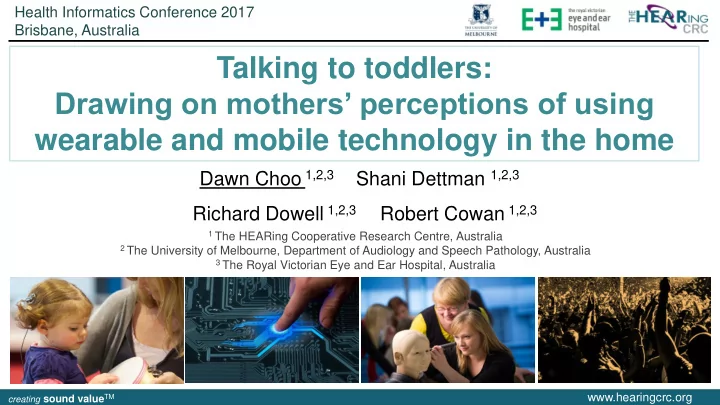
Health Informatics Conference 2017 Brisbane, Australia Talking to toddlers: Drawing on mothers perceptions of using wearable and mobile technology in the home Dawn Choo 1,2,3 Shani Dettman 1,2,3 Richard Dowell 1,2,3 Robert Cowan 1,2,3 1 The


slide-1
SLIDE 1

creating sound valueTM

Talking to toddlers: Drawing on mothers’ perceptions of using wearable and mobile technology in the home

1 The HEARing Cooperative Research Centre, Australia 2 The University of Melbourne, Department of Audiology and Speech Pathology, Australia 3 The Royal Victorian Eye and Ear Hospital, Australia

creating sound valueTM

www.hearingcrc.org

Health Informatics Conference 2017 Brisbane, Australia

Dawn Choo 1,2,3 Shani Dettman 1,2,3 Richard Dowell 1,2,3 Robert Cowan 1,2,3

slide-2
SLIDE 2

creating sound valueTM

1% of child’s waking hours spent in therapy Sensitive period for language learning Intervention(s) which extend into child’s everyday life?

Language and Early Intervention

slide-3
SLIDE 3

creating sound valueTM

Talking to Toddlers in Everyday Environments

  • Adult-Child Turn Taking Interactions (Zimmerman et al., 2009)
  • Amount of Talk by Parents (VanDam et al., 2012)

? ?

VanDam, M., Ambrose, S. E., & Moeller, M. P. (2012). Quantity of parental language in the home environments of hard-of-hearing 2 year-olds. Journal of Deaf Studies and Deaf Education, 17(4), 402-420. Zimmerman, F. J., Gilkerson, J., Richards, J. A., Christakis, D. A., Xu, D., Gray, S., & Yapanel, U. (2009). Teaching by listening: The importance of adult-child conversations to language development. Pediatrics, 124(1), 342-349.

slide-4
SLIDE 4

creating sound valueTM

  • Quantified information about child’s sound and language environment
  • Audio recorder and language processor
  • Speech recognition software
  • Feedback provided to parents
  • 1. Language ENvironment Analysis (LENA)

(Gilkerson & Richards, 2008)

Going Digital

  • 2. Mobile App
  • Daily reminder for parents
  • Short suggested activities
  • Developmentally appropriate

Gilkerson, J., & Richards, J. A. (2008). The LENA Foundation natural language study. Boulder, CO: LENA Foundation.

slide-5
SLIDE 5

creating sound valueTM

Study Aims

  • Trial LENA technology and the mobile app with mother-child

dyads in the Australian context

  • Explore factors perceived to impact on mothers’ use of LENA

technology and the mobile app in the trial.

slide-6
SLIDE 6

creating sound valueTM

  • Prospective 8-week trial with mother-child dyads

Methods

  • Weekly LENA recordings of up to 16 hours
  • 3 Conditions:
  • a. LENA Recording Only
  • b. LENA Feedback Provided to Parents
  • c. LENA Feedback + Use of Mobile App
  • Pragmatic (mixed-methods) approach
  • Mothers completed questionnaires
  • Family demographic information
  • eHealth Literacy Scale (eHEALS; Norman & Skinner, 2006)
  • Thematic analysis of written comments on mother’s trial experience with the

technologies

Norman, C. D., & Skinner, H. A. (2006). eHEALS: the eHealth literacy scale. Journal of medical Internet research, 8(4), e27.

slide-7
SLIDE 7

creating sound valueTM

Participant Demographics

5 Mother-Child Dyads

  • Mothers were smartphone users
  • Mean age= 39 years
  • Typically developing children
  • Mean age=15 months
  • English was the main language spoken at home
  • Both parents were living at home
  • Lived in areas of greater socio-economic relative advantage (ABS, 2011)
  • Mean SEIFA decile=7.6

Diploma, 1 Bachelor's Degree, 2 Postgraduate Degree, 2

Maternal Education

Full-time, 2 Self employed, 1 Part time, 1 Maternity leave, 1

Employment status

slide-8
SLIDE 8

creating sound valueTM

eHEALS: The eHealth Literacy Scale (Norman & Skinner, 2006)

1 2 3 4 5 I know how to find helpful resources on the internet I know how to use the internet to answer my health questions I know what health resources are available on the internet I know where to find helpful health resources on the internet I know how to use the health information I find on the internet to help me I have the skills I need to evaluate the health resources I find on the internet I can tell high quality from low quality health resources on the internet I feel confident in using information from the Internet to make health decisions

Mothers’ (n=4) ratings for 8 items

Mother 1 Mother 2 Mother 3 Mother 4

(1= Strongly Disagree 5= Strongly Agree)

Mother Average Score of 8 eHEALS items 1 4.13 2 3.50 3 4.00 4 4.38 Mothers’ (n=4) Overall Average eHEALs Score: 4

slide-9
SLIDE 9

creating sound valueTM

Simplicity Effort Ergonomics Visual value Engagement Feature fatigue

Perceived Usefulness Perceived Effect of Receiving Feedback Post-Trial Findings Based on Mothers’ Perceptions

slide-10
SLIDE 10

creating sound valueTM

Would Participants use the LENA system or Mobile App again?

YES Mobile App only 1 20% NO 1 20% YES Both LENA & App 3 60%

slide-11
SLIDE 11

creating sound valueTM

Summary of Findings

  • It was feasible to use the LENA system and a mobile app with mother-child dyad in

the home

  • The importance of understanding the target user’s experience
  • What do users value? (e.g. receiving feedback on language behaviours)

Considerations:  demographic profile(s)  self-perceived levels of ehealth literacy

slide-12
SLIDE 12

creating sound valueTM

Now that we have described the profile of the participants and their experience…

Can we change language behaviours?

Venkatesh, V., Thong, J. Y., & Xu, X. (2012). Consumer acceptance and use of information technology: extending the unified theory of acceptance and use of

  • technology. MIS Quarterly, 36(1), 157-178.

Fogg, B. J. (2009, April). A behavior model for persuasive design. In Proceedings of the 4th international Conference on Persuasive Technology (p. 40).

  • Further analysis exploring measurable changes in language behaviours
  • Ongoing 12-Week Trial
  • Mothers and their children with significant hearing loss

Recruiting Clinicians working in Early Intervention

  • Online survey on the use of technology and the mobile app

Next Steps

slide-13
SLIDE 13

creating sound valueTM

Acknowledgements

This research was financially supported by the HEARing CRC established and supported under the Australian Government’s Cooperative Research Centres Programme.

We gratefully acknowledge our collaborative partners and all the families in Melbourne who have volunteered their time to participate in the pilot study.

@Dawn_Choo dawn.choo@unimelb.edu.au

slide-14
SLIDE 14

creating sound valueTM

Members and Acknowledgements

The CRC Programme supports industry led end-user driven research collaborations to address the major challenges facing Australia.