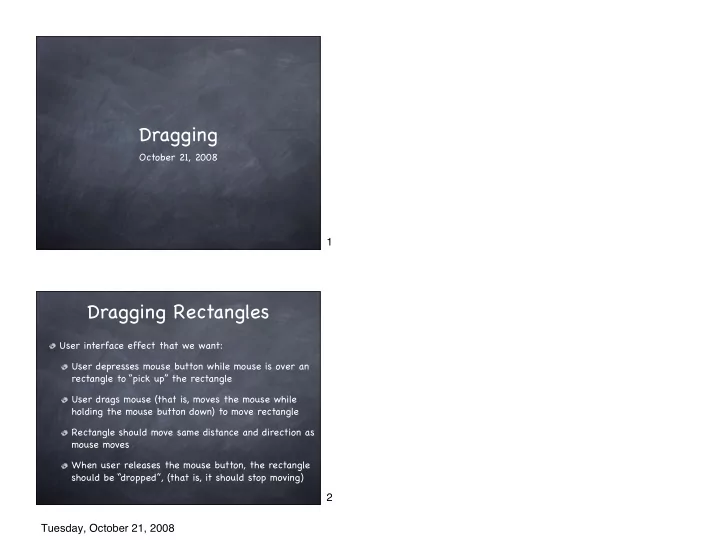
Dragging October 21, 2008 1 Dragging Rectangles User interface - - PowerPoint PPT Presentation

dragging
SMART_READER_LITE
LIVE PREVIEW

Dragging October 21, 2008 1 Dragging Rectangles User interface - - PowerPoint PPT Presentation

Dragging October 21, 2008 1 Dragging Rectangles User interface effect that we want: User depresses mouse button while mouse is over an rectangle to pick up the rectangle User drags mouse (that is, moves the mouse while holding the


slide-1
SLIDE 1

Dragging

October 21, 2008

Dragging Rectangles

User interface effect that we want: User depresses mouse button while mouse is over an rectangle to “pick up” the rectangle User drags mouse (that is, moves the mouse while holding the mouse button down) to move rectangle Rectangle should move same distance and direction as mouse moves When user releases the mouse button, the rectangle should be “dropped”, (that is, it should stop moving)

1 2 Tuesday, October 21, 2008

slide-2
SLIDE 2

Dragging Rectangles

public class DragARectangle { public void onMousePress (Location point) { / / if mouse is over the rectangle, “pick up” the rectangle } public void onMouseDrag (Location point) { / / if the user picked up the rectangle, move it the same / / amount and direction as the mouse moved } public void onMouseRelease (Location point) { / / “drop” the rectangle } }

User depresses mouse button while mouse is over an rectangle to “pick up” the rectangle private boolean rectGrabbed = false; public void onMousePress (Location point) { if (rect.contains (point)) { rectGrabbed = true; } }

Dragging Rectangles

Step 1: Picking up the Rectangle

3 4 Tuesday, October 21, 2008

slide-3
SLIDE 3

Instance variable is used to “remember” a value between methods private boolean rectGrabbed = false; public void onMousePress (Location point) { if (rect.contains (point)) { rectGrabbed = true; } }

Instance Variables

Instance variable Declaration Assignment statement

Instance variables vs. Local variables

private boolean rectGrabbed = false; public void onMousePress (Location point) { if (rect.contains (point)) { rectGrabbed = true; } } public House (DrawingCanvas mysteryCanvas) { FilledRect wall = new FilledRect (...); wall.setColor (WALL_COLOR); ... }

Instance variable Local variable 5 6 Tuesday, October 21, 2008

slide-4
SLIDE 4

Like in Alice, “if statements” allow us to execute code only when some condition is true. private boolean rectGrabbed = false; public void onMousePress (Location point) { if (rect.contains (point)) { rectGrabbed = true; } }

If Statements

contains method returns true if the shape (called “rect” here) contains a particular Location (called “point” here) private boolean rectGrabbed = false; public void onMousePress (Location point) { if (rect.contains (point)) { rectGrabbed = true; } }

contains Method

7 8 Tuesday, October 21, 2008

slide-5
SLIDE 5

User drags mouse (that is, moves the mouse while holding the mouse button down) to move rectangle Rectangle should move same distance and direction as mouse moves public void onMouseDrag (Location point) { / / Determine how far the mouse moved since / / mouse button depressed or since last call to / / onMouseDrag. / / Move the rectangle that distance }

Dragging Rectangles

Step 2: Moving the Rectangle

private Location lastPoint; / / Last mouse location public void onMousePress (Location point) { if (rect.contains (point)) { rectGrabbed = true; lastPoint = point; } } public void onMouseDrag (Location point) { if (rectGrabbed) { / / Determine how far the mouse moved since mouse button / / depressed or since last call to onMouseDrag. / / Move the rectangle that distance lastPoint = point; } }

Dragging Rectangles Step 2a: Remembering last mouse location

9 10 Tuesday, October 21, 2008

slide-6
SLIDE 6

public void onMouseDrag (Location point) { if (rectGrabbed) { / / Determine how far the mouse moved since mouse button / / depressed or since last call to onMouseDrag. double dx = point.getX() - lastPoint.getX(); double dy = point.getY() - lastPoint.getY(); / / Move the rectangle that distance / / Remember where this drag ended. lastPoint = point; } }

Dragging Rectangles Step 2b: Calculating distance to move

Location

public void onMouseDrag (Location point) { if (rectGrabbed) { / / Determine how far the mouse moved since mouse button / / depressed or since last call to onMouseDrag. double dx = point.getX() - lastPoint.getX(); double dy = point.getY() - lastPoint.getY(); ... } } Location represents an x, y coordinate pair getX() method returns the value of the x coordinate (as a double) getY() method returns the value of the y coordinate

11 12 Tuesday, October 21, 2008

slide-7
SLIDE 7

Local Variables

public void onMouseDrag (Location point) { if (rectGrabbed) { / / Determine how far the mouse moved since mouse button / / depressed or since last call to onMouseDrag. double dx = point.getX() - lastPoint.getX(); double dy = point.getY() - lastPoint.getY(); ... } } Local variables are used to remember values during a single method public void onMouseDrag (Location point) { if (rectGrabbed) { / / Determine how far the mouse moved since mouse button / / depressed or since last call to onMouseDrag. double dx = point.getX() - lastPoint.getX(); double dy = point.getY() - lastPoint.getY(); / / Move the rectangle that distance rect.move (dx, dy); / / Remember where this drag ended. lastPoint = point; } }

Dragging Rectangles Step 2c: Moving the Rectangle

13 14 Tuesday, October 21, 2008

slide-8
SLIDE 8

public void onMouseDrag (Location point) { if (rectGrabbed) { / / Determine how far the mouse moved since mouse button / / depressed or since last call to onMouseDrag. double dx = point.getX() - lastPoint.getX(); double dy = point.getY() - lastPoint.getY(); / / Move the rectangle that distance rect.move (dx, dy); / / Remember where this drag ended. lastPoint = point; } }

move Method

move method moves a shape (called “rect” here) some distance horizontally (called “dx” here) and some distance vertically (called “dy” here) from its current location

When user releases the mouse button, the rectangle should be “dropped”, (that is, it should stop moving) public void onMouseRelease (Location point) { / / Drop the rectangle }

Dragging Rectangles

Step 3: Dropping the Rectangle

15 16 Tuesday, October 21, 2008

slide-9
SLIDE 9

When user releases the mouse button, the rectangle should be “dropped”, (that is, it should stop moving) public void onMouseRelease (Location point) { / / Drop the rectangle rectGrabbed = false; }

Dragging Rectangles

Step 3: Dropping the Rectangle

private boolean rectGrabbed = false; private Location lastPoint; / / Last mouse location public void onMousePress (Location point) { if (rect.contains (point)) { rectGrabbed = true; lastPoint = point; } } public void onMouseDrag (Location point) { if (rectGrabbed) { / / How far did mouse move? double dx = point.getX() - lastPoint.getX(); double dy = point.getY() - lastPoint.getY(); / / Move the rectangle that distance rect.move (dx, dy); lastPoint = point; } } public void onMouseRelease (Location point) { / / Drop the rectangle rectGrabbed = false; }

Picking up / dropping 17 18 Tuesday, October 21, 2008

slide-10
SLIDE 10

private boolean rectGrabbed = false; private Location lastPoint; / / Last mouse location public void onMousePress (Location point) { if (rect.contains (point)) { rectGrabbed = true; lastPoint = point; } } public void onMouseDrag (Location point) { if (rectGrabbed) { / / How far did mouse move? double dx = point.getX() - lastPoint.getX(); double dy = point.getY() - lastPoint.getY(); / / Move the rectangle that distance rect.move (dx, dy); lastPoint = point; } } public void onMouseRelease (Location point) { / / Drop the rectangle rectGrabbed = false; }

Moving

Summary of Methods

Defined for FilledRect, FilledOval, FramedRect, FramedOval public boolean contains (Location point) public void move (double dx, double dy) Sample code: FilledRect shape; Location loc; if (shape.contains (loc)) { shape.move (5, 10); }

19 20 Tuesday, October 21, 2008

slide-11
SLIDE 11

Summary of Methods

Defined for Location public double getX () public double getY () Sample code: Location loc; double x = loc.getX(); double y = loc.getY();

21 Tuesday, October 21, 2008