Draft EE 8235: Lecture 9 1 Lecture 9: Spectral theory for compact - - PowerPoint PPT Presentation

draft
SMART_READER_LITE
LIVE PREVIEW

Draft EE 8235: Lecture 9 1 Lecture 9: Spectral theory for compact - - PowerPoint PPT Presentation

Draft EE 8235: Lecture 9 1 Lecture 9: Spectral theory for compact normal operators Resolvent and spectrum of an operator Compact operators Direct extension of matrices Normal operators Commute with its adjoint Compact


slide-1
SLIDE 1

Draft

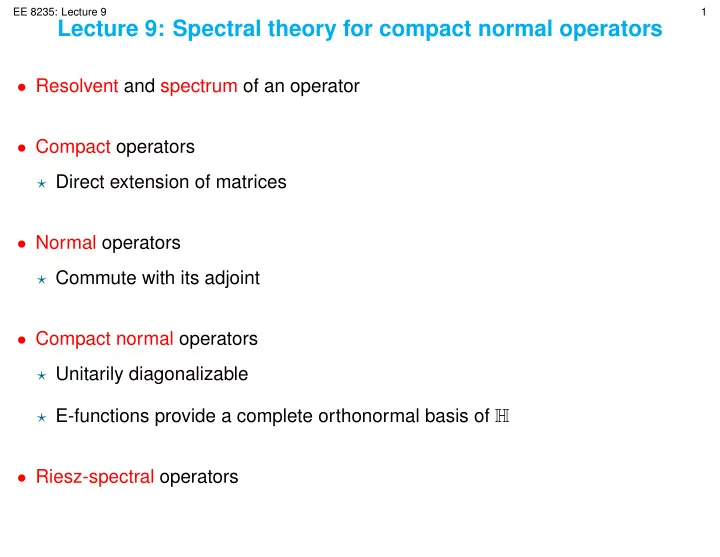
EE 8235: Lecture 9 1 Lecture 9: Spectral theory for compact normal operators
  • Resolvent and spectrum of an operator
  • Compact operators
⋆ Direct extension of matrices
  • Normal operators
⋆ Commute with its adjoint
  • Compact normal operators
⋆ Unitarily diagonalizable ⋆ E-functions provide a complete orthonormal basis of H
  • Riesz-spectral operators
slide-2
SLIDE 2

Draft

EE 8235: Lecture 9 2 Resolvent
  • Want to study equations of the form
(λI − A) ψ = u, {A : H ⊃ D(A) − → H; λ ∈ C; ψ, u ∈ H} Determine conditions under which Aλ = (λI − A) is boundedly invertible Relevant conditions:            (1) Rλ = (λI − A)−1 exists (2) Rλ = (λI − A)−1 is bounded (3) The domain of Rλ = (λI − A)−1 is dense in H
  • The resolvent set of A:
ρ(A) := {λ ∈ C; (1), (2), (3) hold}
  • The spectrum of A:
σ(A) := C \ ρ(A)
slide-3
SLIDE 3

Draft

EE 8235: Lecture 9 3 Spectrum (1) Rλ = (λI − A)−1 exists (2) Rλ = (λI − A)−1 is bounded (3) The domain of Rλ = (λI − A)−1 is dense in H
  • σ(A) can be decomposed into
σ(A) = σp(A) ∪ σc(A) ∪ σr(A) ⋆ Point spectrum σp(A) := {λ ∈ C; (λI − A) is not one-to-one} ⋆ Continuous spectrum σc(A) := {λ ∈ C; (1) and (3) hold, but (2) doesn’t} ⋆ Residual spectrum σr(A) := {λ ∈ C; (1) holds but (3) doesn’t}
slide-4
SLIDE 4

Draft

EE 8235: Lecture 9 4 Examples
  • Point spectrum
{λ ∈ σp(A): e-values; v ∈ N(λI − A): e-functions}
  • Continuous spectrum
multiplication operator on L2[a, b]: [Ma f(·)] (x) = a(x) f(x)
  • Residual spectrum
right-shift operator on ℓ2(N): [Sr f(·)] (n) = fn−1
slide-5
SLIDE 5

Draft

EE 8235: Lecture 9 5 Spectral decomposition of compact normal operators
  • compact, normal operator A on H admits a dyadic decomposition
[A vn] (x) = λn vn(x) vn, vm = δnm
  • ⇒ [A f] (x) =
  • n = 1
λn vn(x) vn, f for all f ∈ H A: H ⊃ D(A) − → H, with compact and normal A−1  
  • A−1 vn
  • (x) = λ−1
n vn(x) vn, vm = δnm
  • A−1f
  • (x) =
  • n = 1
λ−1 n vn(x) vn, f , f ∈ H [A f] (x) =
  • n = 1
λn vn(x) vn, f , f ∈ D(A) D(A) =
  • f ∈ H;
  • n = 1
|λn|2 |vn, f|2 < ∞
slide-6
SLIDE 6

Draft

EE 8235: Lecture 9 6
  • compact, normal operator A on H
[A vn] (x) = λn vn(x), λn = 0 vn, vm = δnm
      u = uR(A) + uN (A) =
  • n = 1
vn vn, u + uN (A)
  • Solutions to
(λI − A) ψ = u, λ = 0
  • 1. λ − not an eigenvalue of A ⇒ unique solution
ψ =
  • n = 1
vn, u λ − λn vn + 1 λ uN (A) 2. λ − eigenvalue of A J − index set s.t. λj = λ
  • ⇒ there is a solution iff vj, u = 0 for all j ∈ J
ψ =
  • j ∈ J
cj vj +
  • j ∈ N\J
vj, u λ − λj vj + 1 λ uN (A)
slide-7
SLIDE 7

Draft

EE 8235: Lecture 9 7 Singular Value Decomposition of compact operators
  • compact operator A: H1 −
→ H2 admits a Schmidt Decomposition (i.e., an SVD) [A f] (x) =
  • n = 1
σn un(x) vn, f
  • A A† un
  • (x)
= σ2 n un(x) ⇒ {un}n ∈ N orthonormal basis of H2
  • A† A vn
  • (x)
= σ2 n vn(x) ⇒ {vn}n ∈ N orthonormal basis of H1
  • matrix M: Cn −
→ Cm M = U Σ V ∗ = r
  • i = 1
σi ui v∗ i ⇒ M f = r
  • i = 1
σi ui vi, f M M ∗ ui = σ2 i ui M ∗ M vi = σ2 i vi
slide-8
SLIDE 8

Draft

EE 8235: Lecture 9 8 Riesz basis
  • {vn}n ∈ N: Riesz basis of H if
⋆ span {vn}n ∈ N = H ⋆ there are m, M > 0 such that for any N ∈ N and any {αn}, n = 1, . . . , N m N
  • n = 1
|αn|2 ≤ N
  • n = 1
αn vn2 ≤ M N
  • n = 1
|αn|2
slide-9
SLIDE 9

Draft

EE 8235: Lecture 9 9
  • closed A : H ⊃ D(A) −
→ H [A vn] (x) = λn vn(x) {λn}n ∈ N simple e-values {vn}n ∈ N Riesz basis of H ⋆
  • A† wn
  • (x) = ¯
λn wn(x) ⇒ {wn}n ∈ N can be scaled s.t. wn, vm = δnm ⋆ every f ∈ H can be represented uniquely by f(x) =
  • n = 1
vn(x) wn, f m
  • n = 1
| wn, f |2 ≤ f2 ≤ M
  • n = 1
| wn, f |2
  • r by
f(x) =
  • n = 1
wn(x) vn, f 1 M
  • n = 1
| vn, f |2 ≤ f2 ≤ 1 m
  • n = 1
| vn, f |2
slide-10
SLIDE 10

Draft

EE 8235: Lecture 9 10 Riesz-spectral operator
  • closed A : H ⊃ D(A) −
→ H is Riesz-spectral operator if [A vn] (x) = λn vn(x)          {λn}n ∈ N simple e-values {vn}n ∈ N Riesz basis of H {λn}n ∈ N totally disconnected A − Riesz-spectral operator with e-pair {(λn, vn)}n ∈ N {wn}n ∈ N − e-functions of A† s.t. wn, vm = δnm  
                  σ(A) = {λn}n ∈ N, ρ(A) = {λn ∈ C; infn ∈ N |λ − λn| > 0} λ ∈ ρ(A) ⇒
  • (λI − A)−1 f
  • (x) =
  • n = 1
1 λ − λn vn(x) wn, f [A f] (x) =
  • n = 1
λn vn(x) wn, f , D(A) =
  • f ∈ H;
  • n = 1
|λn|2 |wn, f|2 < ∞