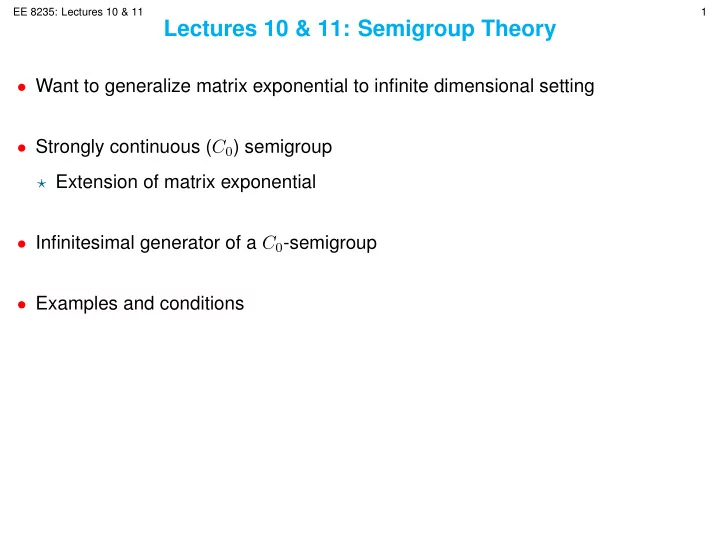
Draft EE 8235: Lectures 10 & 11 1 Lectures 10 & 11: - - PowerPoint PPT Presentation

draft
SMART_READER_LITE
LIVE PREVIEW

Draft EE 8235: Lectures 10 & 11 1 Lectures 10 & 11: - - PowerPoint PPT Presentation

Draft EE 8235: Lectures 10 & 11 1 Lectures 10 & 11: Semigroup Theory Want to generalize matrix exponential to infinite dimensional setting Strongly continuous ( C 0 ) semigroup Extension of matrix exponential Infinitesimal


slide-1
SLIDE 1

Draft

EE 8235: Lectures 10 & 11 1 Lectures 10 & 11: Semigroup Theory
  • Want to generalize matrix exponential to infinite dimensional setting
  • Strongly continuous (C0) semigroup
⋆ Extension of matrix exponential
  • Infinitesimal generator of a C0-semigroup
  • Examples and conditions
slide-2
SLIDE 2

Draft

EE 8235: Lectures 10 & 11 2 Solution to abstract evolution equation
  • Abstract evolution equation on a Hilbert space H
d ψ(t) d t = A ψ(t), ψ(0) ∈ H Dilemma: how to define ”eA t”? Finite dimensional case: M ∈ Cn×n ⇒ eM t =
  • k = 1
(M t)k k!
slide-3
SLIDE 3

Draft

EE 8235: Lectures 10 & 11 3 d ψ(t) d t = A ψ(t), ψ(0) ∈ H
  • Assume:
⋆ For each ψ(0) ∈ H, there is a unique solution ψ(t) ⋆ There is a well defined mapping T(t): H − → H ψ(t) = T(t) ψ(0) T(t) - time-parameterized family of linear operators on H ⋆ Solution varies continuously with initial state T(t): a bounded operator (on H) T(t) = sup f ∈ H T(t) f f < ∞
slide-4
SLIDE 4

Draft

EE 8235: Lectures 10 & 11 4 Strongly continuous semigroups
  • Properties of T(t):
ψ(t) = T(t) ψ(0)
  • Initial condition:
T(0) = I
  • Semigroup property:
T(t1 + t2) = T(t2) T(t1) = T(t1) T(t2), for all t1, t2 ≥ 0 t1 2 t t1+ 2 t t1 T( ) 2 t t1+ T( ) T( )
  • Strong continuity:
lim t → 0+ T(t) ψ(0) − ψ(0) = 0, for all ψ(0) ∈ H a weaker condition than: lim t → 0+ T(t) − I = lim t → 0+ sup f ∈ H (T(t) − I) f f = 0
slide-5
SLIDE 5

Draft

EE 8235: Lectures 10 & 11 5 Examples
  • Linear transport equation
φt(x, t) = ±c φx(x, t) φ(x, 0) = f(x), x ∈ R
     d ψ(t) d t = ±c d d x ψ(t) ψ(0) = f ∈ L2(−∞, ∞)
  • Consider:
φ(x, t) = [T(t) f] (x) = f(x ± ct) In class: T(t) defines a C0-semigroup on L2(−∞, ∞)
  • The infinitesimal generator of a C0-semigroup T(t) on H
A f = lim t → 0+ T(t) f − f t D(A) =
  • f ∈ H;
lim t → 0+ T(t) f − f t exists
slide-6
SLIDE 6

Draft

EE 8235: Lectures 10 & 11 6
  • A couple of additional notes
⋆ Change of coordinates: φt(x, t) = ±c φx(x, t) φ(x, 0) = f(x), x ∈ R
  • z = x ± ct
− − − − − − →
  • φt(z, t)
= φ(z, 0) = f(z), z ∈ R ⋆ Reaction-convection equation: φt(x, t) = ±c φx(x, t) + a φ(x, t) φ(x, 0) = f(x), x ∈ R
  • C0-semigroup:
φ(x, t) = [T(t) f] (x) = ea t f(x ± ct) a > 0 exponentially growing traveling wave a < 0 exponentially decaying traveling wave
slide-7
SLIDE 7

Draft

EE 8235: Lectures 10 & 11 7 Infinite number of decoupled scalar states
  • Abstract evolution equation on ℓ2 (N)
d d t    ψ1(t) ψ2(t) . . .    =    a1 a2 ...       ψ1(t) ψ2(t) . . .    ⇔ d ψ(t) d t = A ψ(t) Solution ψ(t) =    ψ1(t) ψ2(t) . . .    =    ea1 t ea2 t ...       ψ1(0) ψ2(0) . . .    = T(t) ψ(0)
  • In class: conditions for well-posedness on ℓ2 (N)
slide-8
SLIDE 8

Draft

EE 8235: Lectures 10 & 11 8
  • Half-plane condition:
sup n Re (an) < M < ∞ Im Re x x x x x x x x x x x x x M (a) Im Re x x x x x x x x x x x x x x x x x x x x x x x (b) Same condition for: T(t) f =
  • n = 1
ean t vn vn, f
slide-9
SLIDE 9

Draft

EE 8235: Lectures 10 & 11 9 Continuum of decoupled scalar states ˙ ψ(κ, t) = a(κ) ψ(κ, t), κ ∈ R Solution ψ(κ, t) = [T(t) ψ(·, 0)] (κ) = ea(κ) t ψ(κ, 0)
  • Homework: conditions for well-posedness on L2 (−∞, ∞)
Half-plane condition: sup κ ∈ R Re (a(κ)) < M < ∞
slide-10
SLIDE 10

Draft

EE 8235: Lectures 10 & 11 10 Hille-Yosida Theorem closed, densely defined operator A on H: A - infinitesimal generator of a C0-semigroup with T(t) ≤ M eω t
  • every real λ > ω is in ρ(A) and (λI − A)−n ≤
M (λ − ω)n for all n ≥ 1
  • Difficult to check
  • Important consequence: a method for computing T(t)
T(t) = lim N → ∞
  • I −
t N A −N Implicit Euler: d ψ(t) d t = A ψ(t) ⇒ ψ(t + ∆t) − ψ(t) ∆t = A ψ(t + ∆t)
slide-11
SLIDE 11

Draft

EE 8235: Lectures 10 & 11 11 Lumer-Phillips Theorem closed, densely defined operator A on H: Re (ψ, A ψ) ≤ ω ψ2 for all ψ ∈ D(A) Re
  • ψ, A† ψ
  • ≤ ω ψ2
for all ψ ∈ D(A†) ⇓ A - infinitesimal generator of a C0-semigroup with T(t) ≤ eω t
  • Examples:
         [A f] (x) = df dx
  • (x)
D(A) =
  • f ∈ L2 [−1, 1], df
dx ∈ L2 [−1, 1], f(1) = 0
        [A f] (x) = d2f dx2
  • (x)
D(A) =
  • f ∈ L2 [−1, 1], d2f
dx2 ∈ L2 [−1, 1], f(±1) = 0