SLIDE 1
DRAFT EXECUTIVE SUMMARY AND HIGHLIGHTS REPORT
ILO-EU STRENGTHEN (Trade and Employment) Project Inception Workshop Group Discussions from 6 to 7 October 2016, Century Park Hotel, Manila
Overview The International Labour Organization (ILO) Country Office for the Philippines, with the support of the European Union (EU), launched and conducted the inception workshop of its Project on Strengthening the Impact of Trade and Employment in the Philippines (STRENGTHEN), from 6 to 7 October 2016, at the Century Park Hotel, Manila, which was attended by representatives and officials from government, labor, business, the academe and the civil society, among others. Day 1 Presentations and Breakout Sessions
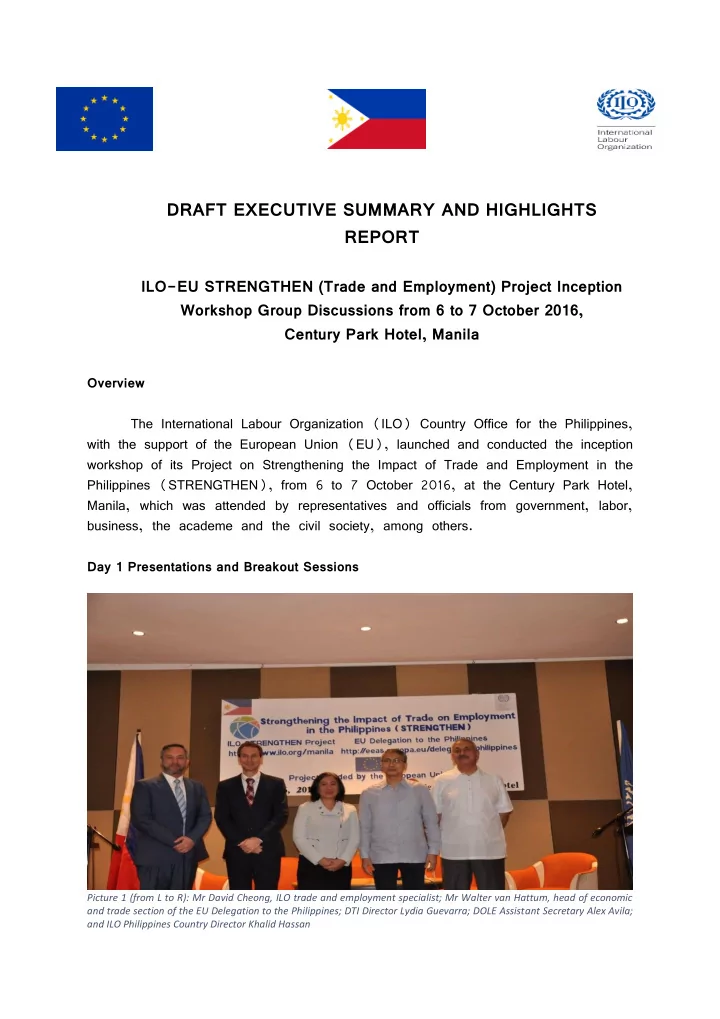
Picture 1 (from L to R): Mr David Cheong, ILO trade and employment specialist; Mr Walter van Hattum, head of economic and trade section of the EU Delegation to the Philippines; DTI Director Lydia Guevarra; DOLE Assistant Secretary Alex Avila; and ILO Philippines Country Director Khalid Hassan
SLIDE 2 The theme for Day 1 centered on trade, employment, decent work and national
- development. The two-day workshop formally began with a keynote message read
by Assistant Secretary Alex A. Avila in behalf of the Honourable Silvestre H. Bello III, Secretary of the Department of Labor and Employment (DOLE). Meanwhile, Director Lydia R. Guevarra of the Resource Generation and Management Service (RGMS) delivered her message of support for the STRENGTHEN Project in behalf of the Department of Trade and Industry (DTI). On the one hand, the European Union (EU) Delegation to the Philippines’ message of support was delivered by Mr Walter van Hattum, head of the EU’s economic and trade section. On the other hand, Mr Khalid Hassan, ILO Philippines country director, welcomed all the participants of the STRENGTHEN Project inception workshop. After the opening ceremonies, the plenary morning sessions followed
- immediately. Presentation 1 on the growth prospects and outlook of the Philippine
economy was delivered by Director Brenda Joyce R. Mendoza of the National Economic and Development Authority (NEDA)-Trade, Services and Industry Staff (TSIS). This was followed by Presentation 2 on decent work, trade and employment policy in the Philippines, which was given by Director Adeline T. De Castro of the DOLE Planning Service, who provided updates on Secretary Bello’s 8-point labor and employment agenda. On the other hand, Presentation 3 on Philippine exports growth and the integration of Filipino micro, small and medium-sized enterprises (MSMEs) into the global value chains was presented by Director Senen M. Perlada of the DTI-Export Marketing Bureau (EMB), who discussed new opportunities, innovations and strategies as to how Philippine exports and MSME firms can become more productive and competitive. As a follow through, during the panel discussion, Assistant Director Agnes Perpetua Legaspi also gave a presentation that further elaborated on the preceding presentation of Director Perlada on Philippine exports vis-à-vis its other competitors in the region such as Vietnam. Among those who sat during the panel discussions were Deputy Executive Director Emmarita Z. Mijares of the Export Development Council (EDC) and Mr Alan Tanjusay of the Associated Labor Unions (ALU), representing the labor sector
SLIDE 3
and workers’ groups that were present during Day 1. The panel discussion was moderated by Dr Rene E. Ofreneo.
Picture 2 (from L to R): Dr Rene Ofreneo, moderating the Day 1 panel discussion, with DTI-EMB Assistant Director Agnes Legaspi, EDC Deputy Executive Director Emmarita Z. Mijares, and Mr Alan Tanjusay of the Associated Labor Unions, representing the labor groups present during the workshop.
After the panel discussion and open forum, Mr David Cheong then proceeded to give the global updates on the STRENGTHEN Project, which is also being implemented in five (5) other countries, aside from the Philippines, such as Myanmar, Guatemala, Benin, Ghana and Morocco. In the afternoon, Dr Rene E. Ofreneo, the workshop facilitator, supervised the discussions and gave some guidelines for the breakout sessions. The participants were divided into two groups: Group A and Group B. Group A was tasked to identify knowledge gaps concerning trade and employment while Group B was tasked to identify the export sector and value chain that could be enrolled in the STRENGTHEN Project’s Trade and Value Chains in Employment-Rich Activities (TRAVERA) programme. Group A was co-chaired by OIC-Executive Director Maria Celeste J. Valderrama of the DOLE-Institute for Labor Studies (ILS) and Executive Director Nestor Palabyab of the DTI-Philippine Trade Training Center (PTTC) while Group B was co-chaired by Ms Rafaelita Castro of the DTI-EMB, and Dr Rene E. Ofreneo.
SLIDE 4
Day 2 Presentations and Breakout Sessions For Day 2, the theme of the workshop now focused on human resource and skills development in the export sector, service exports and movement of natural persons. A recap of what had been discussed the previous day as summarized by Dr Rene E. Ofreneo was presented briefly by Mr Bryan M. Balco, the STRENGTHEN national project coordinator. Director Evariste Cagatan of the DTI-Board of Investments (BOI) gave the first presentation for Day 2 on industry-based human resource (HR) skills and competencies that are needed to boost the competitiveness of the export sector. Director Cagatan also presented the BOI’s industry roadmaps and the DOLE’s HR roadmaps, which were a response to the BOI industrial blueprints. Meanwhile, Executive Director Marissa R. Legaspi of the Technical Education and Skills Development Authority (TESDA)-Planning Office (PO) then followed and gave a presentation on TESDA’s efforts to develop industry-based HR skills and competencies for export competitiveness, especially the certification of skills and conduct of training activities that can support and boost export development. Following the first set of presentations on export skills and competencies, a panel discussion and open forum followed. Sitting with Director Cagatan and Executive Director Legaspi were Mr Oliver Mondigo of the Federation of Free Workers (FFW), representing all the labor groups present during Day 2, and Atty Ranulfo Payos of the Employers Confederation of the Philippines (ECOP). Afterwards, the second set of presentations followed through. Director Levinson Alcantara of the Philippine Overseas Employment Administration (POEA) gave a presentation on the overseas employment situation of the Philippines, not only in terms of deployment and recruitment but also in terms of the bilateral labor agreements that the Philippines has entered into. Director Alcantara’s presentation was complemented by Mr Jose Sandoval of the DOLE-Bureau of Local Employment’s (BLE) presentation on the movement of natural persons, which also tackled trade in services agreements, bilateral labor agreements and the entry of foreign professionals in the Philippines that could also mean bringing new sets of knowledge, information-sharing and skills into the country. The last presentation for Day 2 was given by Mr Lord Louis P. Valera of the
SLIDE 5
Professional Regulation Commission (PRC), who discussed the regulation of professional workers in the country. In the afternoon, the participants were divided into two groups again: Group C and Group D. Most of the participants were asked to join Group C, which will tackle the export sector and skills that would be enrolled in the STRENGTHEN Project’s Skills for Trade and Economic Diversification (STED) programme. Group C was facilitated by Mr Noel Cuevas of TESDA. On the other hand, Group D, whose task was to discuss the creation of the Policy Working Group (PWG) for trade and employment, was more compact and smaller, as only select senior representatives and director-level officials from government, labor and business were invited to join the discussion group. Members of Group D consisted of the following officials and senior representatives from the DOLE (represented by the Institute for Labor Studies and Bureau of Local Employment), DTI (represented by Resource Generation and Management Service and Philippine Trade Training Center), NEDA (represented by the Trade, Services and Industry Staff), Federation of Free Workers (FFW), Trade Union Congress of the Philippines (TUCP), Associated Labor Unions (ALU), Employers Confederation of the Philippines (ECOP), Public Service Labor Independent Confederation (PSLink), and the Philippine Institute of Development Studies (PIDS).
SLIDE 6 Summary of the Group Discussions
Picture 3: DOLE-Institute for Labor Studies (ILS) Executive Director Ma. Celeste J. Valderrama (standing) and DTI-Philippine Trade Training Center (PTTC) Executive Director Nestor Palabyab (to her right) facilitate the discussions for Group A, which was tasked to identify knowledge gaps concerning trade and employment during Day 1 of the STRENGTHEN inception workshop.
The following are some of the highlights of the inputs and recommendations that we were able to consolidate initially during the inception workshop: Group A on knowledge gaps concerning trade and employment:
- It was suggested by Group A that the country studies and
reports under Component A of the STRENGTHEN Project should have first a situational analysis of the Philippines in relation to trade and employment (e.g. issues on competitiveness, decent work and employment, labor policies, trade regulatory environment, policy gaps on trade, employment and investments, skills-jobs mismatch vis-à-vis export industry needs, gender issues in trade, logistics issues in the country like infrastructure and transportation, the need to prepare for future employment needs and demands, and not just the present, and working conditions in SMEs, etc).
- Group A also raised the need to study further the free trade
agreements (FTAs) that the Philippines have already signed and will enter into in the future, especially how FTAs will affect national policies on trade and investment, labor standards, and employment outcomes. It also underscored the need to ensure
SLIDE 7 that the Philippines become more strategic and prepared before entering into new FTAs with other economies.
- While it tackled issues in the IT-BPO, biominerals, services and
human development sectors, the group said that it would also be good and strategic if the project would specifically take a look and study the effect of trade on rural employment, especially the agribusiness sector. In particular, it said that it would be good if food processing would be given focus, because it will show not only the forward and backward linkages but also the gaps and disparities between agriculture and industry. Group B on trade and value chains in employment-rich activities:
- For its part, in identifying the export sector and value chain that
will be enrolled in the TRAVERA Programme, Group B said that it would be best to identify sectors that can help reduce poverty and unemployment and how they can contribute the most to labor such as electronics, autoparts, garments, food processing, furniture and minerals, among others. They also identified the problems in the said sector such as mismatches in electronics and the auto sector, lack of production in food processing as in the case of the tuna industry due to the undercapacity of food factories, the problem of getting skilled workers in the garments sector, and the issue of lack of financial support for MSMEs.
- While recognizing the need to scale up electronics and BPO
services, Group B also agreed that since manufacturing is already number 1 in terms of exports (with electronics leading the way), it would be best to consider other sectors (such as agriculture) and take note of the need to pay more attention to related issues such as creation of jobs, quality employment, impact of the EU GSP+, and sectors that have strong local economic linkages with high employment multiplier effects.
- As a result, Group B decided to choose agriculture/agri-business
because it has a very big potential value chain that remains untapped in the country and once tapped, it could help farmers become more productive, more processing facilities would be put up, and could help address national concerns on food and environmental security.
SLIDE 8
- With Group B deciding to choose agriculture, it also proceeded
to identify key issues by dividing them into two, vertical and horizontal: § Vertical issues: Supply chain and logistical issues, lack of financing, and technology constraints § Horizontal issues: Inadequate investments, structural issues and inadequate research and development
- As a result, Group B also proposed various activities for the
TRAVERA Programme such as revisiting existing global supply chain studies, skills mapping, coordination with workers’ groups, addressing farmers’ concerns and organizing them, building partnerships towards solidary economic enterprises, involving LGUs in the TRAVERA programme, improving food quality and standards, and identifying areas of convergence for agribusiness promotion and development. Group C on skills for trade and economic diversification:
- To ensure synergy with the TRAVERA programme, Group C
agreed that the STED programme will also focus on agri- business, specifically on food processing. Given that TRAVERA was still general in terms of focus, members of Group C on Day 2 who were also members of Group B on Day 1 agreed that the agribusiness sector under TRAVERA should be further narrowed to the food processing export and value chain so that both TRAVERA and STED will complement one another in terms
- f its respective programme interventions.
- With that, Group C proceeded to identify the following skills
requirements that need to be developed under the STED programme, which in turn will help the food processing sector and value chain identified in the TRAVERA component, in terms
- f productivity, growth and competitiveness:
§ HACCP certification, Good Manufacturing Practice (GMP) seal, food safety, maintenance skills for boilers and technicians, skills training for food processor technicians,
SLIDE 9 additional training needs at the enterprise level, conduct
- f labor law compliance and core labor standards education
for food processing companies, and training on packaging and labeling for unemployed and low-skilled, among others
- In particular, Group C also said that there should be more skills
training and development for packaging and labelling so that those from the poor, marginalized and informal sectors could be easily integrated into the agro-industrial activities through gainful and productive employment in the food processing sector.
- In terms of skills mapping, Group C also said that it would be
strategic for the STRENGTHEN Project to refer to the existing HRD roadmaps to address industry requirements and harmonize all HRD plans of relevant government agencies, identify the number of workers by skills based on the industry roadmaps and available data from PSA and other agencies, assist those from the informal sector in upscaling their business activities, provide training to workers (e.g. low-skilled, informal or ex-OFWs) on future skills, consult with employers and industry for labor market information (LMI), and enhance upstream and downstream industry linkages in terms of skills development in the food processing sector. Group D on creating a policy working group for trade and employment:
- For Group D, it was attended by select senior representatives
and director-level officials from government, labor and
- employers. It was agreed upon that the policy working group
should not and would not encroach on already-existing trade- related committees and tripartite structures in government and that the goals and objectives of the PWG would be further revised and edited in such a way that the PWG will be a sort
- f a technical working group or project steering committee that
will complement and support already existing and future national goals, plans and objectives, and that its primary goal is to ensure the successful implementation of the STED and TRAVERA programmes, among others.
SLIDE 10
- To further sort out the remaining issues surrounding the creation
- f the said PWG, a meeting will be further conducted with the
said select representatives in the weeks to come. Follow-up activities and other matters As a result of these inputs and recommendations, the STRENGTHEN Project Team will now proceed with revising the Terms of Reference (TORs) for the country studies and training programmes, STED, TRAVERA and the Policy Working Group. The TORs will now center on the following: In relation to Group A on knowledge gaps concerning trade and employment, the TOR for a country study will now include a literature review of trade and employment policies, programmes, issues and potentials in the Philippines (including a brief review of Philippine free trade agreements or FTAs); Also, with regard to other research issues and training needs mentioned by Group A, two major upcoming workshops are in the pipeline: the proposed employment impact analysis of FTAs by the DOLE-Institute for Labor Studies before the end of 2016, which will serve as a preparatory workshop in time for the STRENGTHEN Project’s own Technical Workshop Assessment of the Impact of Trade on Employment early next year; In relation to Group B on trade and value chains in employment-rich activities, there will be a country study whose TOR will focus on creating more and better jobs through trade and value chains in agri-business, specifically in the food processing sector; In connection to Group C, another country study will also be conducted that will focus on creating more and better jobs through skills development in the agribusiness industry, particularly in the food processing and exporting sector; With regard to Group D, given that the TOR for the PWG would be revised based on the discussions during the last day of the inception workshop, a meeting will soon be called by the project to present the revised TOR and to discuss all the outcomes and outputs of the inception workshop, especially with regard to the TORs for the country studies on trade and employment, STED, TRAVERA and training and assessment workshops;
SLIDE 11 In connection to this, the first meeting of the PWG will focus on the review
- f the revised TOR for the PWG, specifically with regard to its objectives,
specific tasks and functions, and its membership and composition, and as to how the effectiveness of the project can be properly and accurately measured; Finally, an
drive was created (https://apcloud.ilo.org/index.php/s/LliZmBoJzJm2zzH, with password: ILOStr3ngth3nPH), wherein workshop participants and project partners can access all the presentation materials. The online drive will also serve as the
- nline repository of relevant project documents and updates for the perusal
and consumption of the STRENGTHEN project partners and stakeholders. /END/.