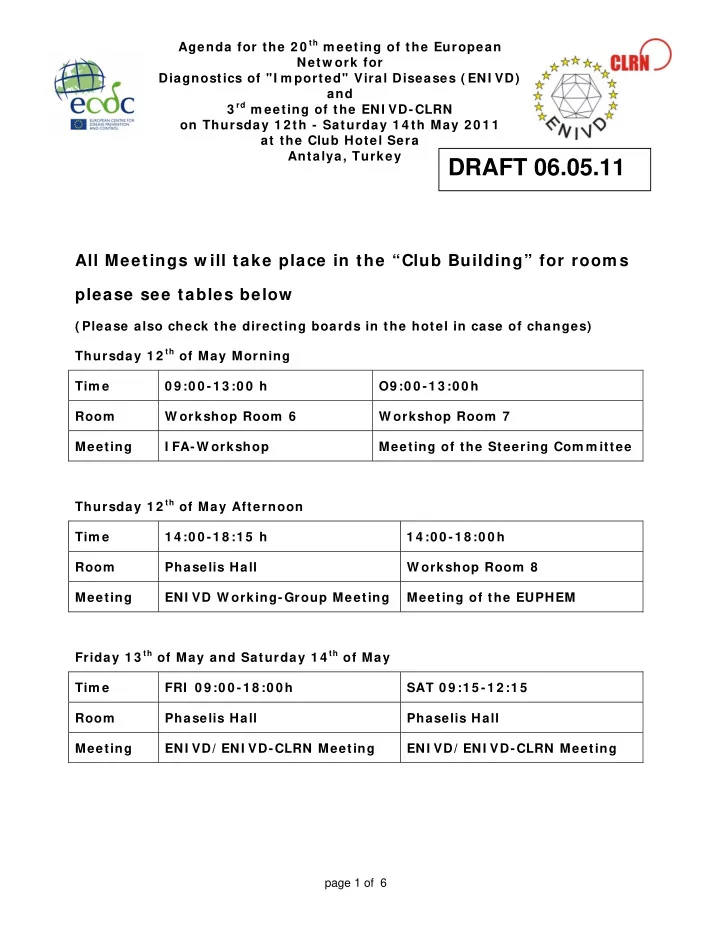
DRAFT 06.05.11 All Meetings w ill take place in the Club Building - - PDF document

draft 06 05 11
SMART_READER_LITE
LIVE PREVIEW

DRAFT 06.05.11 All Meetings w ill take place in the Club Building - - PDF document

Agenda for the 2 0 th m eeting of the European Netw ork for Diagnostics of "I m ported" Viral Diseases ( ENI VD) and 3 rd m eeting of the ENI VD-CLRN on Thursday 1 2 th - Saturday 1 4 th May 2 0 1 1 at the Club Hotel Sera Antalya,


slide-1
SLIDE 1

page 1 of 6

Agenda for the 2 0 th m eeting of the European Netw ork for Diagnostics of "I m ported" Viral Diseases ( ENI VD) and 3 rd m eeting of the ENI VD-CLRN

  • n Thursday 1 2 th - Saturday 1 4 th May 2 0 1 1

at the Club Hotel Sera Antalya, Turkey

DRAFT 06.05.11

All Meetings w ill take place in the “Club Building” for room s please see tables below

( Please also check the directing boards in the hotel in case of changes) Thursday 1 2 th of May Morning Tim e 0 9 :0 0 -1 3 :0 0 h O9 :0 0 -1 3 :0 0 h Room W orkshop Room 6 W orkshop Room 7 Meeting I FA-W orkshop Meeting of the Steering Com m ittee Thursday 1 2 th of May Afternoon Tim e 1 4 :0 0 -1 8 :1 5 h 1 4 :0 0 -1 8 :0 0 h Room Phaselis Hall W orkshop Room 8 Meeting ENI VD W orking-Group Meeting Meeting of the EUPHEM Friday 1 3 th of May and Saturday 1 4 th of May Tim e FRI 0 9 :0 0 -1 8 :0 0 h SAT 0 9 :1 5 -1 2 :1 5 Room Phaselis Hall Phaselis Hall Meeting ENI VD/ ENI VD-CLRN Meeting ENI VD/ ENI VD-CLRN Meeting

slide-2
SLIDE 2

page 2 of 6

Thursday the 1 2 th of May

09:00 IFA Workshop (EUROIMMUN) 14:00 Welcome (M. Niedrig) W orking group m eeting for Hantaviruses ( Chair: P. Heym an/ A. Vaheri) 14:05 New markers for severe course of Puumala virus infection: complement activation, 90k/Mac2bp and pentraxin-3 (A. Vaheri) 14:20 Current situation on hantavirus infection in Turkey (Y. Uyar) 14:35 Hantavirus outbreak in Germany in 2010: the year thereafter (R. Ulrich) 14:50 Hantavirus infection in three family members returning from Cuba (F. Rovida) 15:05 Presentation and update on recent investigations (S. Eßbauer) 15:20 Re-emergence of hantavirus and differential diagnosis of hemorrhagic fever in Albania (M. Kota) 15:35 Emergence of a novel variant of Dobrava-Belgrade hantavirus causing fatal cases of hemorrhagic fever with renal syndrome in Eastern Europe (B. Klempa) 15:50 Coffee break W orking group m eeting for Phleboviruses ( Chair: N.N.) 16:20 A novel phlebovirus in sandflies collected in Lefkas Island, Greece (A. Papa) 16:35 Review of sandfly fever virus infections in Turkey for last 3 years (D. Yağçi Çağlayik) W orking group m eeting for TBE virus ( Chair: M. Niedrig) 16:50 Characterisation of TBEV field isolates from Switzerland (C. Beuret) 17:05 Exchanging of TBEV subtypes between tick species in Estonia, Latvia and Eastern Poland (I. Golovljova) 17:20 Recent investigations on the phylogeny and biological properties of TBEV (S. Eßbauer) 17:35 Relation of genetic phylogeny and geographical distance of tick-borne encephalitis virus in Central Europe ( M. Weidmann) W orking group m eeting for W est Nile virus ( Chair: M. Niedrig)

slide-3
SLIDE 3

page 3 of 6 17:50 Outbreak of West Nile infections in Greece (A. Papa) 18:05 End of Session

I n parallel to the ENI VD w orking group m eetings there w ill be the EUPHEM Meeting 2 0 1 1 from 1 4 .0 0 – 1 7 .0 0 hrs. See separate agenda.

slide-4
SLIDE 4

page 4 of 6

Friday the 1 3 th of May ECDC / ENI VD-CLRN issues ( Chair: M. Niedrig)

09:00 Welcome by the hosting Refik Saydam National Public Health Agency (Gülay Korukluoğlu) 09:10 Welcome and introduction of new members/deputies: Ivan-Christian Kurolt (Croatia); Sebastien Plumet (France); Rolf Horstmann (Germany); Concetta Castilletti, Elisa Franchin, Francesca Rovida (Italy); Chantal Reusken (Netherlands); Miguel Martinez (Spain) new partners and guests: Norbert Nowotny (Austria); Birgit Arnold, Erik Lattwein, Thomas Laue (Germany); Mateja Jelovšek (Slovenia); Handan Kalaycıoğlu, Dilek Yağçi Çağlayik, Sultan Yolbakan (Turkey) Fellows: Giovana Jaramillo Gutierrez (RIVM); Katherina Zakikhany (HPA) 09:30 WP 1: Management of the ENIVD-CLRN (M. Niedrig) 09:45 WP 1: Administrational issues (B. Arnold) 10:00 WP 2: Epidemic Intelligence activities (A. Tenorio) 10:15 WP 3: Support activities (P. Dubois) 10:30 WP 4: Preparedness activities (O. Donoso Mantke) 10 :45 Coffee break 11:15 WP 5: Training activities (M. Koopmans) 11:30 WP 5: Training activities (C. Escadafal, RKI) 11:45 WP 5: Training activities (J. Vanhomwegen, Insitut Pasteur) 12:00 WP5 : Training activities (K. Zakikhany, HPA) 12:15 WP 5: Training activities (G. Jaramillo, RIVM) 12:30 New ECDC perspectives (H. Zeller) 12:45 EuroWestNile: a research project funded by the 7th Framework Programme (A. Tenorio)

slide-5
SLIDE 5

page 5 of 6 13:00 Presentation of EpiSouth (H. Kalaycıoğlu) 13:15 Lunch break (group picture in front of Hotel)

Surveillance ( Chair: M. Niedrig)

15:15 Emergence of West Nile Virus infections in humans in Turkey (G. Korukluoğlu) 15:30 The German Arbovirus Surveillance and Mosquito Monitoring Program 2009-10 (J. Schmidt-Chanasit/ R. Horstmann) 15:45 Monitoring of arboviruses in Ticino – preliminary results (O. Engler) 16:00 Surveillance of WNV disease, dengue and chikungunya fever in Veneto Region, Italy 2010 (L. Barzon) 16:15 Coffee break 16:45 Overview on the West Nile situation in Europe (N. Nowotny) 17:00 Dengue virus emergence in metropolitan France, 2010 (M. Grandadam) 17:15 Increase of dengue cases in 2010 (M. Van Esbroeck) 17:30 The ENIVD-CLRN hanta survey 2010 (P. Heyman) 17:45 Multiple co-infections of rodents with hantaviruses, leptospira and babesia in Croatia (I-C. Kurolt) 18:00 End of Session 19:30 Dinner

slide-6
SLIDE 6

page 6 of 6

Saturday the 1 4 th of May Diagnostic and Research reports ( Chair: O. Donoso Mantke)

09:15 3 new assays for CCHF-, Dengue- and Chikungunya virus. (T. Laue) 09:30 Alkhurma hemorrhagic fever virus infection in an Italian traveller returning from Egypt (C Castilletti) 09:45 Short overview of the Hospital Clinic Microbiology Department, current and future plans on arboviruses (M. Martinez) 10:00 New diagnostic tools for CCHFV (A. Mirazimi) 10:15 Coffee break

Outbreak reports ( Chair: M. Koopm ans)

10:45 Viral features associated to chikungunya virus emergence in metropolitan France ( I. Leparc-Goffart) 11:00 Suspected Lassa case in Sweden (A. Mirazimi) 11:15 The genetic and phylogenetic identification of the first Croatian autochtonuos Dengue virus infection (I-C. Kurolt) 11:30 Imported cases of dengue virus infection in Emilia-Romagna,Italy, 2010 (V. Sambri)

Miscellaneous (Chair: M. Niedrig)

11:45 Future tasks; next meetings 12:00 End of ENIVD/ENIVD-CLRN meeting 12:15 Lunch 13:00 Sight-Seeing

slide-7
SLIDE 7

ENIVD-meeting Participants Antalya as of 06.05.2011

n° name county bez 1 Dr. Aberle, Stephan Austria 2 Dr. Alves, Maria Joao Portugal 3 Dr. Avšič-Županc, Tatjana Slovenia 4 Arnold Birgit Germany 5 Dr. Barzon, Luisa Italy 6 Dr. Beuret, Christian Switzerland 7 Dr. Brown, David UK 8 Dr. Castiletti, Concetta Italy 9 Dr. Chinikar, Sadegh Iran 10 Dr. Christova, Iva Bulgaria 11 Dr. Di Caro, Antonino Italy 12 Dr. Donoso Mantke, Oliver Germany 13 Dr. Dubois, Philippe France 14 Dr. Duffy, Margaret Ireland 15 Dr. Engler, Olivier Switzerland 16 Escadafal, Camille Fellow 17 Dr. Eßbauer, Sandra Germany 18 Dr. Fomsgaard, Anders Denmark 19 Dr. Franchin, Elisa Italy 20 Dr. Garcia Costa, Juan Spain 21 Dr. Gjeruldsen-Dudman, Susanne Norway 22 Dr. Golovljova, Irina Estonia 23 Dr. Grandadam, Marc France 24 Dr. Hewson, Roger UK 25 Heyman, Paul Belgium 26 Prof. Horstmann, Rolf Germany 27 Dr. Hukic, Mirsada Bosnia- Herz. 28 Jelovšek, Mateja Slovenia 29 Jaramillo Gutierrez, Giovanna Fellow 30 Dr. Kalaycıoğlu, Handan Turkey 31 Dr. Kis, Zoltan Hungary 32 Dr. Klempa, Boris Slovakia 33 Dr. Kolupaeva, Tatjana Latvia 34 Dr. Koopmanns, Marion Netherlands 35 Dr. Korukluoglu, Gulay Turkey 36 Dr. Kota, Majlinda Albania 37 Kurolt, Ivan-Christian Croatia 38 Dr. Lattwein, Erik EUROIMMUN 39 Dr. Laue, Thomas Germany 40 Dr. Leparc-Goffart, Isabelle France 41 Dr. Lipnickiene, Vilnele Lithuania 42 Litzba, Nadine Germany 43 Dr. Manuguerra, Jean-Claude France 44 Dr. Martina, Byron Netherlands 45 Dr. Martinez, Miguel Spain 46 Dr. Mirazimi, Ali Sweden 47 Dr. Niedrig, Matthias Germany

slide-8
SLIDE 8

ENIVD-meeting Participants Antalya as of 06.05.2011

48 Dr. Opp, Matthias Luxembourg 49 Dr. Pannetier, Delphine France 50 Dr. Papa, Anna Greece 51 Dr. Plumet, Sebastien France 52 Dr. Reusken, Chantal Netherlands 53 Dr. Rovida, Francesca Italy 54 Dr. Sambri, Vittorio Italy 55 Dr. Schädler, Regina Germany 56 Dr. Schmitdt-Chanasit, Jonas Germany 57 Dr, Schutten, Martin Netherlands 58 Dr. Storozenko, Jelena Latvia 59 Dr. Tenorio, Antonio Spain 60 Dr. Tordo, Noel France 61 Dr. Ulrich, Rainer Germany 62 Dr. Uyar, Yavuz Turkey 63 Dr. Vaheri, Antti Finland 64 Dr. Van Esbroeck, Marjan Belgium 65 Vanhomwegen, Jessica Fellow 66 Dr. Weidman, Manfred Germany 67 Dr. Yagci Caglayik, Dilek Turkey 68 Dr. Yolbakan, Sultan Turkey 69 Dr. Zakikhany, Katherina Fellow 70 Dr. Zelená, Hana Czech Rep. 71 Dr. Zeller, Hervé ECDC

slide-9
SLIDE 9

ENIVD-meeting Participants IFA workshop Antalya as of 06.05.2011

n° name county 1 Dr. Aberle, Stephan Austria 2 Dr. Barzon, Luisa Italy 3 Dr. Chinikar, Sadegh Iran 4 Dr. Christova, Iva Bulgaria 5 Dr. Engler, Olivier Switzerland 6 Dr. Gjeruldsen-Dudman, Susanne Norway 7 Dr. Golovljova, Irina Estonia 8 Jaramillo Gutierrez, Giovanna Fellow 9 Jelovšek, Mateja Slovenia 10 Dr. Leparc-Goffart, Isabelle France 11 Dr. Lipnickiene, Vilnele Lithuania 12 Dr. Pannetier, Delphine France 13 Dr. Rovinda, Francesca Italy 14 Dr. Uyar, Yavuz Turkey 15 Dr. Kota, Majlinda Albania 16 Dr. Van Esbroeck, Marjan Belgium 17 Vanhomwegen, Jessica Fellow 18 Dr. Yagci Caglayik, Dilek Turkey

slide-10
SLIDE 10

EpiSouth EpiSouth-

  • Plus

Plus EpiSouth EpiSouth Plus Plus

The Network for the Control of Public Health Threats and

  • ther risks in the Mediterranean Region and Balkans

Handan Kalaycıoğlu Refik Saydam National Public Health Agency , Ankara, Turkey

  • n behalf of the EpiSouth Plus Partners
  • n behalf of the EpiSouth Plus Partners

1

slide-11
SLIDE 11

2

EU Countries at the Project starting (Oct 2006)

slide-12
SLIDE 12

EU Member States Partners in EpiSouth Plus Iss, Italy ASLTO1, Italy IP France MoH, Malta IPHB, Romania NIPH Slovenia IP, France ISC III, Spain InVS, France NCIPD B l i NIPH, Slovenia Padua GH, Italy INMI, Italy CINECA It l NCIPD, Bulgaria HCDCP, Greece MoH, Cyprus CINECA, Italy IPH, Croatia (to be verified)

3 12 th April 2011 12 th April 2011

slide-13
SLIDE 13

Non EU Member States Partners in EpiSouth Plus Non-EU Member States Partners in EpiSouth Plus

  • ALBANIA, Tirana (Institute of Public

Health);

  • ALGERIA, Alger (National Institute of

Institute of Public Health);

  • LEBANON Beirut (Ministry of Public

, g ( Public Health);

  • BOSNIA & HERZEGOVINA (Ministry of Civil

Affairs, Sarajevo; Ministry of Health and Social Welfare, Banja Luka, Republic of

  • LEBANON, Beirut (Ministry of Public

Health);

  • MONTENEGRO, Podgorica (Institute of

Public Health);

  • MOROCCO Rabat (Ministry of Health);

, j , p Srpska; Public Health Institute, Mostar, Federation of B&H);

  • CROATIA, Zagreb (Croatian National

Institute of Public Health);

  • MOROCCO, Rabat (Ministry of Health);
  • PALESTINE, Ramallah (Ministry of Health);
  • SERBIA, Belgrade (Institute of Public

Health);

  • SYRIA Damascus (Ministry of Health);

)

  • EGYPT, Cairo (Ministry of Health and

Population);

  • FYROM–Former Yugoslav Republic of

Macedonia, Skopje (Institute for Health

  • SYRIA, Damascus (Ministry of Health);
  • TUNISIA, Tunis (Ministry of Health);
  • TURKEY, Ankara (Ministry of Health; Refik

Saydam National Public Health Agency)

  • LIBYA Tripoli (Infectious Diseases

pj ( Protection; Clinic of Infectious Diseases);

  • ISRAEL (Center for Disease Control, Tel

Hashomer; Ministry of Health, Jerusalem);

  • LIBYA, Tripoli (Infectious Diseases

Department Tripoli Central Hospital) 4

  • JORDAN, Amman (Ministry of Health);
slide-14
SLIDE 14

5

Countries as per September 2010

slide-15
SLIDE 15

EpiSouth EpiSouth-Plus Plus p

Starting date: 15 October 2010 Starting date: 15 October 2010 Duration: 30 months Co-Funding Agencies: EU DGSANCO EU DGDEVCO It li M H EU DGSANCO,EU DGDEVCO,Italian MoH, ECDC

6

slide-16
SLIDE 16

General Objective General Objective j

To increase the health security in the Mediterranean Area To increase the health security in the Mediterranean Area y and Balkans by enhancing and strengthening the and Balkans by enhancing and strengthening the preparedness to common health threats and other preparedness to common health threats and other risks risks at national and regional levels in the Countries of at national and regional levels in the Countries of EpiSouth Network EpiSouth Network in the framework of the International in the framework of the International Health Regulations implementation Health Regulations implementation Health Regulations implementation Health Regulations implementation.

7

slide-17
SLIDE 17

Specific Objective (1) Specific Objective (1)

i) Establishment of a Mediterranean Regional L b t i t k (WP4) Laboratories network (WP4): A network of regional laboratories will be established in

  • rder to facilitate common threats detection in the
  • rder to facilitate common threats detection in the

countries involved. WP leaders: French Inst it ut e Past eur & Refik S

aydam Nat ional

Public Health Agency, Minist ry of Healt h of Turkey

8

g y,

y f f y

slide-18
SLIDE 18

S f O ( ) S f O ( ) Specific Objective (1) Specific Objective (1) Main needs and gaps to be addressed Main needs and gaps to be addressed

i) Establishment of a Mediterranean Regional Laboratories network (WP4):

  • Lack of cross-border lab facilities services for Med Countries
  • Strengthening complementary with the vertical and fragmented lab

t k tl ti i th networks presently operating in the area

  • Overcoming national logistic and legislation constraints

9

slide-19
SLIDE 19

Specific Objective (2) Specific Objective (2)

ii) Promotion of common procedures in interoperable Generic

Preparedness and Risk management for the Countries involved in the Network (WP5): in the Network (WP5): Specific capacity building measures will address the need of interoperability and intersectoral collaboration of countries' preparedness plans to fit the requirements of the IHR and to ensure preparedness plans to fit the requirements of the IHR and to ensure multi-country harmonic and prompt response. WP l d

S i h I i d S l d C l III & h I i

WP leaders: S

panish Inst it ut o de S alud Carlos III & t he Inst it ut Nat ional de S ant é Publique of Algeria.

10

slide-20
SLIDE 20

Specific Objective (2) Specific Objective (2) Specific Objective (2) Specific Objective (2) Main needs and gaps to be addressed Main needs and gaps to be addressed

ii) P

ti f d i i t bl G i P d d

ii) Promotion of common procedures in interoperable Generic Preparedness and

Risk management for the Countries involved in the Network (WP5):

  • Reducing the variability of procedures in the Countries involved
  • Contributing to enhancing capacity and sharing field experiences
  • Strengthening cross-border concerted actions

G

  • Facilitating national GPP development and communication strategy

11

slide-21
SLIDE 21

Specific Objectives (3) Specific Objectives (3)

iii) Interoperable Early warning systems (EWS) and alerts platform able to ) p y g y ( ) p share info between EpiSouth countries and with other Early Warning platforms and optimization of EI (WP6):

Participating countries should be able to share alerts generated by their national EWS p g g y with the EpiSouth EWS platform and other EWSs, including the European Early Warning and Response System (EWRS), in the EPIS/ECDC environment. Exchanging of national alerts with cross border potential and Epidemic Intelligence information that could be determinant to prevent health risk dissemination.

WP leaders: French Inst it ut de Veille S

anit aire & MECIDS

  • Middle East

Consort ium for Infect ious Diseases S urveillance -

12

slide-22
SLIDE 22

S f O ( ) S f O ( ) Specific Objective (3) Specific Objective (3) Main needs and gaps to be addressed Main needs and gaps to be addressed

iii) Interoperable Early warning systems (EWS) and alerts' platform able to iii) Interoperable Early warning systems (EWS) and alerts platform able to share info between EpiSouth countries and with other Early Warning platforms and optimization of EI (WP6):

  • Enhancing “horizontal” cross-border and inter-countries alerts sharing

in the Med Area

  • Complementing the presently operating EWSs (national > supra
  • Complementing the presently operating EWSs (national > supra-

national) with the info from the Med EWS

  • Optimisation and minimization of duplication of EI activities

13

slide-23
SLIDE 23

Specific Objectives (4) Specific Objectives (4)

i ) P d ti f id li d t t i d t b d iv) Production of guidelines and strategic documents based on assessments and surveys aimed at facilitate IHR implementation (WP7): (WP7): In order t o support t he implement at ion of IHR, specific surveys and assessment s will be conduct ed among t he EpiS

  • ut h Count ries in
  • rder t o describe how nat ional plans and legislat ions can

p int eract / int erfere wit h IHR requirement s

14

slide-24
SLIDE 24

Specific Objective (4)

Main needs and gaps to be addressed iv) Production of guidelines and strategic documents based on assessments and surveys aimed at facilitate IHR implementation (WP7): (WP7): Define obst acles and const raint s which are affect ing capacit ies’ assessment and adequacy in t he count ries p q y involved Cont ribut e t o t he definit ion and implement at ion of appropriat e st rat egies which facilit at e IHR nat ional plans in accordance wit h t he requirement s

15

slide-25
SLIDE 25

Wp4: Regional Mediterranean Laboratory Network

Co-leadership: RSNPHA, Turkey and Institut Pasteur, France

16 1st

st SC Meeting

SC Meeting – Luxembourg Luxembourg -

  • 3 February 2011

3 February 2011

slide-26
SLIDE 26
  • General Obj ect ives:

1. Set up a Regional Medit erranean Laborat ory Net work, wit h all count ries of 1. Set up a Regional Medit erranean Laborat ory Net work, wit h all count ries of t he EpiSout h plus net work, for an opt imal surveillance of communicable diseases S ifi Obj t i

  • Specific Obj ect ives:

1. Creat e a complement ary laborat ory net work t o t he already set up epidemiological net work from EpiSout h epidemiological net work from EpiSout h 2. St rengt hen capacit y of t he different count ries involved 3. Have t he most adapt ed met hods set up t o t he most relevant quest ions/ needs in t he region. (common ident ified needs, involving at least q g ( , g

  • ne lab of each concerned count ry)

4. Opt imisat ion exchange (informat ion, samples) bet ween t he different part ners and int ernat ional organisat ions (WHO, ECDC, IEO, … ) 5 Aim at sust ainabilit y

17

5. Aim at sust ainabilit y

slide-27
SLIDE 27

St t t hi th l (1)

  • Strategy to achieve these goals (1):
  • Ident ificat ion of priorit y areas of act ion (general needs, pat hogens

and corresponding diseases)

  • Ident ificat ion and meet ing of expert commit t ee t o set minimum

i t d d requirement s needed

  • Ident ificat ion of laborat ories meet ing t he requirement s and

int erest ed in cont ribut ing t o t he EpiSout h init iat ive t k li k it h t h i t i t k

  • t o make link wit h t he exist ing net works
  • Mapping of exist ing biological expert ise (Labs and Net works)
  • Meet ing wit h t he heads of Laborat ories int erest ed in t he approach
  • Ident ificat ion of st rengt hs and needs of laborat ories for diagnoses for

priorit y diseases in t he region: human, t echnical and organizat ional

18

slide-28
SLIDE 28
  • Strategy to achieve these goals (2):
  • Pilot ing of t he Direct ory of Regional Laborat ories on t he websit e
  • Preliminary recommendat ions on t raining and capacit y building
  • One week t raining module at PI Paris
  • One week t raining module at PI Tunis (or RSNPHA Turkey)
  • St ages at Past eur or ot her Inst it ut es (2 persons for 1 mont h each or more for

g ( p short er period of t ime)

  • Draft a Recommendat ion Document
  • Follow up
  • Follow up

19

slide-29
SLIDE 29
  • Ident ificat ion of priorit y areas of act ion (pat hogens and corresponding

diseases)

  • Lab management and biosafet y
  • Communicable disease

Communicable disease

  • Endemic in t he region of int erest :
  • High prevalence (TB)
  • Change of endemicit y of t he disease, spread (eg due t o climat e

change (Leishmaniasis), human migrat ion)

  • Emerging charact er: pat hogen (West Nile

)

  • Emerging charact er: pat hogen (West Nile, …

)

  • Increased incidence in humans (resist ance, …

)

20

slide-30
SLIDE 30
  • Increase lab capacit y may change effect iveness of surveillance

(Vaccine prevent able) ( p )

  • A cert ain expert ise should be present (sust ainabilit y)
  • Fall back on exist ing net works (TB, influenza, Leishmaniasis, …

.) Import ance of displaced populat ions (human migrat ion) (link wit h

  • Import ance of displaced populat ions (human migrat ion) (link wit h

IHR, eg TB)

  • According t o need not yet addressed by ot hers

Quest ionnaires will be sent t o FP for priorit y set t ing of preselect ed

diseases

21

slide-31
SLIDE 31
  • Pilot ing of t he Direct ory of Regional Laborat ories on t he websit e
  • Follow up and net work “ animat ion”

Follow up and net work animat ion

  • Regular cont act wit h FP and heads of Labs
  • Create a strong link with the surveillance and early warning network
  • Make exchange of document s possible
  • Make exchange of document s possible
  • Promot e st andardisat ion for more homogeneous surveillance
  • Link wit h ot her exist ing init iat ives

Make link wit h IHR act ivit ies

  • Make link wit h IHR act ivit ies
  • Make course mat erial available
  • Qualit y cont rol net work

22

slide-32
SLIDE 32

23