Downtown Capital LLC Petition for Waiver or Suspension of the - - PowerPoint PPT Presentation

downtown capital llc
SMART_READER_LITE
LIVE PREVIEW

Downtown Capital LLC Petition for Waiver or Suspension of the - - PowerPoint PPT Presentation

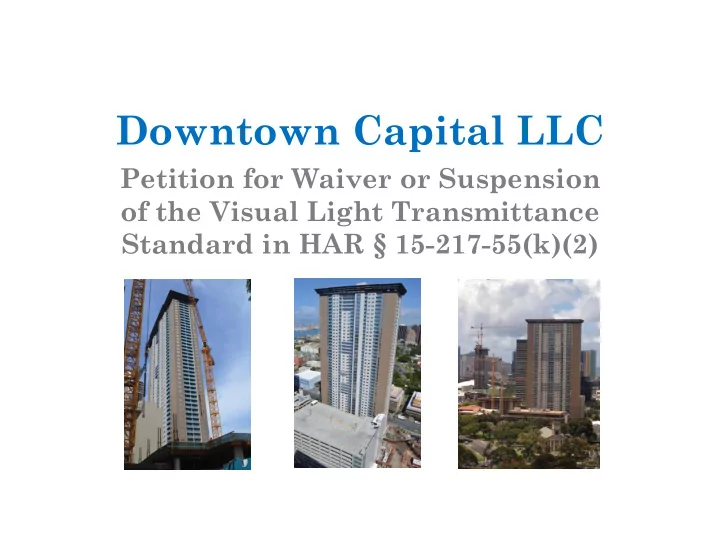
Downtown Capital LLC Petition for Waiver or Suspension of the Visual Light Transmittance Standard in HAR 15-217-55(k)(2) Ex. 25 at 1 Ex. 2 at 1 Approved as to the requirements of the Mauka and/or Makai area Plans and Rules 8.6.13


slide-1
SLIDE 1

Downtown Capital LLC

Petition for Waiver or Suspension

  • f the Visual Light Transmittance

Standard in HAR § 15-217-55(k)(2)

slide-2
SLIDE 2
  • Ex. 25 at 1
slide-3
SLIDE 3
  • Ex. 2 at 1
slide-4
SLIDE 4
  • Ex. 2 at 2

“Approved as to the requirements of the Mauka and/or Makai area Plans and Rules” – 8.6.13

slide-5
SLIDE 5
slide-6
SLIDE 6
  • Ex. 4
slide-7
SLIDE 7
  • Ex. 4 (calculations by Dredging)
slide-8
SLIDE 8
slide-9
SLIDE 9

HAR § 15-217-55 Architectural design. (k) Windows: (1) Highly-reflective, mirrored, and opaque window glazing are prohibited; (2) Window glazing shall be transparent with clear or limited UV tint so as to provide views out of and into the

  • building. Visible light transmission level of windows on

the ground floor shall be seventy per cent or greater and

  • n all other floors the visible light transmission level

shall be fifty per cent or greater; (3) For floors one through ten, all principal building windows shall be operable; (4) Vinyl window frames are prohibited, except for Figures BT.1 to BT.3, dated September 2011, made a part of this chapter, and attached at the end of this chapter; (5) Pop-in muntins are prohibited below the third floor; and (6) Window grilles are prohibited except at window openings to podium parking or on building elevations facing alleys.

slide-10
SLIDE 10
slide-11
SLIDE 11
slide-12
SLIDE 12
  • Ex. 9 at 1 (4/2/15 letter)
slide-13
SLIDE 13
  • Ex. 9 at 2 (4/2/15 letter)
slide-14
SLIDE 14
slide-15
SLIDE 15
slide-16
SLIDE 16
slide-17
SLIDE 17
slide-18
SLIDE 18
slide-19
SLIDE 19
  • Exs. 11-14
slide-20
SLIDE 20
slide-21
SLIDE 21
  • Ex. 1 at 91:21-92:2

Q [Member Bassett] Previous testimony stated some kind of happy balance, this nice range where ultimate VLT. Do you have any range that you would say is an ideal VLT range? A [HCDA Consultant Patrick Yen] From what I’ve read, a lot -- like kind of like an industry standard, you could say is a range between maybe 20 and up to 40 percent.

7/22/15 Transcript in OliverMcMillan

slide-22
SLIDE 22
  • Ex. 1 at 72:1-5
  • MR. NEUPANE: So at that time, HCDA staff

just took the consultant’s recommendation that 50 percent VLT is reasonable, can be made, and, excuse me, it will address the external reflectivity, heat island as well as the dark look

  • f buildings.

7/22/15 Transcript in OliverMcMillan

slide-23
SLIDE 23
  • Ex. 16 at 12:9-18
  • MR. NEUPANE: Yes, Chair Whalen. The

consultants are here, and they have prepared a graph of VLT versus reflectance based on over a hundred different glass with the manufacturers that was mentioned, Viracon and the same three

  • manufacturers. So I just wanted to provide that

information to the board. And just to summarize the results, basically, it says that, you know, mathematically, it shows that there is no correlation between the two data points.

9/2/15 Transcript in OliverMcMillan

slide-24
SLIDE 24
  • Ex. 1 at 72:16-17
  • MR. NEUPANE: If you look at the glazing data,

then it shows that you can have a product that has a very low VLT, but has low reflectivity too.

7/22/15 Transcript in OliverMcMillan

slide-25
SLIDE 25
  • Ex. 7 at 5

“In a residential building, a high VLT glazing may cause privacy issues.”

7/22/15 Staff Report in OliverMcMillan

slide-26
SLIDE 26
  • Ex. 1 at 45:25-46:7

Q [Vice Chair Scott] . . . [W]hat is the advantage to the public to have a higher VLT? You’re talking about the public that’s

  • utside the building. I know from the

inside of the building, obviously, you don’t want to be living in a fishbowl . . . . where everyone can be looking in. A [Keith Chan] Right.

7/22/15 Transcript in OliverMcMillan

slide-27
SLIDE 27
  • Ex. 6 at 4

[H]igher VLT glazing typically results in lower energy efficiency in a building. If sustainability and environmental consideration are priorities, lower energy consumption by a building may be more desirable than its transparency. This means that lower VLT values may be more desirable.

HCDA Consultant Report in OliverMcMillan

slide-28
SLIDE 28
  • Ex. 1 at 60:7-13

Q [Vice Chair Scott] If you impose a higher VLT, you’re going to end up . . . . having a much -- much more difficult time keeping the environment in the apartment comfortable. A [Daniel Nishikawa] Correct.

7/22/15 Transcript in OliverMcMillan

slide-29
SLIDE 29
slide-30
SLIDE 30
slide-31
SLIDE 31
  • Ex. 25 at 1
slide-32
SLIDE 32
  • Ex. 25 at 2
slide-33
SLIDE 33
  • Ex. 25 at 3
slide-34
SLIDE 34
  • Ex. 25 at 4
slide-35
SLIDE 35
  • Ex. 25 at 5
slide-36
SLIDE 36
  • Ex. 22 at 1
slide-37
SLIDE 37
  • Ex. 25 at 1
slide-38
SLIDE 38

Downtown Capital LLC

Petition for Waiver or Suspension

  • f the Visual Light Transmittance

Standard in HAR § 15-217-55(k)(2)