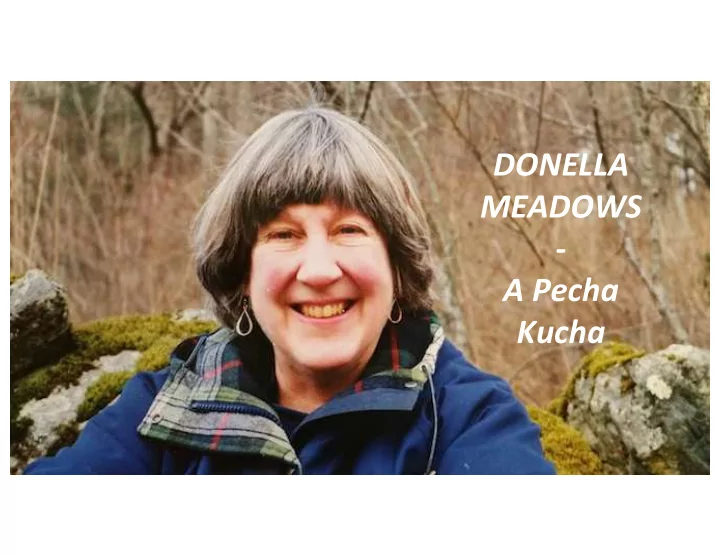
DONELLA MEADOWS - A Pecha Kucha Walter C. Paine Science - - PowerPoint PPT Presentation

donella meadows a pecha kucha walter c paine science
SMART_READER_LITE
LIVE PREVIEW

DONELLA MEADOWS - A Pecha Kucha Walter C. Paine Science - - PowerPoint PPT Presentation

DONELLA MEADOWS - A Pecha Kucha Walter C. Paine Science Education Award (1990) MacArthur Fellowship (1994) John H. Chafee Excellence in Environmental Affairs Award (2001, posthumous) Cobb Hill Cohousing Sustainability Institute


slide-1
SLIDE 1

DONELLA MEADOWS

  • A Pecha

Kucha

slide-2
SLIDE 2
slide-3
SLIDE 3

Walter C. Paine Science Education Award (1990) MacArthur Fellowship (1994) John H. Chafee Excellence in Environmental Affairs Award (2001, posthumous)

slide-4
SLIDE 4

Sustainability Institute Cobb Hill Cohousing

slide-5
SLIDE 5
slide-6
SLIDE 6

Dancing with Systems

1. Get the beat 3. Expose your mental models to the

  • pen air

8. Pay attention to what is important, not just what is quantifiable

  • 10. Expand time

horizons

slide-7
SLIDE 7

Who lives in the Global Village?

If the world were a village of 1,000 people, it would include: · 584 Asians · 124 Africans · 95 East and West Europeans · 84 Latin Americans · 55 Soviets · 52 North Americans · 6 Australians and New Zealanders Of the total $3 million: · $181,000 goes to weapons and warfare · $159,000 for education · $l32,000 for health care

slide-8
SLIDE 8

Places to Intervene (12 Leverage Points)

slide-9
SLIDE 9
  • 12. Constants,

parameters, numbers (such as subsidies, taxes, standards)

slide-10
SLIDE 10
  • 11. The size of

buffers and other stabilizing stocks, relative to their flows

slide-11
SLIDE 11
  • 10. Structure of material stocks

and flows (such as transport network, population age structures)

slide-12
SLIDE 12
  • 9. Length of delays,

relative to the rate of system changes

slide-13
SLIDE 13
  • 8. Strength of

negative feedback loops

slide-14
SLIDE 14
  • 7. Gain around

driving positive feedback loops

slide-15
SLIDE 15
  • 6. Structure of

information flow

slide-16
SLIDE 16
  • 5. Rules of the system (such

as incentives, punishment, constraints)

slide-17
SLIDE 17
  • 4. Power to add, change, evolve, or self-organize system structure
slide-18
SLIDE 18
  • 3. Goal of the system
slide-19
SLIDE 19
  • 2. Mindset or

paradigm that the system arises from

slide-20
SLIDE 20
  • 1. Power to

transcend paradigms

slide-21
SLIDE 21
slide-22
SLIDE 22
  • Abhishek Tiwari And Tahmid Mehdi